Trip Report: Tadoba Andhari Tiger Reserve, Dec 2013

Trip Report:        Tadoba Andhari Tiger Reserve (TATR)

Dates:                   21-23 Dec 2013

Camp:                   Svasara Jungle Lodge

As I start typing this post, we’re just about to leave for Nagpur. It is 2 PM and the flight back to Bangalore is at 8 PM. Nagpur is some 100 kms away, and we’ll have time to kill at the airport. Meanwhile, there’s a long-tailed shrike brooding on a perch that a green bee-eater habitually sallies from. A large flock of chestnut shouldered petronias skulks in a bush a little to the right. A pair of little brown doves, and a pair of sparrows are starting to nest in two tiny ficus shrubs on the lawn outside. There’s a pair of red vented bulbuls that haunts a bamboo thicket a little to the left. And finally, there’s a tailor bird that is a very occasional visitor to the shrubbery. These are the regular habitués around my room in the Svasara Jungle Lodge. Not an unpleasant place to stay in at all.

TATR

Not that we’ve had much time to keep track of the local avifauna. It’s been a hectic three days. We did four safaris in all, but the remarkable thing about TATR is the time allowance. The morning safari starts at 6:30 AM and goes on until 11:30 AM. Back for a quick lunch at noon and barely enough time for a battery recharge (cameras’, not ours), and off again for the second safari which starts at 2 PM (gate opening time) and goes on until 6 PM. So five hours in the morning and four hours in the afternoon. Nine hours of safari time each day, with little time for anything else. It is rather tiring.

TATR is 650 sq kms of dry deciduous forest, and a dry, warm place. Even in December the days are sultry, though evenings and especially mornings are cold. The teak trees are shedding prodigiously, and the ground in many places is carpeted with the large rotting leaves. Many of the Mahua trees are bare, as are the Indian ghost trees (in pic below). Crocodile bark and tendu trees still retain their green, as do the jamun trees by the waterlines. After having read about the place lacking the magnificence of Kanha or Corbett, I guess my expectations had been tempered down significantly; Happily, the forest seemed pretty enough in compensation. And the safaris are very productive.

Image

The safaris

We did four safaris in all. Svasara Jungle Lodge is sited a couple of hundred meters from the Kolara gate, which in turn is on the north-eastern periphery of TATR. This gate opens into the Tadoba range. Three of our four safaris were limited to the Tadoba range. For our second safari (yesterday AM) alone, we passed through the Tadoba range to reach the Katoda gate, and thereon into Andhari (Moharli range).

The first safari was an evening one. A short while into it, we sighted a ratel – Mellivora capensis. None of us had ever seen one before, and we were elated. We then reached Panderpauni, with its pretty little lake and vast meadows teeming with chital, langur and wild boar. Tree swifts in large numbers hawked insects on the wing. There was quite a bit of birdlife in the waterhole.

A short distance from Panderpauni, on the way to Tadoba lake, we ran into a bunch of Gypsies clustered at a crossroads. One of them had spotted a tigress disappearing into the underbrush. The Gypsies hung around with hopes of the tigress re-emerging for a while, but eventually people started giving up and moving on. Around six Gypsies stayed on, and our patience was finally rewarded. Someone spotted a movement at the far end of the arrow-straight road to our left. Turned out to be P2, a four-year old tigress in fine fettle. She strode down the road unmindful of the cluster of Gypsies, skirted right around us, and ambled into the one road where entry was forbidden. Some of the Gypsies scrambled to loop back for another interception, but the tigress had other ideas. She stepped off the road, into the thickets and disappeared. But P2 was not done with us. In the three remaining safaris, we experienced close encounters with her twice more.

Image

Tadoba lake is a large natural reservoir, with flocks of lesser whistling ducks lining its banks, interspersed with the occasional basking croc. Black headed ibis call noisily from a heronry on the opposite bank. On all visits to this lake, we looked for but failed to spot the grey headed fish eagle and the brown fish owl that were reputed to haunt its banks. Nearby is the little shrine dedicated to the eponymous Gond diety Tadoba or Taru (which is apparently out of bounds to tourists). From here we took the chital road to the Jamunbodi loop, where we spotted a sloth bear about fifty feet off the road – in the late afternoon atypically, and well before sunset.

Image

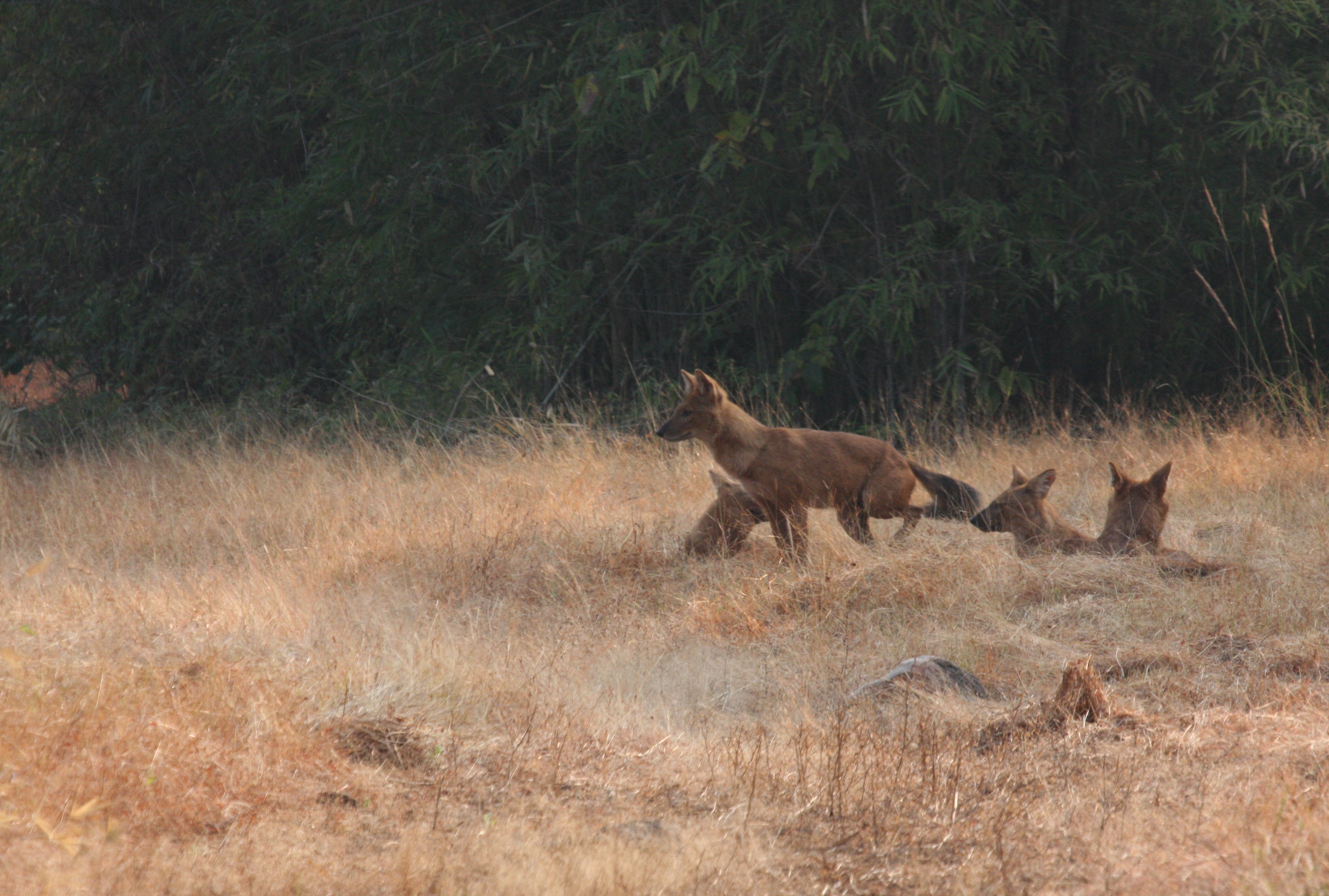
On day two we covered the Moharli range. On the Tadoba-Moharli tar road, we stopped by a pack of five dhole cavorting by the roadside. They appeared relaxed, stretching, rolling in the grass and frisking around as these creatures are wont to do, but when a couple more Gypsies piled in, they withdrew a short distance away. We proceeded to the Katoda checkpost (which delineates the Tadoba and Moharli ranges) for a breakfast break, and by the time we were done and resuming our way to Telia lake, they had brought down a chital just beyond the checkpost. The kill lay in high grass, and little could be seen beyond one or the other dog’s head bobbing above the stalks as it dipped into breakfast.
Image

The area around Telia lake on the Jamunjhora loop presents picturesque dark bamboo forests. Thirty percent of Tadoba’s greenery comprises bamboo and there is bamboo everywhere, but Jamunjhora has especially heavy growth.

The third safari (evening) was a quiet one, with much of the time spent on birdlife, but in the last half hour, we ran into P2 again, on another arrow-straight road. This time she walked towards us, with one Gypsy ahead of, and three vehicles tailing her. Since among the occupants of these vehicles were the field director and the ranger, we were waved off the road. She marched past our Gypsy and away down the road, completely ignoring everyone around.

Image

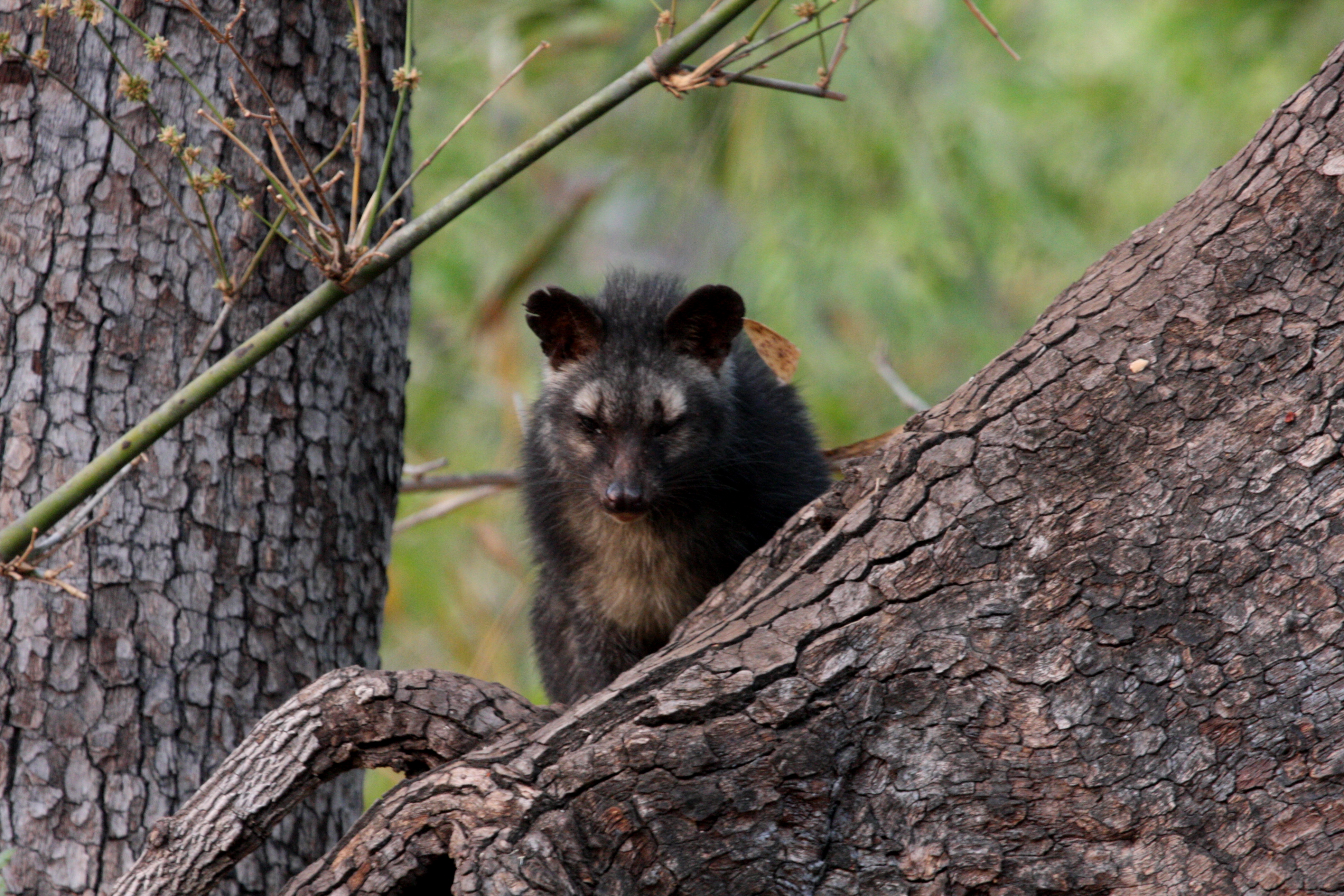
On the way back, we found an Asian palm civet on a bole a few feet from the ground (I had earlier described this as a small Indian civet, but S. Karthikeyan  noticed and was kind enough to point this out). Being a little too early in the civet’s day, it was evidently groggy; at any rate, it did nothing for a long while, sitting with somnolent eyes while we sat and watched it. It finally roused itself to do something about all the attention and clambered up the bole and out of sight.
Image

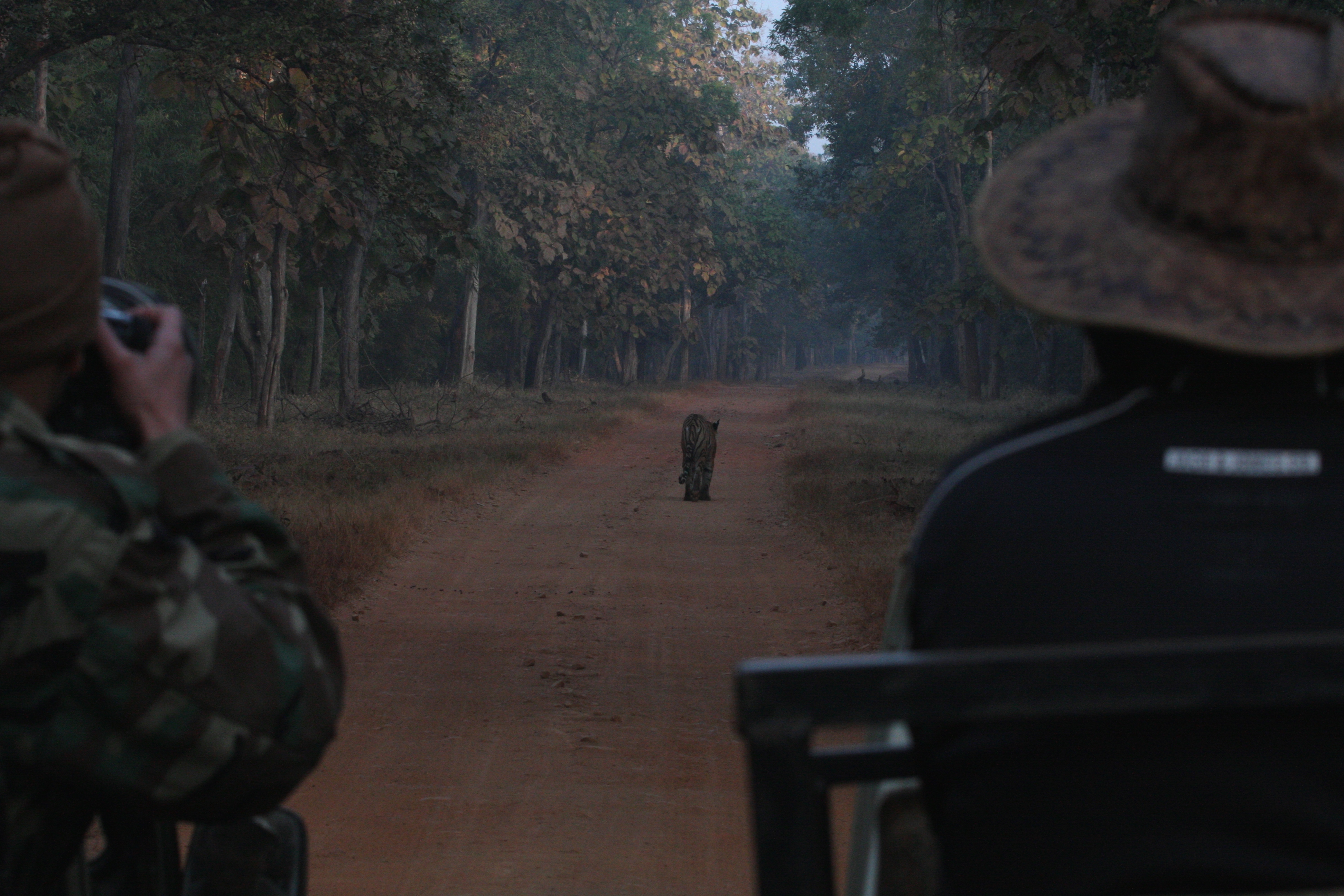
The last day’s safari was a morning one. We had covered pretty much all the local megafaunal attractions barring the nilgai and the leopard. Navegaon is a village on the northern periphery that has been relocated out in the past six months.  As in Kanha, the sites of relocated villages serve as excellent grassland habitats, supporting a healthy ungulate population. So off we went to Navegaon, looking for nilgai and birds. On the road from Panderpauni to Navegaon, who should we run into but P2. It started off with chital alarm calls. We had stopped over at the Panderpauni waterhole to check on the birdlife when calls started from the other side of the lake. We took the road that loops around the lake and stopped over on another side of the water. A brief flash of stripes, and it was another hurtling ride further down the road to try and intercept her. P2 finally emerged and did her thing – the walk on the road unmindful of the gawking audience. She walked towards us, past us and then away, and two columns of Gypsies, perhaps twelve to fifteen in all tailed her at walking pace. The tigress sauntered along unconcerned, stopping by select trees to mark her scent. This went on for the next fifteen minutes, until she turned off the road and disappeared. The Gypsy mobbing phenomenon of the popular tiger reserve is undoubtedly unseemly and downright ugly, but I’m not sure what exactly should be done about it. And Tadoba is undeniably tiger-centric. Guides and drivers do not expect tourists to come looking for much else, and at times it almost feels like they have difficulty mentally processing asks for lesser creatures.
Image

Having touched on the topic of relocated villages, I should not omit to mention Jamni, which is the first landmark after entering from the Kolara gate. The village is in the process of being relocated, and appears largely deserted. The recently harvested paddy fields around boast of a high incidence of tiger sightings – with the beats of two tigresses P1 and P2 cleaving across this area.

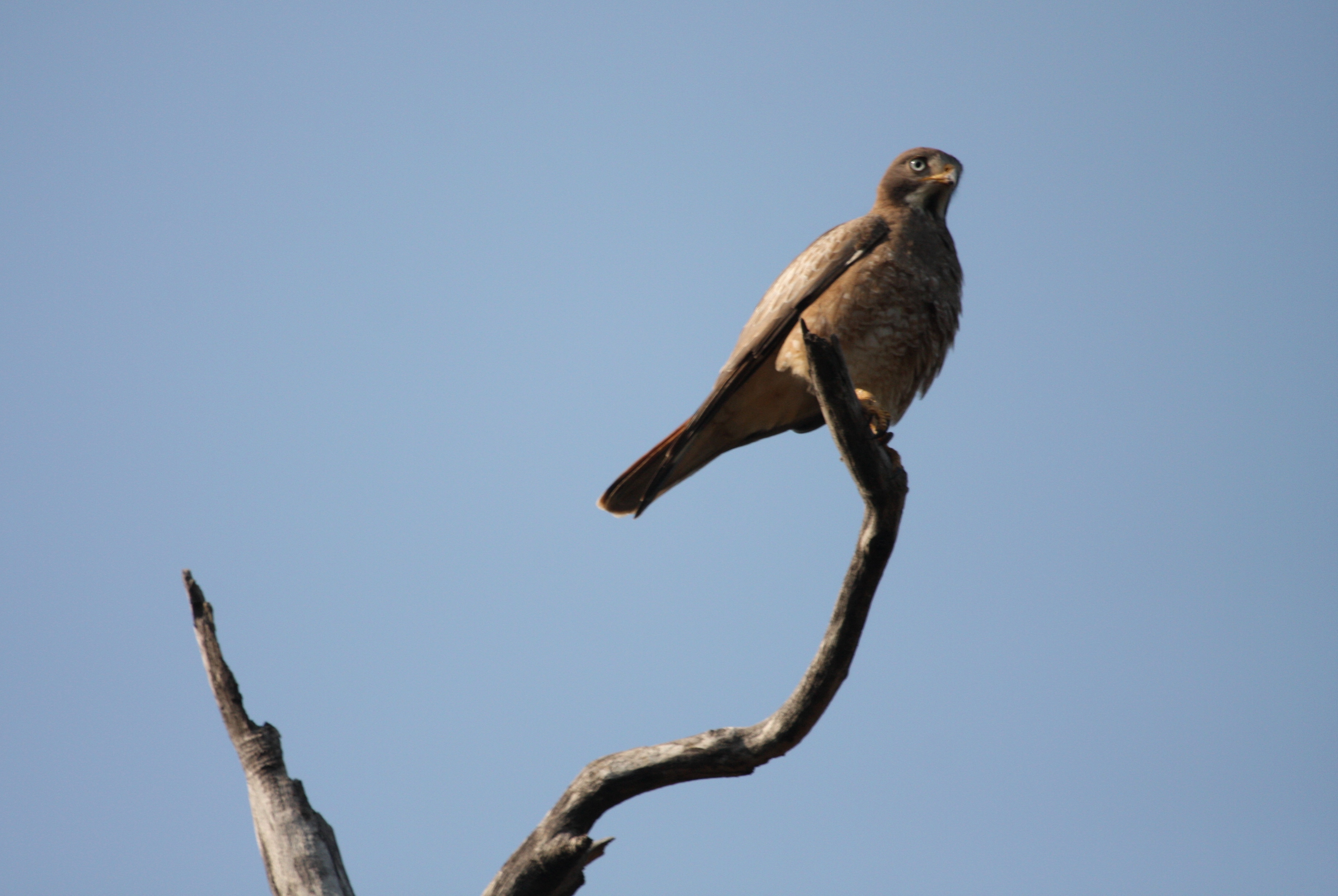
Anyway, we did eventually get to Navegaon, and we did see all the nilgai we could have wished for. And a few herds of gaur thrown in to boot. And plenty of birdlife.
Image

Image

I was hoping to meet the couple that has been doing splendid conservation work in Tadoba – Harshawardhan and Poonam Dhanwatey (their organization is called TRACT – Tiger Research and Conservation Trust) – but this privilege will have to wait for the next trip.

The list

Here’s the full list of sightings from three remarkable days:

Avifauna

  1. White eyed buzzard (fairly frequent sightings)
  2. Sirkeer Malkoha
  3. Common pochard
  4. Lesser whistling duck (plenty of them)
  5. Black headed oriole
  6. Indian treepie (everywhere)
  7. Crested serpent eagle
  8. Orange headed thrush
  9. Plum headed parakeet
  10. Rose ringed parakeet
  11. Tickell’s blue flycatcher
  12. Tree swift
  13. Black drongo
  14. Brahminy starling
  15. White wagtail
  16. White browed wagtail
  17. Red wattled lapwing
  18. Common myna
  19. House sparrow
  20. Asian koel
  21. White browed bulbul
  22. Yellow footed green pigeon
  23. White breasted waterhen
  24. White throated kingfisher
  25. Purple heron
  26. Grey heron
  27. Peafowl
  28. Longtailed shrike (plenty of them, especially outside the reserve)
  29. Pond heron
  30. Common sandpiper
  31. Shikra
  32. Coucal
  33. Chestnut shouldered petronias
  34. Spotted dove
  35. Little brown dove
  36. Eurasian collared dove
  37. Pied bushchat
  38. Leaf warbler
  39. Black redstart (female)
  40. Indian robin
  41. Magpie robin
  42. Black shouldered kite
  43. Plain prinia
  44. Tailor bird
  45. Black headed ibis
  46. Asian open billed stork
  47. Black ibis
  48. Egrets
  49. Indian roller
  50. Jungle babbler
  51. Lesser flameback
  52. Green bee eater
  53. Grey junglefowl (calls only)

Mammals

  1. Ratel/Honey badger
  2. Panthera tigris (3 of 4 safaris, few feet away each time)
  3. Ruddy mongoose (couple of comfortable sightings)
  4. Sambar
  5. Sloth bear
  6. Barking deer (couple of close sightings, quite unmindful of us)
  7. Wild dog/Dhole
  8. Asian palm civet
  9. Nilgai
  10. Gaur
  11. Wild boar
  12. Chital
  13. Common langur

Others

  1. Mugger
  2. Olive keelback (at the resort, rescued with injuries)

Tadoba 555

Image

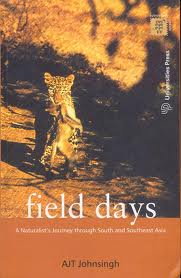
Book Review: Field Days, by A.J.T. Johnsingh

field days

Field Days – A Naturalist’s Journey through South and Southeast Asia

by A.J.T. Johnsingh

Universities Press, 2006

I had spotted this little book in the library of the JLR K. Gudi camp a few months back, and dipped into it for a bit over the next couple of days. I liked it well enough to order my copy as soon as I got back.

The book took me longer than expected to get through. At a little over three hundred pages, I would have expected to speed-read my way through it in less than a week’s time. It has taken me more like three. And that is not because the book is not readable. On the contrary, it is superbly readable. It is just that it is too rich in terms of the information it is loaded with and that makes it hard to binge-read. Smaller doses are the order of the day.

A.J.T.  Johnsingh needs no introduction, but a book review of this sort probably deserves a brief profile of the author. So here goes. A chance discovery of a Tamil translation of Corbett in his boyhood days set Dr. Johnsingh on a path that eventually made him one of India’s best known field biologists. Inspired further by a chance meeting with JC Daniel of the BNHS, Johnsingh undertook a study of dholes in Bandipur in 1976-78. This was the first study ever by an Indian scientist of a free-ranging large mammal in the wild. It also earned Dr. Johnsingh his Ph.D. This was followed by a post-doctoral research stint in the United States. Johnsingh then joined the Wildlife Institute of India (WII), Dehradun in 1985 and rose to retire as the dean of the faculty of wildlife sciences in 2005. He is now a member of the National Tiger Conservation Authority and continues to be actively involved with various initiatives.

The book is a collection of pieces published by Dr. Johnsingh for lay audiences in various publications over three decades, between 1972 and 2005. Almost half of these were published in the WII Newsletter over the years. The book is organized by region, into five sections. These deal with the south, central/west, north and the north-east of India, with an additional section covering countries further east. While well known PAs like Kanha, Kaziranga and Bandipur are profiled, a host of lesser-known places are also dealt with masterfully – PAs like the Pakhui WS (Arunachal Pradesh), Dampa Tiger Reserve (Mizoram), Bhagmara Pitcher Plant Sanctuary (Meghalaya), Srivilliputhur Grizzled Giant Squirrel Sanctuary (TN) and Point Calimere Wildlife Sanctuary (TN). In all, over thirty PAs are covered.

The narration is a delightful mix of personal experiences, detailed floral and faunal descriptions and prescriptive observations. For many of the pieces which were written decades back, there are thoughtful post-scripts provided which outline the current situation. Dr. Johnsingh’s extraordinary knowledge of his stuff is obvious, the book is fairly well-written and the anecdotes it is peppered with are fascinating.  Plenty of chilling encounters are recalled – crouching in lantana to hide from an enraged cow elephant in Bandipur, running into a pair of gamboling leopards in KMTR, his first and terrifying sighting of a tiger in the wild – he was blowing into a medium-bore rifle cartridge to mimic the whistling call of a dhole, and instead brought an indignant tiger charging out of the undergrowth. There are plenty more like these. You’ll enjoy them.

A quick mention of the pieces I especially liked. The narrations of walking through the Periyar TR and Neyyar WS make for fine reading. Two chapters deal in some detail with the years Dr. Johnsingh spent in Bandipur and are engrossing. When I reached this topic, I was especially interested in reading Dr. Johnsingh’s version of a gruesome incident I had read about in another book (Wildlife Memoirs by R.C. Sharma). In ’77 Johnsingh had accompanied Rajasekaran Nair, who was guiding a bunch of trainees from an institution which was the precursor to the WII, into the forest on foot. Dr. Johnsingh’s mortal fear of elephants has been mentioned in more than once place, including by him. As luck would have it, a tusker they ran into charged and killed Nair, leaving Johnsingh unscathed but traumatized. This tragic incident was recounted in Sharma’s book as he was one of Nair’s trainees on that trip. And now I read Johnsingh’s own version of what transpired.

The chapter on Gir is fascinating, as is the fairly detailed piece that talks about how Kuno-Palpur was identified as a viable alternative habitat for the Asiatic lion. Corbett aficionados will like the narrative on trekking through the Ladhya and Sharda valleys. The chapters on Rajaji NP, Pin Valley NP and one on trekking in the Lushai and Garo hills are spectacular as well.

Dr. Johnsingh is quite evidently besotted with angling, and an entire chapter is devoted to the fate of the blue-finned mahseer in Parambikulam. Johnsingh also speaks wistfully of fishing for carnatic carp with spoons in the Tambiraparani (in KMTR), and of landing a 5-6 kg mahseer on his first cast in Parambikulam – an incident that he says, made him an admirer of the species forever.

In conclusion, if you have an interest in wildlife or conservation, this is a book to possess. Apart from the pleasure of reading it cover to cover like I did, the book is probably invaluable to check through specific chapters when you plan to travel to any of these PAs. There are personal insights and a level of detail that is hard to match elsewhere.

Swifts & Swallows

Telling swifts from swallows, in flight

If like me, you’ve wondered if that is a swift or a swallow flying overhead, this may help. I pulled out the differences from online sources, and then cross-checked them with The Book of Indian Birds (Salim Ali, Thirteenth Edition). Guess what. There are enough exceptions to shoot some of these rules out the window. Here it is anyway, for what it is worth.

To begin with, pulled these silhouettes, from here:

Swallow:

swallow

Swift:

Swift

The swallow:

  • Has a deep forked tail, often with long streamers (does not apply though to the house and streak-throated swallows)
  • Has broad wings, relatively
  • Has a white or light coloured underside
  • Has a rusty red chin patch (the common swallow only)
  • Is passerine, can and does perch
  • Builds nests of mud and straw

The swift:

  • Has a slightly forked tail though not as deeply forked as the swallow’s (exceptions: crested tree-swift and Asian palm-swift)
  • Has long narrow swept-back wings resembling a crescent or scythes
  • Is dark brownish all over with a pale throat
  • Calls noisily while flying
  • Clings with tiny weak legs, cannot perch
  • Breeds in holes and crevices of old buildings

Post Script: While on the topic, don’t miss this most delightful piece of verse by rickyengland:

HOLLOW VICTORY

The fly flew over the meadow

A Swallow he followed the fly

‘I’ll fly’, said the fly, ‘to the hollow’

‘For the Swallow is swifter than I’

Too soon did the triumphant fellow

Let out his victory cry

For there on the edge of the meadow

A Swift did swallow the fly

References:

http://www.bbc.co.uk/nature/22527420

http://www.rspb.org.uk/wildlife/birdguide/name/s/swift/identification.aspx

http://www.naturalenterprise.co.uk/pages/news/46-have-you-seen-a-swift

Choosing My Binoculars

One of the things that came out of the JLR Naturalist Training Program (for me) was the need felt for a pair of binoculars. I had trouble with a pair some years before, and had experienced some serious vignetting (blackening of the edges) while trying to look through them. I figured that this had to do with my wearing glasses, but not knowing the first thing about binoculars, I didn’t realize this was an addressable issue, nor did I really apply my mind to it. I simply stayed away from using binoculars instead. (I was aware of the dioptric adjustment, but that has never worked for me, possibly due to my astigmatism or more likely, ignorance).

We were handed Olympus 8X40 binoculars during our field walks in the NTP and using them, I wondered how I managed all these years without a pair. Binoculars are a truly invaluable aid to the serious nature enthusiast.  I duly set out hunting for a pair to buy, as soon as the NTP was done. Beyond being able to spell the word correctly, I knew next to nothing about binoculars. Karthik explained a little, I learned a little more from Dr. R and other folks around, and subsequently read up still more online to build a rudimentary picture in my head. This post seeks to record some of this basic understanding.

We know that the binoculars’ primary specification is represented as two numbers separated by a cross. 8X40, 10X50 and suchlike. Let’s take the 8X40 for our illustration. The 8 represents the degree of magnification – what you look at is magnified 8 times. The 40 represents the size of the outer or larger lens (the objective lens), in millimeters. Why is this important? Larger the objective lens, more the light the binoculars captures. You can view that bird better in late evening light if you have a larger objective lens. Corresponds somewhat to the aperture measure in photography terms.

Now there is also a relation between the magnification and the size of the objective lens. If you bump up the magnification, you should logically have a commensurately larger objective lens size to be able to gather enough light. This relationship is measured by what is called the Exit Pupil. Size of the objective lens divided by the magnification. 40/8 in our example is 5. And this is represented in millimeters:  hence, an Exit Pupil of 5mm.

With this in mind, there are three other basic concepts that are worth addressing.

There is a parameter called Eye Relief, measured in millimeters, which broadly represents the max distance from which you can look into the eyepiece without experiencing vignetting. Why is this important? If you wear glasses, you will have to allow for the intervening distance from the eyepiece, and that is precisely the problem I had run into earlier. The binoculars need to have an eye relief measure large enough to accommodate your eyeglasses in the way.

There is also a self-evident measure of the minimum distance the binoculars can focus from.

Last is in terms of body design. Porro Prism and Roof Prism. Readers who are familiar with binoculars terminology will kindly refrain from cringing at my crudely dumbed-down interpretation of these two terms. I’ve been at this for all of two days and have the most basic degree of understanding possible. Porro Prism binoculars have the typical binocular shape familiar to us all, where the eyepiece and objective are not aligned along the same line. The eyepieces are in two little cylinders which are parallel to each other, and these two lie between the two larger cylinders which contain the objective lenses. Roof Prism binoculars have both the eyepiece and objective lens affixed at the two ends of a single cylinder, to put it very crudely. This only describes what they look like. I didn’t gain too much of an understanding around how each one corrects the inversion of the image, or what their pros and cons are. Once I figured out this understanding didn’t really matter as far as my immediate choice of purchase was concerned, I abandoned that trail. So much for my scientific temper.

Dr. R was kind enough to share a crystal-clear guide to choosing a pair, aimed at the beginner. This piece is by Sumit Sen, and is on the Kolkatabirds website. Here’s the URL:

http://www.kolkatabirds.com/binocs.htm

From this guide, I pecked out the following normative checklist:

Parameter

Desirable   Value

Magnification & Objective 8X40 or 10X50; indicates 8X40 good enough for beginners
Weight < 1 kg
Exit Pupil (Objective/Magnification) > 3 mm, < 7 mm
Eye Relief (from a glass-wearer’s perspective) 15 mm +, with fold-down eyecups
Close focus < or = 10 feet
Body design Porro Prism or Roof Prism, either is okay
Weather proofing Nitrogen purging is preferable, weatherproofing is nice-to-have
Coating Multi-coating is best, though a nice-to-have

Scouting around, I found the Nikon Action 8X40 EX (Porro Prism) retailing at a little over Rs. 11K on www.Flipkart.com. This model conforms to all the specs on the checklist with the single exception of close focus distance. ~16 feet as against the normative < 10 feet. I’ll probably go ahead and buy it anyway in a week or two.

Post Script: You knew the Caveat Emptor was coming. Readers will pardon any inadvertent errors in this post. Being quick and accurate on the uptake is not one of my strengths, and it is quite possible that I’m completely off on some of this stuff.

Program Review: JLR’s Naturalist Training Program (NTP)

JLR’s Naturalist Training Program (NTP)

I have encountered two experiences over the past as many weeks, both which have been deeply impactful. The first was the reading of a remarkable book – Of Birds & Birdsong – by M. Krishnan. The second was the attending of the 3-day Naturalist Training Program run by Jungle Lodges and Resorts (JLR). I’ll post a review of the book shortly; this post is about my impressions of the JLR program.

S. Karthikeyan

The NTP is run by S. Karthikeyan, the Chief Naturalist of JLR, a much-revered man with a formidable reputation. Karthik’s thirty years of work as a naturalist in some form or the other mean he’s notched up the ten thousand hours that Malcolm Gladwell talks about, five times over. He is therefore extremely knowledgeable. In addition he is a naturally gifted teacher, sharply observant and articulate, and this had a strong bearing on the pedagogy of the course. It was a deeply fulfilling experience to spend almost three full days in Karthik’s constant company.

The Program

I’ve been hearing about the NTP for many years now. A couple of months back, a birding and photography hobbyist I met in K. Gudi (BR Hills) gave me information on how to register. The NTP program has been running since 2006, and has seen over twenty batches so far. It is a program with a reputation – so much so that registrations get filled to capacity within a few minutes of announcement. I got lucky and was one of the few people who’d managed to get on the program within a few weeks of registering my name.

The program runs for two and a half days at the Bannerghatta Nature Camp of JLR. Mornings and evenings are utilized for short forays into the surrounding forest, and the day is spent in classroom sessions. The sessions seek to give participants an appreciation and understanding of biodiversity, birdwatching skills, plant-animal interactions and conservation. There is a lot you can learn in this classroom, regardless of the degree of seasoning you possess as a nature enthusiast. There is a general de-emphasis on the typical fascination with “charismatic megafauna”, and a keen emphasis on encouraging appreciation of the more modest critters around us – flora, lichens, fungi, insects, amphibians, and suchlike.

There is the usual JLR tradition of film-screening in the evening and in terms of creature comforts, it is the typical JLR experience.

The Class

We were a small class of 17. There were three techies, two doctors, a wilderness resort manager, a student, a WWF employee, a housewife, a financial consultant, and so on. A very diverse group with one strong commonality – an avid interest in the natural world.  And over the three days, we became a fairly close-knit group. Karthik has a delightful tradition of getting each participant to assign a natural world nickname to her/himself, and this was the handle we used for each other, for most part. One of the big advantages of the program lies in fostering this networking with like-minded people. I know of people from early NTPs who continue to nurture strong friendships and collaboration with their batch-mates.

The Field Walks

The class did four field walks in all, mornings and evenings. Focus was on the development of systematic field/observation skills, rather than in familiarizing the class with the resident avifauna. And the stage for this line of approach was set with a seemingly simple question Karthik posed – how do crows and mynas locomote while on the ground? Something we’ve all seen very many times. And yet, no one was really sure. We hadn’t really noticed. Do they hop? Or walk? Or is it a combination of the two?

For me, photography exacerbates this degraded sense of observation. Caught up in judging the light, composition and trying to capture something interesting, there is no bandwidth left to really look at the creature.

So what is the antidote to this blindness? Sketching!

Frederick Franck, in The Zen of Seeing wrote “I have learned that what I have not drawn, I have never really seen, and that when I start drawing an ordinary thing, I realize how extraordinary it is…’ Karthik took the class out into the field and made us sketch every bird we encountered. Capture detail. Where is the little white streak placed? Does the black stripe run all the way around or not? I realized that there is so much that we have looked at and not really seen. Memory that aids observation had atrophied from underuse. I had to refer back and forth in multiple iterations to transfer what I saw onto paper. And this is for common birds I have seen scores of times. The real value of using a field notebook with sketches and comments to aid systematic observation was brought home very vividly to every person in the class.

I also realized that it isn’t a good idea to use a camera as an ID’ing tool – capture a picture and ID the bird (or animal) at leisure, later. This does two things to me – one, it impedes keen observation – there is simply no need to expend effort in careful scrutiny with a nice RAW image up-close in the bag. Second, I find that after I ID the bird, the identification doesn’t really register. In any case, there is not much point in going on a spree of simply spotting and identifying, and doing little more than just that. That is about as mindless as counting cars on a highway by way of leisure.

My Takeaways

This is what I brought away in terms of adjustments to attitude, not counting the significant knowledge accretion:

One, I’m more aware now of staying clear of the mindless ID’ing trap it is easy to fall into. Birding trips were miniature versions of the Big Year – you spotted a bunch of birds, ID’d them all, made a list, and felt good you knew so much. You were happier if you saw forty species, and not so happy if you saw just three. And you were ecstatic if you spotted something out-of-the ordinary. A Blue-faced Malkoha. Or a Green Imperial Pigeon.

The book review of Of Birds and Birdsong will come back to this theme. Krishnan spent hours watching crows, mynas and bulbuls. The more commonplace the bird, the more time he spent making original, keen, systematic observations. His sense of curiosity, ability to observe detail and patience are staggeringly impressive and inspiring. Compare this with running around on an ID’ing spree. See what I mean? It is important to be able to identify birds, or for that matter mongooses or butterflies, but stopping with just ID’ing ability would be stunting one’s development as a naturalist, completely shorn of depth.

Two is what I’m thinking now about photography. I already talked about photography limiting my ability and inclination to observe. Going further, I found myself asking the question as to why I want to get another picture of that Kestrel or Blue Jay when thousands of people have already captured a gazillion images and posted them online? Is it just so I can post the gazillion-and-one-th image on INW or someplace and feel good when people respond with TFS, nice capture or great shot? I’m getting to Tadoba next month. Perhaps I’ll try switching to binoculars in lieu of camera, and sit back and enjoy myself simply observing. BIL and nephews will be capturing all the images we’d need for posterity in any case. I’ll lug my camera along alright, but it’ll probably sit on the seat beside me and stay there. Will keep you posted on how that experiment goes.

Three is a desire to increase my scope of indulgence as a naturalist, beyond just Mammalia and Aves  – trees definitely, reptiles and butterflies too perhaps. And expand this out gradually over time. Karthik pointed me to a tree walk this weekend, but I’ll be traveling and will miss it.

Four may sound rather strange. I experienced pleasure at watching a bird at work for the first time. Something I’d have earlier associated with watching Munna or Machli, or an elephant perhaps.  There was this Pied Kingfisher fishing that we watched for a while, and I believe I could now amuse myself watching him for hours on end, with a good pair of binoculars.

Five is not something that the program itself engendered, but after the experience, I do feel a more intense desire to contribute meaningfully in some small way, to either conservation or natural science. I’ve requested Karthik to bookmark this mentally and point me to some relevant opportunity.

In Conclusion

If you have any sort of serious interest in the natural world, this program is very likely to change the way you think. If you are a birder, wildlifer or any sort of naturalist, you are missing out on a truly remarkable opportunity by not signing up. And while you do that, I’ll run along and buy myself a nice pair of binoculars and a sharp pencil or two.

Trip Report: Sathyamangalam Tiger Reserve Oct ’13

Trip Report:        Sathyamangalam Tiger Reserve

Dates:                   26/27/28 Oct 2013

Camp:                   Wild Valley Farm, Germalam P.O.

Companions:       GK and VR

Photos:                 http://www.flickr.com/photos/72698571@N06/sets/72157637122198774/

——————————————————————-

STR: Wikipedia Abstract

Sathyamangalam Tiger Reserve (STR) was declared as a PA in 2008 with 524 sq kms of area. In 2011, another 887 sq kms were added, bringing the size to 1,412 sq kms – which makes it the largest wildlife sanctuary in Tamilnadu. STR is a part of the Nilgiri Biosphere Reserve, and is contiguous with BRT Tiger Reserve, Mudumalai National Park, Bandipur National Park and Masinagudi (Sigur Plateau). Sathyamangalam falls under Erode district, overlaps two taluks (Sathyamangalam and Gobichettipalayam) and is the fourth Project Tiger reserve in TN (after Mudumalai, Anamalai and KMTR).

The topography varies from scrub and thorn jungle in the plains, to lush shola forests at higher altitudes. A December ’11 camera trapping study estimated the presence of 28 tigers. In the same year, the population of elephants was estimated at 850. A 2009 wildlife survey had estimated 10 tigers, 866 elephants, 672 gaur, 27 leopards, 2,348 chital, 1,068 blackbuck, 304 sambar, 77 barking deer and chausingha, 843 wild boar, 43 sloth bears and 15 striped hyenas. Mr. Daniel (see later) mentioned a tiger scat study that had enumerated some 46 tigers in the area.

Paranormal Phenomena

The area is infamous as being the haunt of the sandalwood and ivory smuggler Veerappan for years.  You can find online references to STR as one of the most haunted spots in India after his slaying. Strangely, four people we separately asked were puzzled or amused by the question and seemed to be completely unaware of any such reputation the place possessed. We went looking for spooky stories, but this came a cropper. So much for the supernatural.

Wild Valley Farm

We stumbled on the place online and it turned out to be a great choice. The farm is near a village called Germalam, exactly 205 kms from my home in Bangalore, via Kanakapura road/NH209. To get there, you drive to Kollegal and ask for the road to MM Hills/Udayarpalya. Some 20-30 kms down this road, you see another road forking off to the right, with a large signboard that reads “Wildlife…” something (“Wildlife Conservation Society”?) This road leads straight to Germalam, where you’ll need to turn left to get to the farm. Germalam is 60 kms from Kollegal, and is a very short distance from the Karnataka border.

WVF is owned by S.R. Daniel, a very amiable and interesting man who lives on the place. He is one of those rare people who’re actually living out their dreams, having bought 100 acres of uncultivated land  at the back of nowhere in his late twenties, and then having settled there and learned to farm successfully. We had some very interesting conversations with Mr. Daniel. His love for the place, its people and the animals came through very clearly. Especially memorable were his anecdotes about the relentless struggle to keep wild elephants out of the farm.  This quest to elephant-proof the farm seems to be a big part of Mr. Daniel’s life and he talked about the big bulls that aren’t deterred by the electric fencing.

These elephant fences are single wires strung out at heights varying from 6.5 feet to 7 feet or so, and connected to an electric fence machine that spits out a pulse of high voltage (4,000 volts) and low wattage (Ampereage?) at intervals of about a second. The pulsing and low wattage ensure contact doesn’t kill. Getting entangled in the wires however can, and we heard of cattle as well as inebriated men getting killed this way.

Coming back to the topic of the bull elephants, Mr. Daniel spoke of them hurling a branch or trunk to get the wire to sag, and then flooring the entire contraption, fence post, wire and all by stamping down on the live wire with their forelegs, notwithstanding the shock of the electric current. Alternatively, they’d get hold of one of the posts with their trunk, and heave it right out of the ground, uprooting poles for 50 meters or so on either side in the process, and bringing the whole arrangement crashing. I was reminded of Dr. Lucy King’s experiment with beehive fences in Kenya (see Sanctuary Asia, October ’13 issue). These fences have wires between posts from which the hives are suspended, and if the pachyderm attempts to dismantle or even touch the fence, it sets the hives swinging. Dr. King found that the resultant angry buzz the bees make is enough to get the elephant to back off. The hive fence also generates an additional income for the farmer. I did mention this to Mr. Daniel, though I’m not sure if he found the idea convincing enough to attempt.

We crossed under the live fence-wires a couple of times, gingerly stepping across, bending much lower than was required, and staying low well after the wire was passed. For all the caution exercised, we discovered later that we had been trudging right under one of these fences strung between our tent and the toilets, blissfully unaware of its electrifying presence a few inches above our heads.

The staff on the farm is polite and hospitable, and the frosting on the cup-cake is the dogs – five of them – Bilbo the lab/GSD, Rover his brother, Spike the Dobermann and a couple of Lhasa Apsos. They are, especially the first three, delightfully friendly. Bilbo slept on the grass outside our tent once he figured we liked dogs as much as he did. And the cherry on the frosting is the Red Spurfowl calls in the darkness that resound through the forests around the farm, vaguely reminiscent of something plopping into water. Grey junglefowl call too, and so do peafowl – all of which are very pleasant sounds to those of us who love our forests. And during the day, bulbuls, sunbirds and other birds set up a cacophonic chatter. The farm is verily a birder’s paradise, at least in winter.

Accommodation is by way of fabric tents pitched on grass plots near the forest edge, with no power supply. The tents overlook a patch of turmeric and gooseberry beyond which lies the forest’s edge. Each tent holds upto four camp cots, and little else. The farm has a total of 20 such tents, and they are erected when booked and dismantled after. Toilets and bathrooms are in a regular, electrified facility about 50 meters away. The arrangements are not luxurious by any stretch, but certainly clean and functionally adequate. Dining arrangements are a little way off, near a large kitchen constructed for the purpose – there is a little al fresco dining area with a delightful view. No, not quite al fresco, but you can eat on the porch whilst looking at the forest with the ever-present elephant fence-wire in the foreground. We must say we quite enjoyed the simple south-Indian fare. All the wandering in the forests and the clean air helped sharpen our appetites too.

The weather in October was warm and dry during the day for most part (though it must have been cool enough on the farm), with a nip in the air come evening. Nights are pleasantly cold.

The one inconvenience we faced staying on the farm was the distance from there to the starting point for our drives – Hasanur – 23 kms away. This required a headstart, which meant leaving at 5 AM to link up with our guide at 5:45 AM. In the evenings, this distance had to be factored to ensure we returned to the farm in time to get our dinner (latest by 9:30 PM or so). But despite this constraint, there are enough reasons to visit the farm again and we would recommend it to anyone wishing to visit the area.

The Outings

VR had discovered a most resourceful fellow who was a driver to the ranger for 9 years and consequently knew the topography of the place intimately. We covered as much ground as we did because of this. And cover ground we did. In the two days on which we drove into the forests, we covered 400 kilometers, much of it over boulder strewn stretches, dry stream crossings and generally rubber-ripping non-roads. In any event, the Scorp (“Vanessa”) held up her end of the bargain remarkably well in these proceedings.

So this is what we broadly did:

Day 1:

Germalam-Hasanur-Thalavady-Chikkahalli-Thalaimalai-Begaletti-Mavanattam-Dimbum-Hasanur

This is a delightful stretch of wilderness. Mixed deciduous and shola forests, with ample roadside sightings in the late evenings. The road is tarred and in grand condition.

We came upon a sloth bear in the fading light, intent on digging out what were presumably termites. Enormous male in his prime. He sniffed and snorted around a circle some 10 feet in dia, completely ignoring us as we sat with the engine turned off, hardly 10 feet away – except for one irritable moment when he rose on his hind legs and flashed the white V on his chest as he warned us off. We watched him in silence for a good ten minutes before he made off into the undergrowth. That’s the longest I’ve ever watched a sloth bear for, not counting the Daroji Bear Sanctuary sightings where one can watch sloth bears at one’s leisure and often for hours, but from a very long way off. (I did hear recently that the Daroji sightings are now a thing of the past, with the elimination of the stone-crushing units that dot that landscape – and that they have now apparently dispersed across a much larger area).

This must have been the Night of No Fear, since we also came across a pair of Indian Civets cavorting on the roadside in the darkness, quite unmindful of our presence.

A short while later, on the drive back to Germalam, we ran into another bear, a much smaller one, but this one fled as soon as it spotted us.

Day 2:

First leg: Germalam-Hasanur-Dimbum-Bhavani Sagar-Sujilkuttai-Kulithurapatti-Karavanrayan Koil-Alli Mayar-Dimbum

To traverse this route, one needs to first tackle the 29 hairpin bends down the Dimbum escarpment (including an infamous one called the raikal bend which spirals up seemingly interminably and then abruptly spins out in the opposite direction). There is a lot of heavy lorry traffic on this stretch, and the narrow road, steep inclines, hairpin bends and heavy loads make for a potent combination.

Re-entry into the forest then is beyond Bhavani Sagar (with its lower Bhavani Sagar dam), and the trail meanders through dry scrub jungle where Blackbuck can be sighted, until the Moyar/Mayar river is reached. This is the Moyar river valley and you can spot White-rumped and possibly other vultures patrolling the skies in this area. I am confused by the differing spellings for this river – Mayar and Moyar. Our guide’s take was that the original/correct name is Moyar, but that it has morphed into Mayar or the enchanted river on account of its vagaries, coming into flow suddenly and unpredictably.

At Alli Mayar, the road ran into the river quite literally, and diagonally at that, requiring a crossing through rushing waters 2.5 to 3 feet deep, for a distance of around 100 feet. I didn’t have the nerve to attempt the crossing (in my defense, the Scorp was hardly three months old), and we turned back to Dimbum, wisely I think. I don’t believe there are too many options for towing a Scorp with a flooded engine block out of the Moyar in the middle of that forest.

The roads on this outing varied from poor to worse, inside the forest. The boulder-strewn slopes that flank stream crossings tend to be especially vicious as far as tyres and underchassis are concerned. You cannot attempt this route in a vehicle with inadequate ground clearance.

Second leg: Dimbum-Mavanattam-Begaletti-Thalaimalai- and then a u-turn shortly before reaching Chikkahalli, at a place called Dasarapallam, to return to Dimbum via the same route and thence to Hasanur.This Dasarapallam is reputed to be the stretch of forest where Veerappan had secreted his celebrity abductee Dr. Rajkumar for several months.

This was a repeat of the previous day’s route. While passing the spot where we’d had the stretched bear sighting the previous evening, I remarked that this was the spot and turned to point and as luck would have it, the same sloth bear was in the exact same spot. And curiously, this time accompanied by a Grey Junglefowl cock, pursuing him for any stray, wholesome insects he was dislodging. The sun was just starting to set and mellow evening light still suffused the forest, so we could see him much more clearly than on the previous occasion. We screwed up with the camera, having forgotten to reset the exposure comp a few minutes earlier. The images we got were frame-filling, but irredeemably blurred and overexposed. Yet another lesson to promptly return the exposure comp setting to zero if it is ever tinkered with – this is not the first image to be ruined on account of this oversight.

This was déjà vu day, as after Bruin, we again ran into a civet on the way back, perhaps one of the same pair we ran into the previous evening.

The highlight of the evening however was a glorious Makhna mock charge. A Makhna, for the uninitiated, is a tuskless male elephant (unlike the African elephant, only the males carry tusks in case of the Asian Elephant, and that too not all of them). Shortly before we reached Chikkahalli, we came across a massive tuskless bull feeding right beside the road. I was intent on my driving and drove right past, missing him completely. The guide urgently whispered and we slammed to a stop, backed up and sat watching him in silence. He was hardly 40 feet away and we were obviously way too far into his comfort zone (do I correctly remember the recommended safe distance for motorists as 100 feet?).
The elephant then started showing signs of agitation, decided to get his retaliation in first (a la Jack Reacher), and came hurtling towards the Scorp with a short warning trumpet. There was a shallow rainwater ditch between us, but it was hardly designed as an elephant barrier. The animal stopped some 15 feet away after effortlessly snapping a 6-inch wide bamboo stem with his trunk in a demonstration of disgust, and I dutifully moved the car a short distance ahead to pacify him. He then resumed feeding, still showing signs of agitation. We left in a short while to avoid precipitating a second charge.

I’ve seen plenty of mock charges, but they were all with the perceived comfort of having a professional safari driver at the wheel. This was the first time I’ve experienced a charge while at the wheel myself, and this ups the feeling of anxiety. In any case, I’ve found mock charges at close proximity to be intimidating enough to send my pulse racing in each case. I think I’d freeze in place if I were on foot instead. We read about the signs of mock charges vis a vis intent to make contact – flaring of ears, outstretched trunk, trumpeting – but I somehow lose the capacity to assess these the moment that grey-brown mass comes hurtling through the lantana.

After this incident, I remembered what I’d read as a child about Makhnas in E.P. Gee’s The Wildlife of India; Gee surmised that Makhnas tend to be larger and stronger than tuskers as a rule, to compensate for their lack of in-built weaponry. Elephants are large, Makhnas are larger, and all objects appear larger than they are in the dusk!

It should be noted that most of the routes described here are closed to the public, and that there is no organized tourism in STR. Permission to enter the jungle has to be obtained from the forest department.

Hasanur figures on the itinerary not because it lies en route to Germalam (it does not), but in order to pick up and drop our guide who lived there. It is a short way ahead from the Germalam turn-off.

There would be broadly three categories of visitors to this forest I’d imagine, excluding the politico-VIP-types who’d get in anyway. Bands of men or youngsters out to drink, hoot at elephants, maybe bathe in the river, and generally have a jolly good time. Families, out to look at some wildlife, with someone who can get them into the forests. And then amateur naturalists with a serious interest in the forest and its wildlife. It makes a lot of sense for the forest department to find a way to encourage the latter category, and to make some money in the process. Look at what Jungle Lodges & Resorts has done in Karnataka. The Kerala Forest Department does this in some limited way I assume, from what we’d seen in Gavi/Periyar TR earlier. I haven’t seen meaningful eco-tourism deployment anywhere in TN, and that is a pity. We were refused entrance in KMTR, and met with a very lukewarm response in Top Slip, and these are all places with tremendous ecotourism potential.

Day 3

We dispensed with the drives on day 3 and opted for a “long” trek organized by Mr. Daniel. Slipping under the electric fence below the dining area, we entered the bamboo forests by the Moyar with two guides, one a short distance ahead and another just behind us. Mr. Daniel repeatedly warned us against trying to catch up with the leading guide, as he might make himself scarce in a trice in the event of an elephant charge, leaving us at the mercy of the elephant. The lag would give us a head-start if we were to encounter an angry elephant. The reason for his caution became apparent very soon, with large deposits of elephant dung appearing just about every ten feet in the forest. This area is quite obviously infested with elephants, though there was some temporal respite in the fact that their movement in this area was almost always nocturnal. There was not much birdlife active in the jungle in the forenoon, and the forest was largely silent barring some junglefowl calling dispiritedly at intervals.

We climbed for a distance of around three kilometers and then descended by another route. The trek was moderately easy, with a little bit of clambering up rocky slopes. What was surprising was the unlikeliness of the places where we found elephant dung – on steep boulder-strewn slopes where it was hard to imagine an elephant making his way.

Mr. Daniel had told us about a Brown Fish Owl that we might encounter, we did see a large bird beside the Moyar that took to flight at our approach, but we couldn’t determine if it was this worthy or a CSE/CHE. GK found a discarded Chital stag’s antler that I carried home with me – it is much heavier than you’d imagine and I pity the stag that carried two of these around on his head. Incidentally, I read somewhere that deer seem to use their antlers solely for sparring with other stags of their own species, and do not even attempt to use them in any manner of self-defense when confronted with a predator or other assailant.

Overall as far as the trek was concerned, we got ourselves some good exercise on our feet and the delight of being in the forest, but not much by way of sightings. And no elephants either despite all the signs scattered everywhere. Thank God for that, I suspect both GK and VR would easily outrun me, not to mention our two guides (note to self: restart the thrice-a-week running schedule before venturing into elephant-infested forests again).

Post script: Kenneth Anderson aficionados will find bells ringing a chorus in their heads with all the place-names that leap straight out of his stories – Gedesal, Thalavady, Thalaimalai, Dimbum and so on.

Sightings:

Avifauna:

  1. Asian Blue Fairybird
  2. Ashy Crowned Sparrowlark
  3. Asian Koel
  4. Barn Swallow
  5. Bay-backed Shrike
  6. Blue-faced Malkoha
  7. Blue Jay
  8. Brahminy Kite
  9. Brahminy Starling
  10. Brown Rock Chat
  11. Brown Shrike
  12. Changeable Hawk Eagle
  13. Chestnut Headed Bee Eater
  14. Coppersmith Barbet (calls)
  15. Crested Serpent Eagle
  16. Drongo
  17. Chestnut-headed Bee-eater
  18. Eurasian Collared Dove
  19. Golden Oriole
  20. Green Bee-eater
  21. Grey Headed Fish Eagle
  22. Grey Junglefowl
  23. Grey Francolin
  24. Grey Tit
  25. Hoopoe
  26. Hovering raptor – unidentified, with rapid fluttering of wings while hovering in place
  27. Indian Bushlark
  28. Indian Grey Hornbill
  29. Indian Robin
  30. Jungle Bush Quail
  31. Jungle Prinia
  32. Lesser Flamebacked Woodpecker
  33. Little Brown Dove
  34. Long Tailed Shrike
  35. Magpie Robin
  36. Owl (unidentified/indistinct in the morning darkness)
  37. Peafowl
  38. Pied Bushchat
  39. Purple Sunbird
  40. Purple-rumped Sunbird
  41. Red-rumped Swallow
  42. Red Spurfowl
  43. Red Vented Bulbul
  44. Red Wattled lapwing
  45. Red Whiskered Bulbul
  46. Rufous Treepie (calls)
  47. Shikra
  48. Small Green Barbet
  49. Small Minivet
  50. Spotbilled Duck
  51. Spotted Dove
  52. White-browed Wagtail
  53. White-throated Kingfisher
  54. White-rumped Vulture

Fauna:

  1. Blackbuck
  2. Blacknaped Hare
  3. Bonnet Macaque
  4. Chital
  5. Common Langur
  6. Elephant
  7. Gaur
  8. Indian Civet
  9. Malabar Giant Squirrel
  10. Sambar
  11. Sloth Bear
  12. Star Tortoise