Trip Report: Bandipur National Park, March 2014

Trip Report: Bandipur National Park 

Dates:           29-31 Mar 2014

Camp:           JLR’s Bandipur Safari Lodge

This trip was organized by a bunch of us from the Nov ’13 NTP batch. It was open to the batch, but just four of us ultimately signed up. With the temperature rising, we were hopeful of productive mammal sightings; the forest fire which broke out a little before the middle of March threatened to put paid to our plans, but the safaris resumed after 4-5 days of disruption. We drove through some of these charred forests on one of the safaris, and the affected swathes can also be seen by the Ooty highway a little beyond the Bandipur reception area. A thousand acres were impacted by the fire, although this is perhaps not necessarily the tragedy it is made out to be. If you want to know why I say so, this is a very insightful piece to read.

Bandipur Mar 14 327

We did four safaris and I wouldn’t exactly say that the outings were brimming over with sightings, in terms of birds or mammals. Certainly not a patch on my last trip to Bandipur just before the south-west monsoon, when the safaris were vibrant with encounters every few minutes. That was in fact one of the best trips I have ever done (three tiger sightings, ten minutes spent backing up right besides a magnificent and very tolerant tusker, a Black naped hare, Ruddy and Stripe-necked mongooses that permitted prolonged and close observation, and plenty of birdlife).

This time in stark contrast, most of the time was spent in driving through a silent forest shorn of leaves (and completely infested with lantana), the jeep throwing up a pall of fine dust which settled on and fouled everything. Despite the subdued productivity, it was nevertheless time well-spent for us, with some intense birding and an interesting tigress sighting.

There was a tree spreading over our rooms, and weighed down with hundreds of golden-orange figs. Naturally, this was a magnet for frugivores of all hues and we spent a considerable amount of time between safaris under this tree and around the camp. Red-vented bulbuls, Plum-headed parakeets, Asian koels, Coppersmith barbets and palm squirrels were probably the most common gourmands – we found these on the tree with near-certainty at any point. Red-vented bulbuls were in force and aggressively so, and given to relentlessly harassing their more timorous red-whiskered cousins. Indian grey hornbills appeared fairly frequently.

Elsewhere in the camp, there were plenty of Purple-rumped sunbirds, Cinereous tits, Blyth’s reed warblers, Asian brown flycatchers, Common ioras, Oriental white-eyes and White-bellied drongos. A coucal was a constant (and constantly calling) fixture right outside our door, where we also spend an enthralling few minutes watching a flock (murder is the correct albeit awkward term) of crows mob a Shikra which had settled down to partake of something dead and delicious clutched in its claws. Unfazed, the Shikra decamped only after consuming its meal entirely, leaving nothing for the crows.

On the safaris, the first and last threw up elephant sightings, something that I was looking forward to. A small herd of three each time. In terms of birds, most common were hoopoes, Grey junglefowl, Brahminy starlings, Red-vented bulbuls, Magpie-robins, Flamebacks, Streak-throated woodpeckers, Jungle mynas and babblers (both Jungle and White-headed).

The tiger sighting happened in the third safari (evening). Our driver got a call and headed to a waterhole called Kadamatur Katte, where a couple of vehicles waited by the bank. Alarm calls were strangely absent though a langur foraged nearby. Deer were missing in the vicinity. A lapwing was calling hysterically though, punctuated by peacock calls. A few minutes later, a tigress walked out of a game trail on the opposite bank, and descended to the water to drink. However she seemed uneasy with the presence of the jeeps and wandered away to the right, disappearing into the undergrowth. Our jeep cranked up and moved in the same direction hoping for another interception when the van behind us, still parked at the same spot, signaled frantically. Backing up, we found that the tigress had returned to the water hole, slid into the shallows, and was lying with her haunches submerged. We spent some time watching her until she hauled herself out of the water and stalked away into a game trail in the shrubbery, to our left this time. Turning around, we drove some distance and parked near a spot where the drivers judged her likely to emerge. Five or six vehicles had congregated by this time, and we all waited in expectant silence.

The keyed-up tension settled in a few minutes, and we were trying to determine whether a flock of babblers we could see on a forking track ahead was common or white-headed when the tigress abruptly emerged and cantered across the track a short way ahead, much in the manner of a startled cow. We turned into another road in the same direction and some distance ahead, again found a likely spot where she might emerge. A few more vehicles had added on by this time and a long line waited in patient silence.

line

Eventually our patience ran out and concluding that we’d lost her, we started on our way and had hardly gone fifty meters ahead when she was spotted sitting amidst the lantana, a short way off the road. Our screeching to a halt however alarmed her and rising, she finally turned around and disappeared into the lantana.

Dr. R had stayed on to do an additional safari after we left, and an interesting sidelight is that he returned to the same waterhole the next evening and noticed that in our excitement, we had probably missed spotting a carcass floating in the water. There was evidently some flutter at the human-like appearance of the carcass, but the forest department staff were informed and presently fished out a dead langur.

(Pic by Dr. R).

_MG_9221 jpg-LANGUR

Here are a few more pictures.

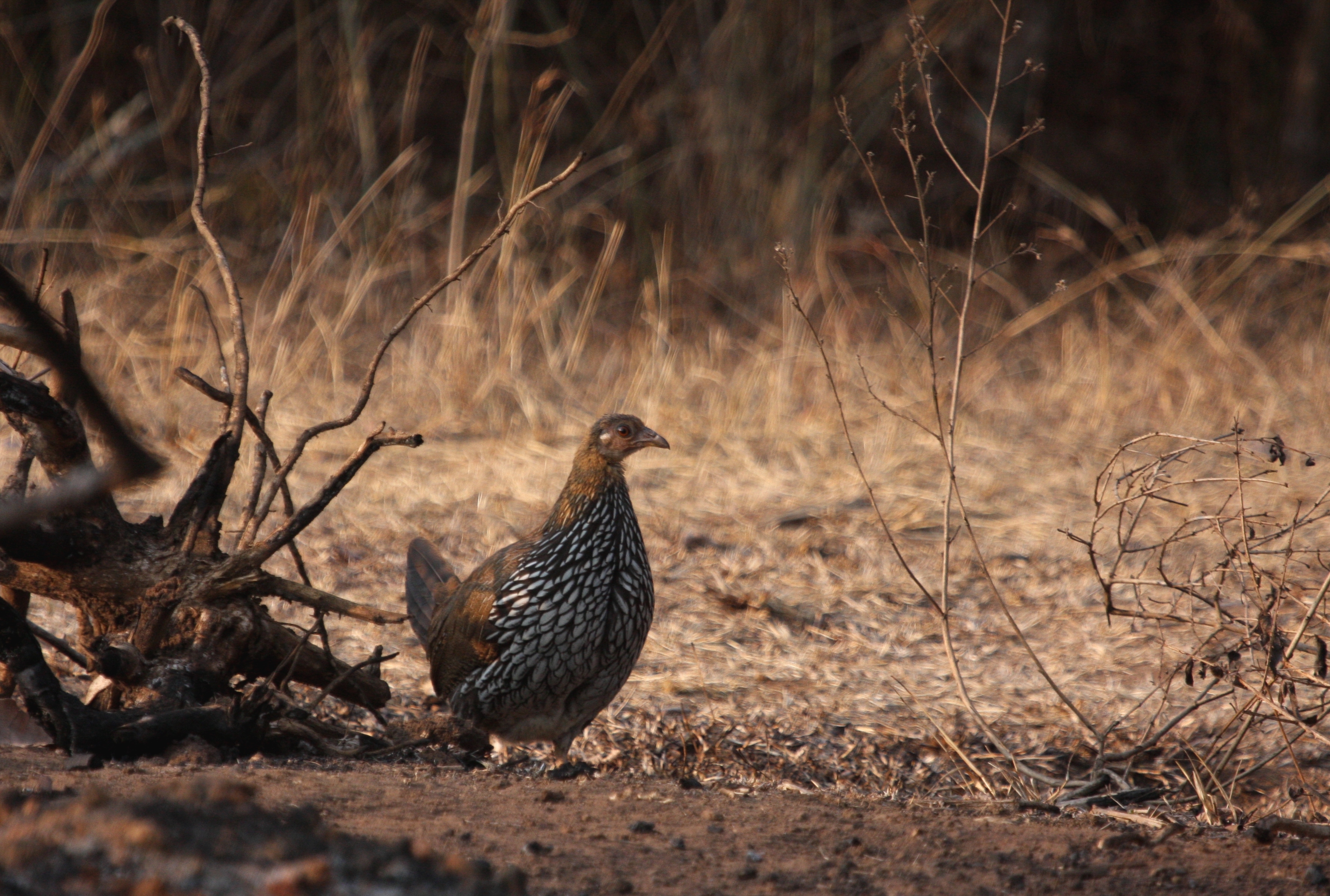
Grey junglefowl, Mr. and Mrs.

Bandipur Mar 14 158

Bandipur Mar 14 422

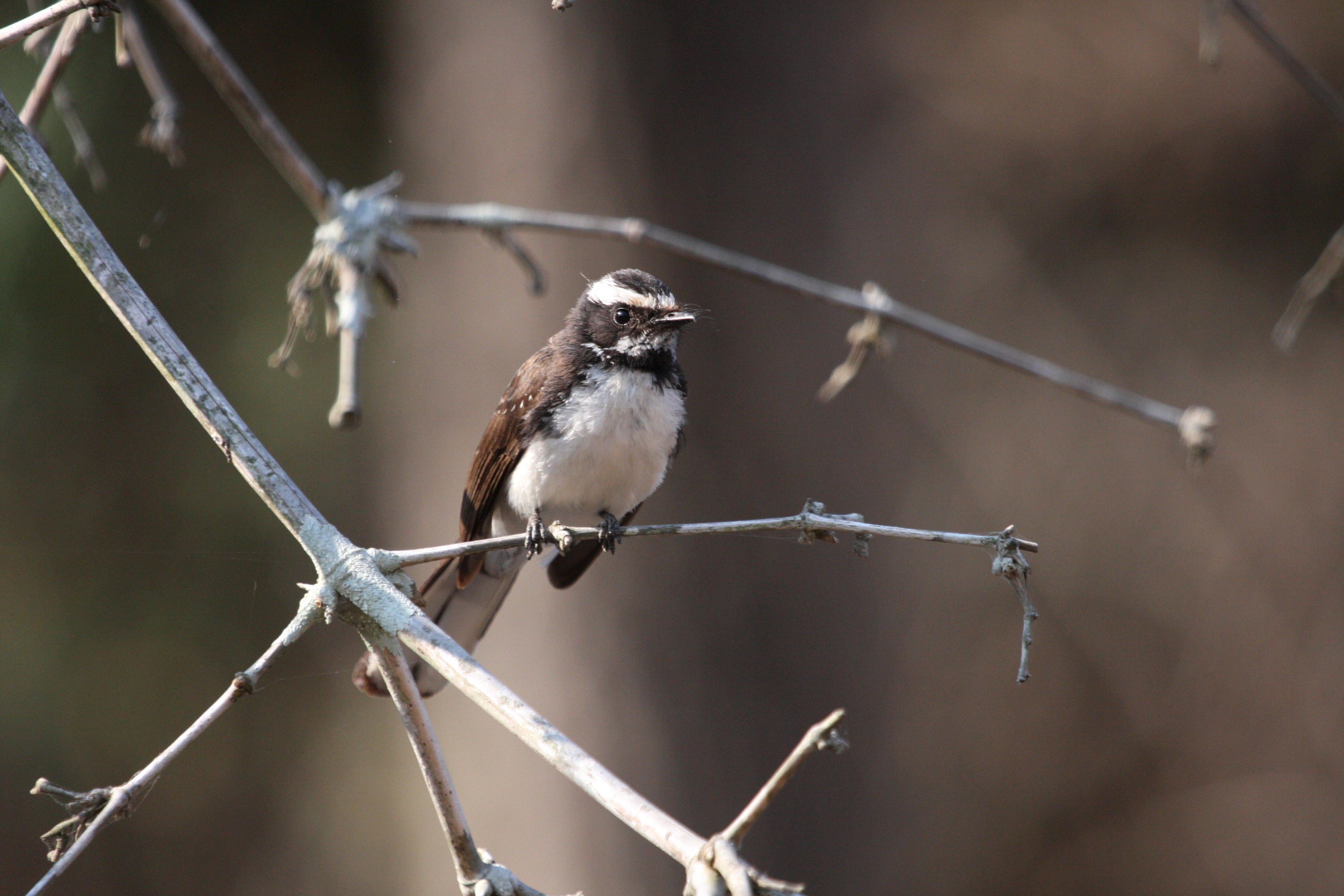
White-browed fantail:

Bandipur Mar 14 212

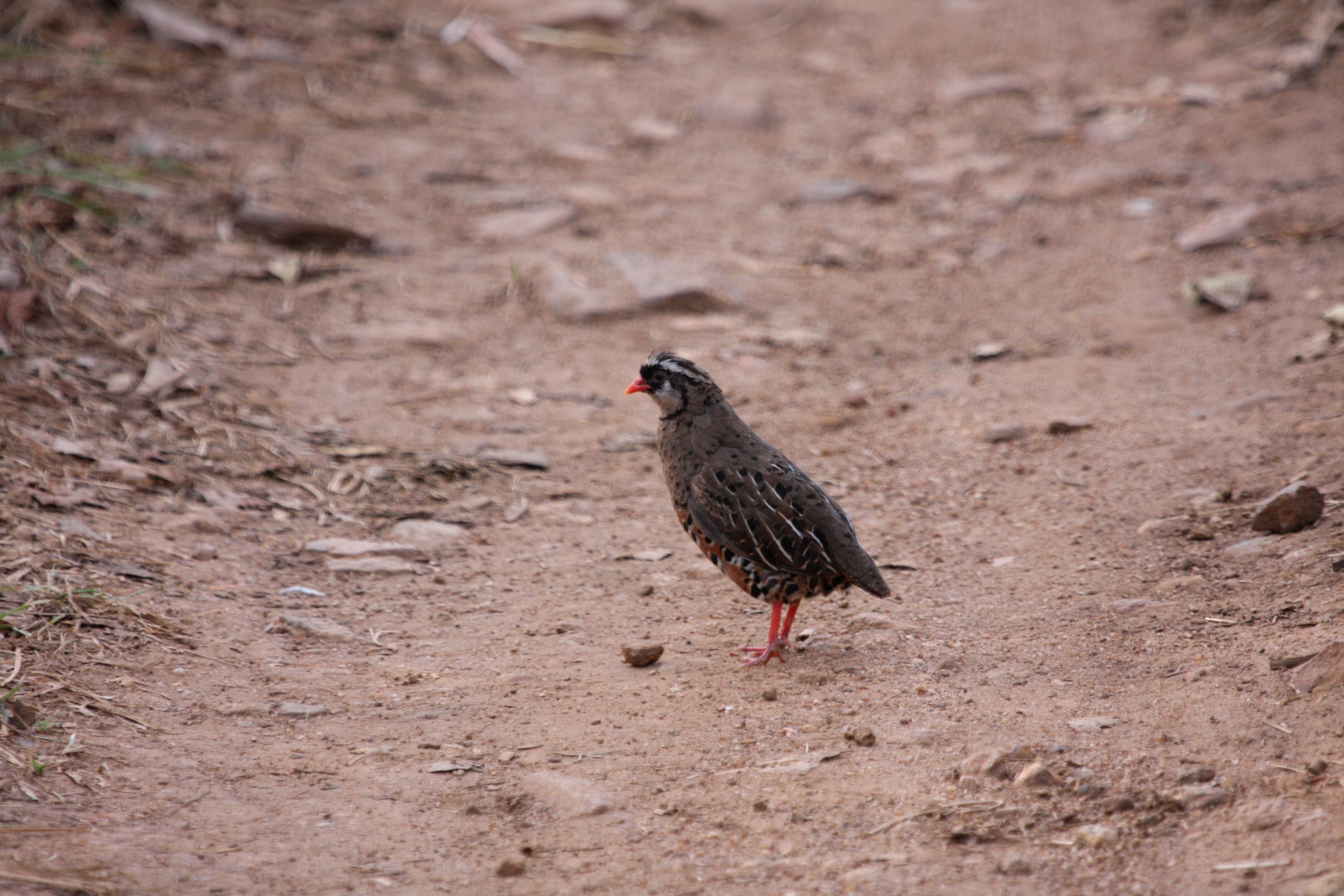
Grey francolin:

Bandipur Mar 14 371

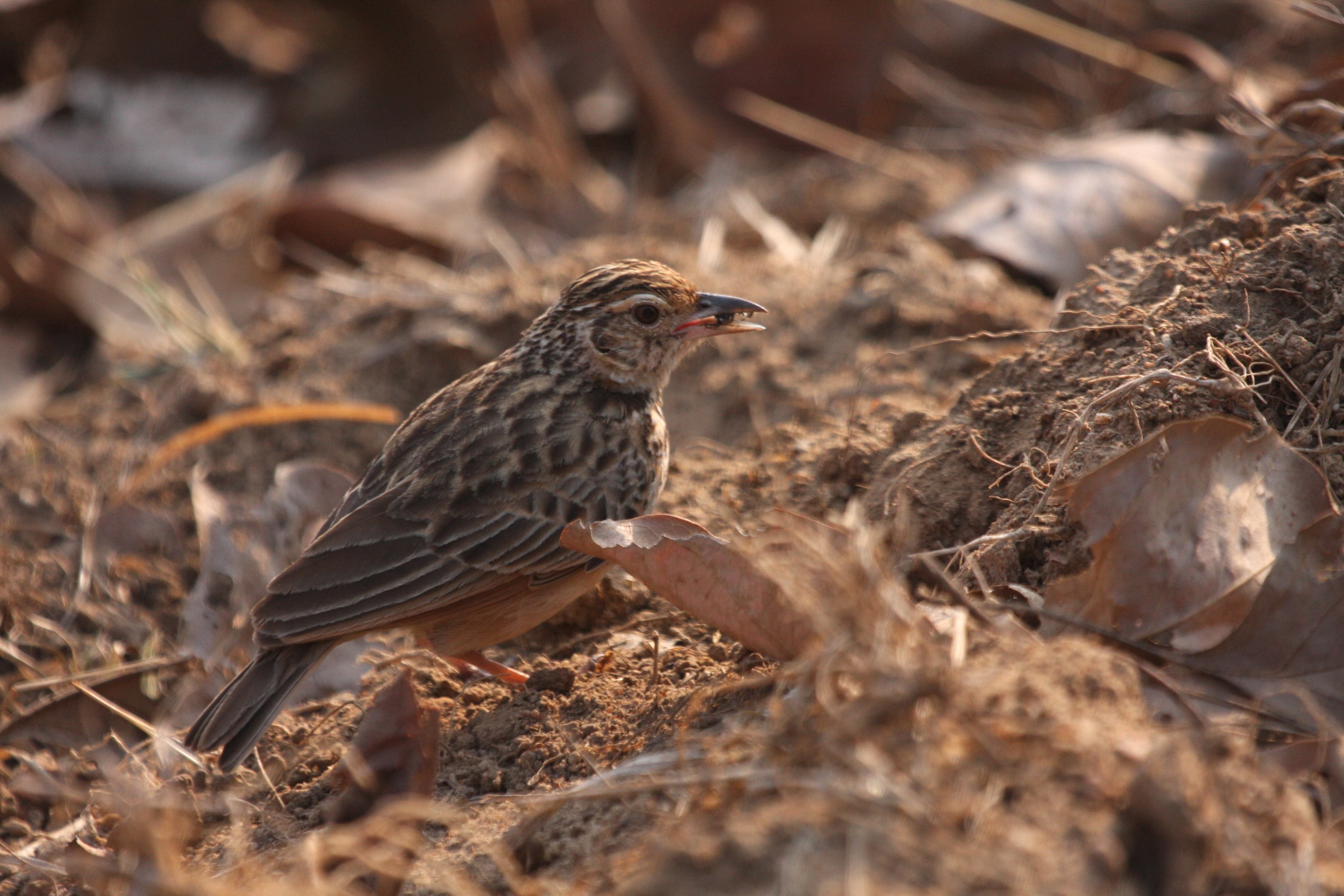
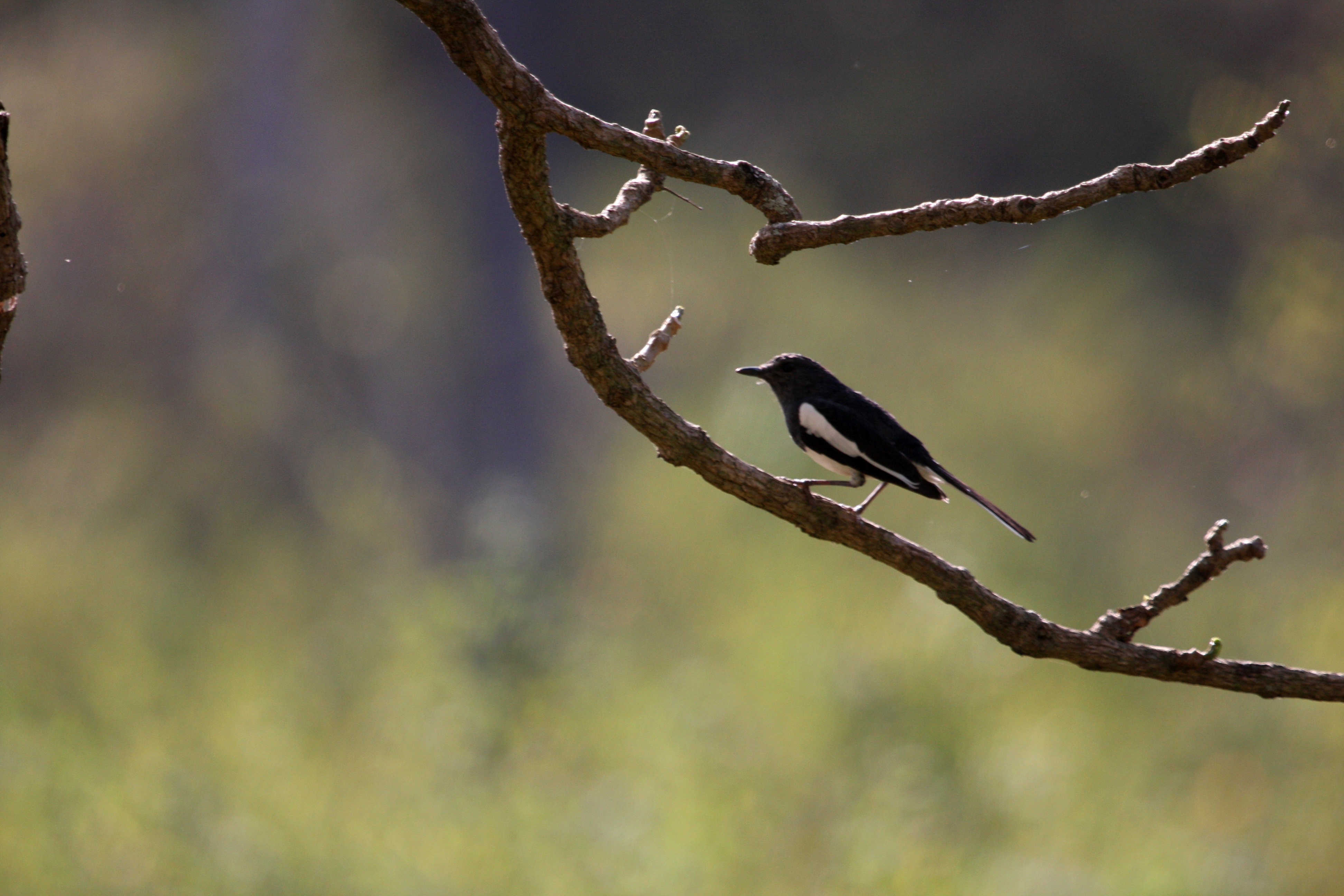
Paddyfield pipit:

Bandipur Mar 14 483

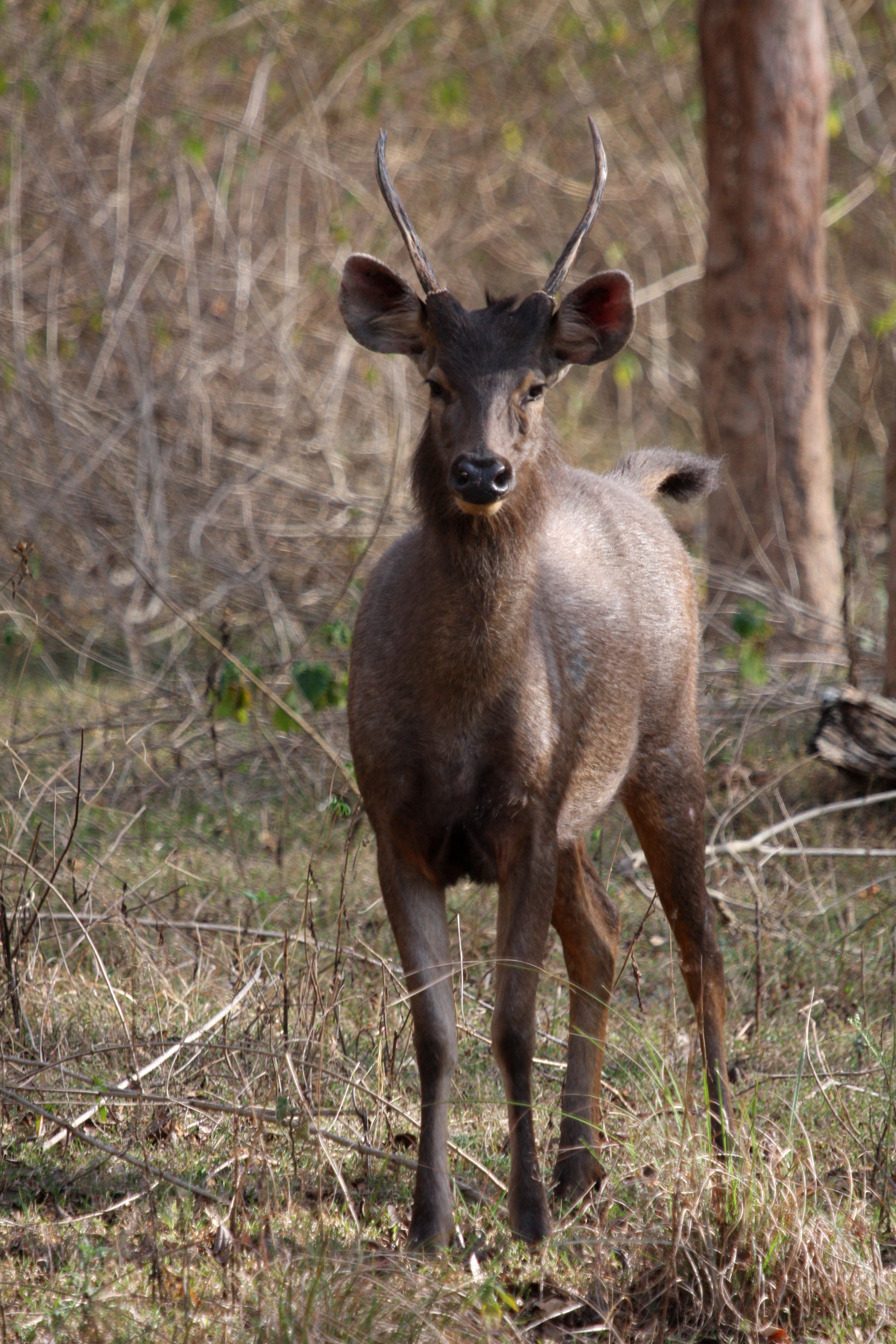
Sambar, note the hairless patch on the neck – this is found in adult males and in pregnant or lactating females, sometimes oozes liquid, and is postulated to be glandular in nature:

Bandipur Mar 14 262

Peek-a-boo:

Bandipur Mar 14 292

Common mongoose on the main road:

Bandipur Mar 14 267

Stripe-necked mongoose, this is the largest species of mongoose in India:

Bandipur Mar 14 092

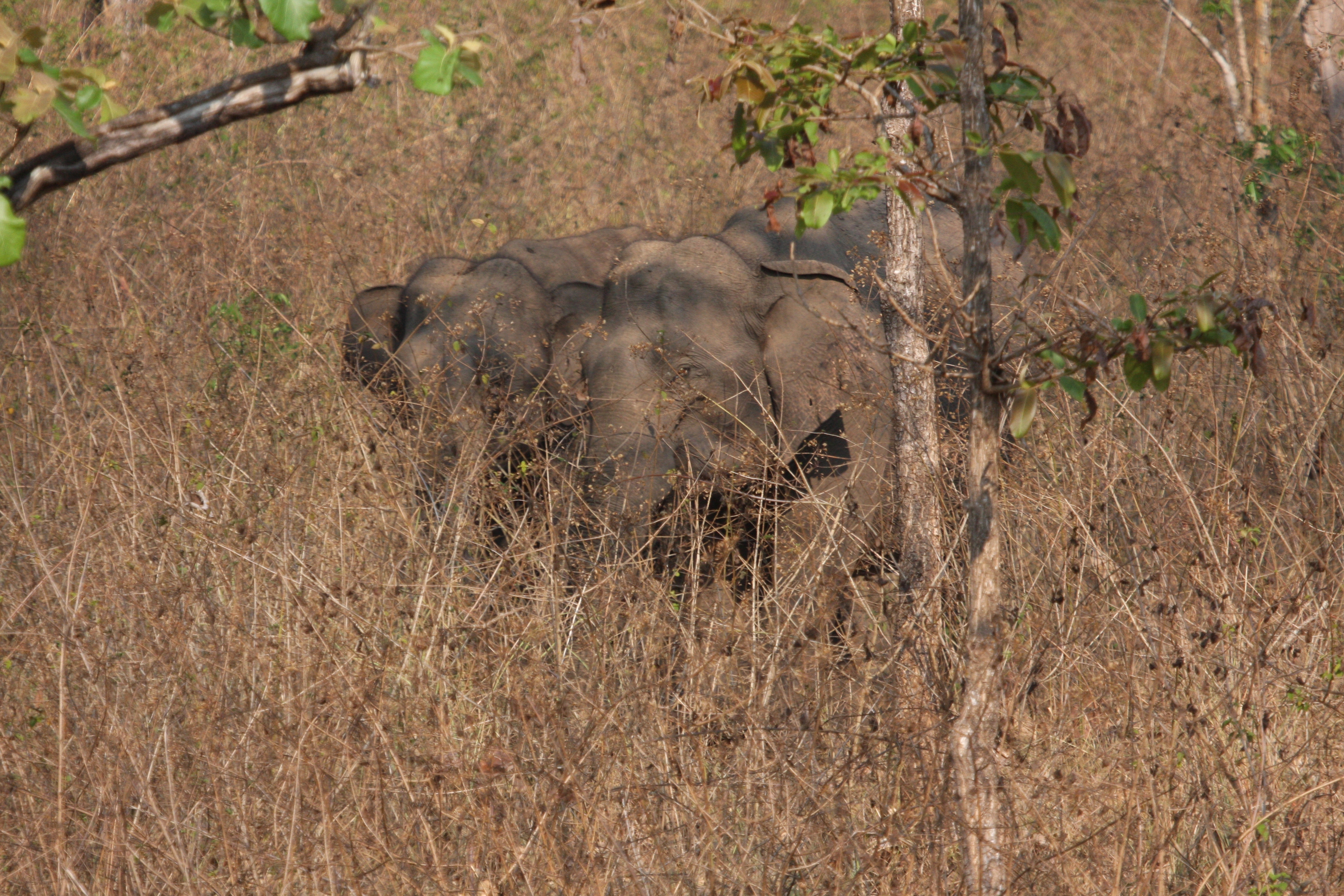
Elephant herd in the grass:

Bandipur Mar 14 512

Unnerved by the presence of the jeep, this nervous matriarch turns to flee:

Bandipur Mar 14 076

Tiger tiger burning bright, pic by Dr. R:

_MG_8803tiger

Here is the complete list of sightings.

Avifauna

1. Asian brown flycatcher

2. Asian koel

3. Ashy drongo

4. Ashy prinia

5. Asian paradise flycatcher

6. Bay-backed shrike

7. Blue-faced malkoha

8. Blyth’s starling

9. Blyth’s reed warbler

10. Brahminy starling

11. Brown fish owl

12. Brown shrike

13. Chestnut shouldered petronias

14. Cinereous tit

15. Common hawk cuckoo

16. Common iora

17. Common kestrel

18. Common myna

19. Coppersmith barbet

20. Coucal

21. Crested serpent eagle

22. Eurasian collared dove

23. Greater flameback

24. Green barbet

25. Grey francolin

26. Grey heron

27. Grey junglefowl

28. Grey wagtail

29. Hoopoe

30. Indian grey hornbill

31. Indian robin

32. Indian treepie

33. Jungle babbler

34. Jungle myna

35. Large cuckooshrike

36. Lesser flameback

37. Little brown dove

38. Little egret

39. Long-tailed shrike

40. Magpie robin

41. Oriental white-eye

42. Paddyfield pipit

43. Pied bushchat

44. Pigmy woodpecker

45. Plum-headed parakeet

46. Purple-rumped sunbird

47. Racket-tailed drongo

48. Red spurfowl

49. Red-vented bulbul

50. Red-wattled lapwing

51. Red-whiskered bulbul

52. Rose-ringed parakeet

53. Shikra

54. Sirkeer malkoha

55. Small green bee-eater

56. Spotted dove

57. Streakthroated woodpecker

58. White-bellied drongo

59. White-browed fantail

60. White-browed wagtail

61. White-headed babbler

62. White-throated kingfisher

63. Yellow-footed green pigeon

Mammals

64. Barking deer

65. Chital

66. Common mongoose

67. Elephant

68. Gaur

69. Malabar giant squirrel

70. Ruddy mongoose

71. Sambar

72. Stripe-necked mongoose

73. Tufted langur

74. Wild boar

75. Tiger

Others

76. Terrapin
Trip report: BRT Tiger Reserve, March 2014

Trip Report:        BRT Tiger Reserve/K Gudi

Dates:               15-17 Mar 2014

Camp:               K. Gudi Wilderness Camp

This was the first of a series of summer trips planned months in advance. I did this trip with a friend VV, and my six year old son. We were perhaps a month too early, as the summer mammal sightings had not yet begun in earnest. However we were compensated by abundant avian winter migrant sightings.

The Biligiri Ranganathaswamy Temple (BRT) Tiger Reserve spreads over 590 sq kms of a mosaic of habitats, ranging from scrub to Shola-evergreen forests.  The reserve comprises five ranges – the eponymous BR temple is in the Yelandur range while the K. Gudi camp falls under the Chamarajanagar range. It lies at the southern border of Karnataka, and is contiguous with the Kollegal FD to its east (which in turn connects with the Cauvery Wildlife Sanctuary further east). The Sathyamangalam Tiger Reserve lies to its south (which in turn is contiguous with the Nilgiri Biosphere Reserve/Mudumalai to its west). The BRT reserve therefore forms a part of the ecological bridge running east-west between the Western and Eastern Ghats.

We stayed two nights at the K. Gudi camp and did four safaris in all. Summer was just beginning to set in and the days were hot and dry, while the temperature plummeted sharply at sun-down leaving the nights mildly chill. Most trees had shed heavily leaving the forest bare. Visibility was nevertheless poor due to lantana thickets crowding in ubiquitous profusion. Common trees were Terminalia elliptica (crocodile bark), Radermachera xylocarpa (maan kombu maram in Tamil), teak on some slopes and plantation areas, and a tree which our driver Rajesh knew the Kannada name of, which we could not identify.

The camp itself was alive with birdlife. Most common were Cinereous tits and Asian brown flycatchers. These two species were pretty much on every other twig. Followed by Orange minivets, Velvet fronted nuthatches, Malabar parakeets, Asian paradise flycatchers, Bronzed drongos, Ashy drongos, Little brown doves and Jungle babblers. The Jacaranda trees in riotous bloom around the reception area had a constant supply of Vernal hanging parrots on them. Black hooded orioles called frequently though we sighted just one individual. We also sighted a Gold fronted leaf bird, a Pigmy woodpecker, a Large cuckooshrike, Grey wagtails, Magpie robins and Indian treepies, apart from Sambar. I’m not counting the chital and wild pigs which are always to be found in the camp. Nor the semi-domesticated blackbuck doe with the Dr. Jekyll-and-Mr. Hyde personality; it toggled between begging for food and belligerent head-butting.

K. Gudi was the first JLR property I visited (over ten years back). Around the turn of the millennium, we were in the habit of visiting K. Gudi almost once every quarter for a couple of years. Memories of being driven out on safari by Thapa  – one of the best spotters you can ever find – and numerous exciting incidents are fresh in my memory. I find I can still recognize the spots where some of those incidents happened.

The four safaris were largely centred around birding, considering that not too much showed up by way of  megafauna, charismatic or otherwise. I was especially disappointed not to see any elephants. For me, elephant sightings carry the same thrill as sighting large carnivora.

Most abundant in the forest were three types of drongos (Bronzed, Ashy and White-bellied), Magpie robins, Malabar parakeets, Lesser flamebacks, Indian blackbirds, Bulbuls (both Red-whiskered and Red-vented),  Jungle mynas, Hill mynas, Asian paradise flycatchers, Blue capped rock thrushes,  Hoopoes, Jungle babblers and Indian treepies. Fairly common also were Common hawk cuckoos, Orange headed thrushes, Indian pittas, Ashy woodswallows and Grey junglefowl.

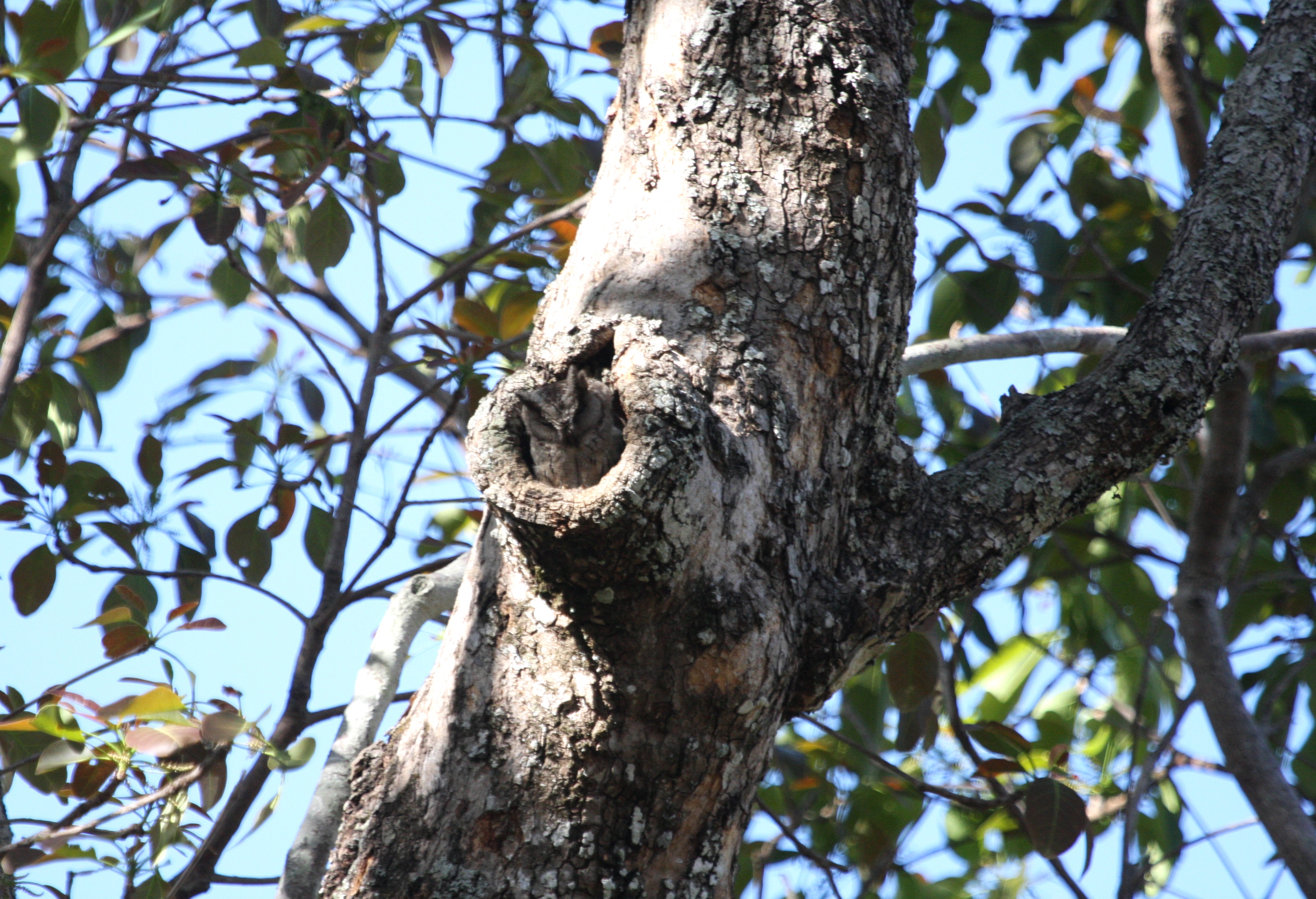
We had multiple sightings of a Brown fish owl by the same kere. On the way to the safari and a short way from the camp, an Indian scops owl roosted in a burrow high up – we looked for it each time we passed and sighted it twice. And on the way back to camp, a Racket tailed drongo consistently showed up at one spot. For that matter, the pitta turned up in the same place for multiple sightings, as did one particular Asian paradise flycatcher individual. Incidentally, VV and I had some discussion around differentiating juvenile and female Asian paradise flycatchers in the field. Both are rufous and broadly similar looking, but the juvenile male has a jet black throat, and a blue eye-ring. The female has a paler throat and lacks the eye-ring.

Two encounters with atypical individuals happened in the first safari. The first one concerned a sambar stag. We sighted it beside the track and halted. The stag was frozen immobile and alert, watching us. We inched forward in spurts getting closer and closer, and it didn’t move a muscle. Finally when we were practically beside it, its nerve gave way and stamping its foreleg as sambar are wont to do when spooked, it honked in alarm, the sudden loud calls resonating in the quiet of the jungle. Another unseen individual in lantana thickets just beyond was unnerved by these calls and gave alarm too. The herd of three finally disappeared, crashing through the undergrowth.

The second concerned a Grey junglefowl cock that effectively blocked the road, showing little sign of fear at the sight of the jeep. We were forced to tail it slowly for a distance before it stepped off the road and made way.

On day two post breakfast, we drove down the highway towards the south, turning back shortly before the Navodaya checkpost. Chital were calling in alarm at a waterhole a little before this checkpost. We waited for a while, but nothing emerged and the calls presently subsided. Incidentally, a male tiger was sighted on this stretch at 8:30 AM the previous morning by a batch of pilgrims. Elephant encounters are also apparently a daily occurrence here and a little beyond the K Gudi camp, a pack of dhole had been sighted the previous day. However our luck was limited to Malabar parakeets, a Yellow-capped woodpecker, a pair of Orange minivets, a Jungle owlet, Bay-backed shrikes and Tufted langurs,

We then drove back and past the camp, all the way north, turning back a little before the eponymous BR temple. This section of the forest is heavily disturbed, with plenty of traffic, grazing cattle and settlements and is not particularly pleasurable to drive through for this reason.

Here is a full list of the sightings:

Avifauna

  1. Ashy drongo
  2. Ashy woodswallow
  3. Asian blue fairybird
  4. Asian brown flycatcher
  5. Asian paradise flycatcher
  6. Bay backed shrike
  7. Black hooded oriole
  8. Blue bearded bee eater
  9. Blue capped rock thrush
  10. Bronzed drongo
  11. Brown fish owl
  12. Cinereous tit
  13. Common hawk cuckoo
  14. Common rosefinch
  15. Coppersmith barbet (calls only)
  16. Coucal
  17. Gold fronted leaf bird
  18. Greater flameback
  19. Greater racket tailed drongo
  20. Green barbet
  21. Grey junglefowl
  22. Grey wagtail
  23. Hill myna
  24. Hoopoe
  25. Indian blackbird
  26. Indian Pitta
  27. Indian Scops owl
  28. Indian treepie
  29. Jungle babbler
  30. Jungle myna
  31. Jungle owlet
  32. Large cuckooshrike
  33. Lesser flameback
  34. Little brown dove
  35. Magpie robin
  36. Malabar parakeet
  37. Malabar whistling thrush
  38. Orange headed thrush
  39. Orange minivet
  40. Painted bush quail
  41. Pigmy woodpecker
  42. Pipit (species not recognized)
  43. Red spurfowl
  44. Red vented bulbul
  45. Red whiskered bulbul
  46. Rufous babbler
  47. Spotted dove
  48. Streak throated woodpecker
  49. Tickell’s blue flycatcher
  50. Tricoloured munia
  51. Velvet fronted nuthatch
  52. Vernal hanging parrot
  53. White-bellied drongo
  54. White-throated kingfisher
  55. Yellow capped woodpecker

Mammals

  1. Barking deer
  2. Bonnet macaque
  3. Chital
  4. Gaur
  5. Malabar giant squirrel
  6. Sambar
  7. Stripe-necked mongoose
  8. Three-striped palm squirrel
  9. Tufted langur

Here are some random pictures:

Magpie robin:

BR Hills Mar 14 008

Painted bush quail:

BR Hills Mar 14 016

Jungle myna:

BR Hills Mar 14 030

Sambar:

BR Hills Mar 14 093

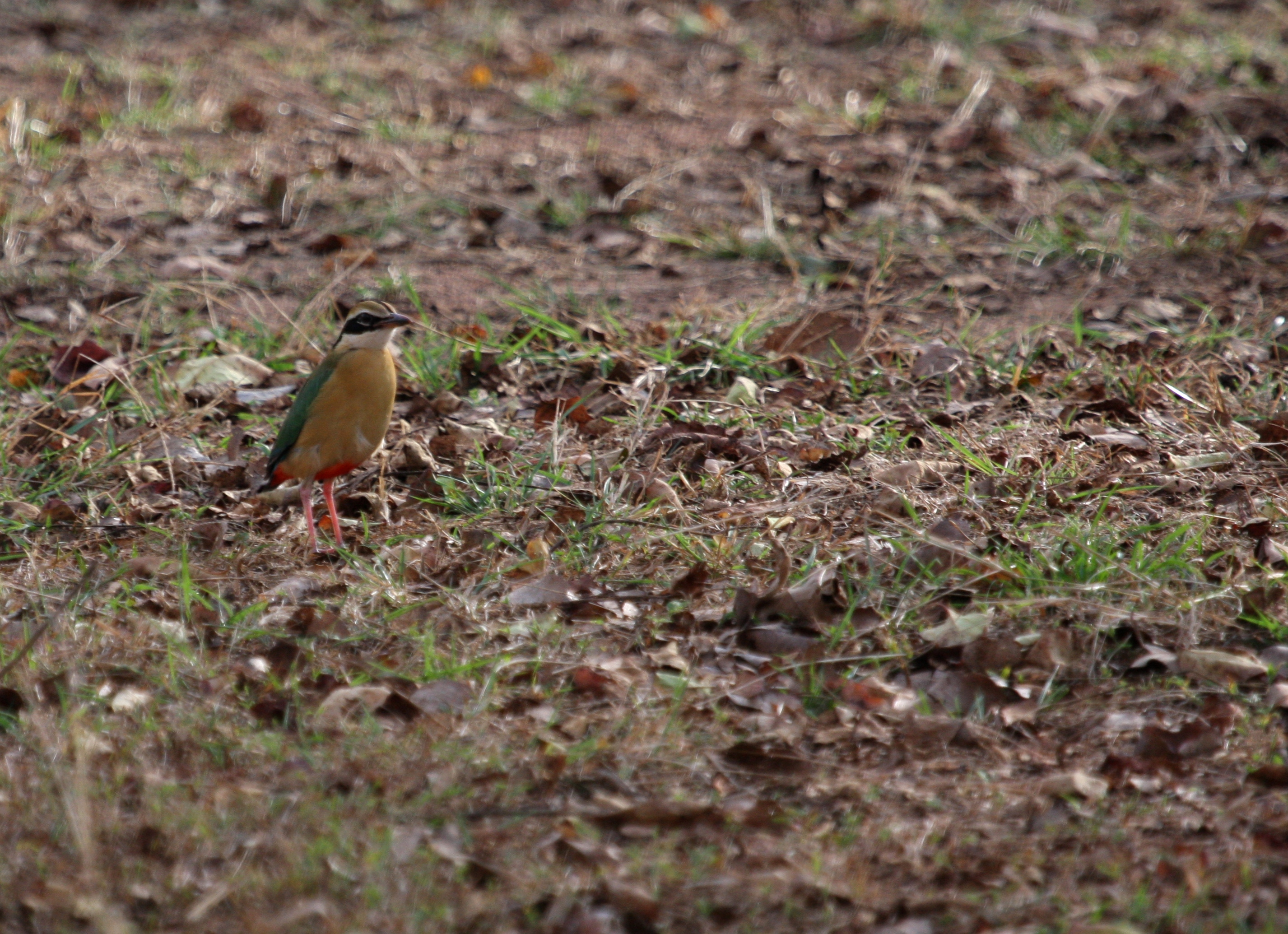
Indian pitta:

BR Hills Mar 14 150

Blue bearded bee eater

BR Hills Mar 14 218

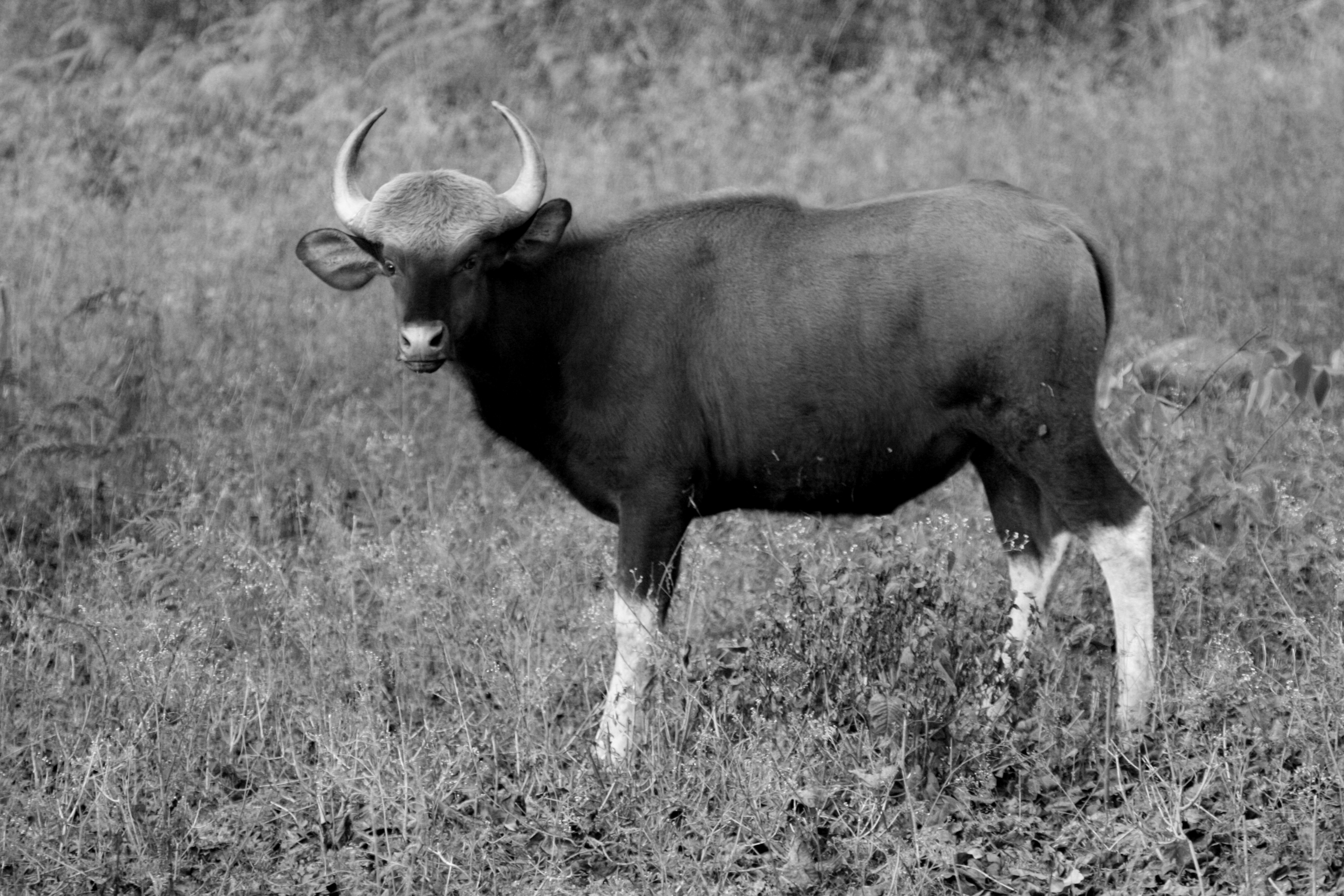
Gaur:

BR Hills Mar 14 229

Barking deer:

BR Hills Mar 14 321

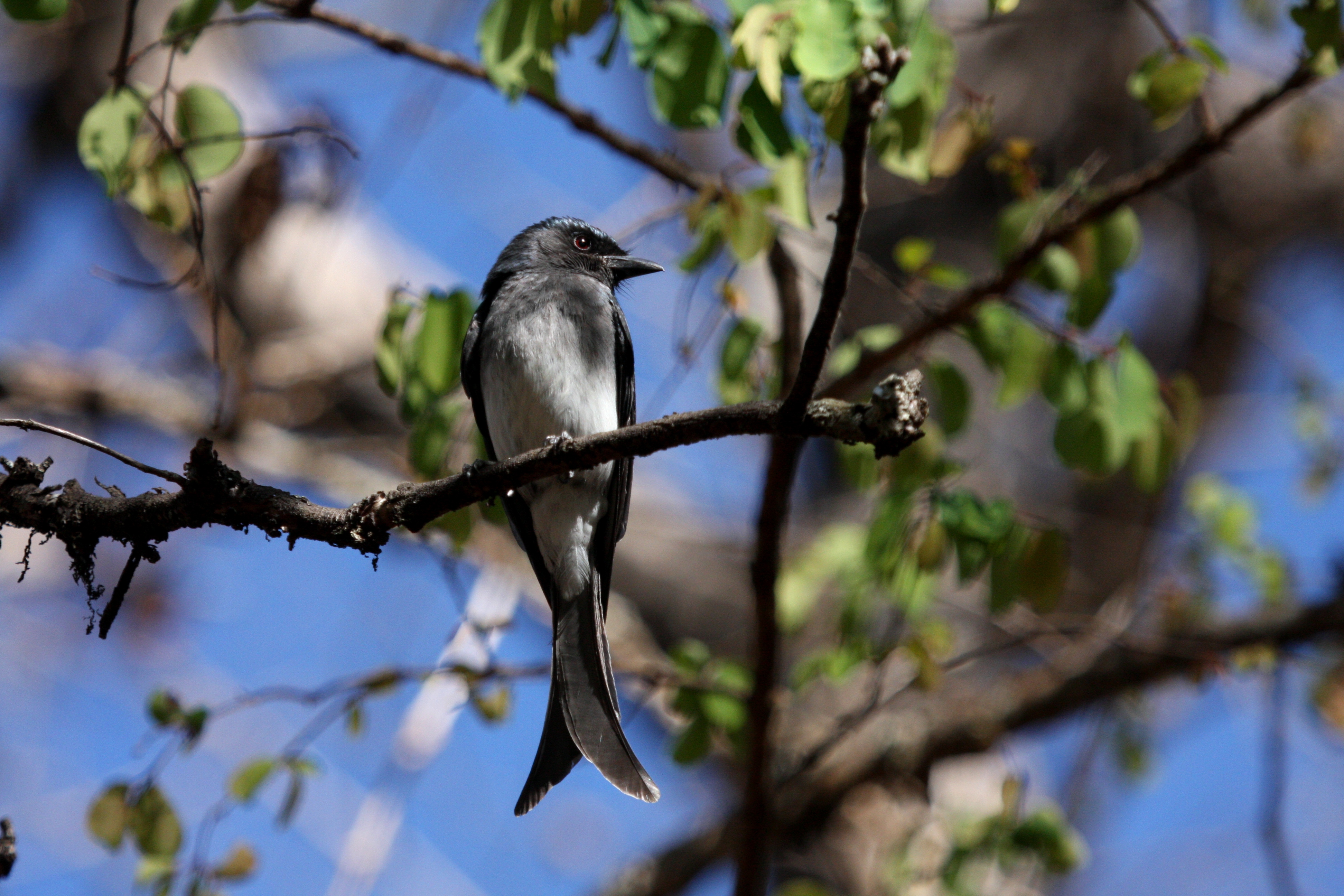
White-bellied Drongo:

BR Hills Mar 14 368

Indian Scops owl:

BR Hills Mar 14 484

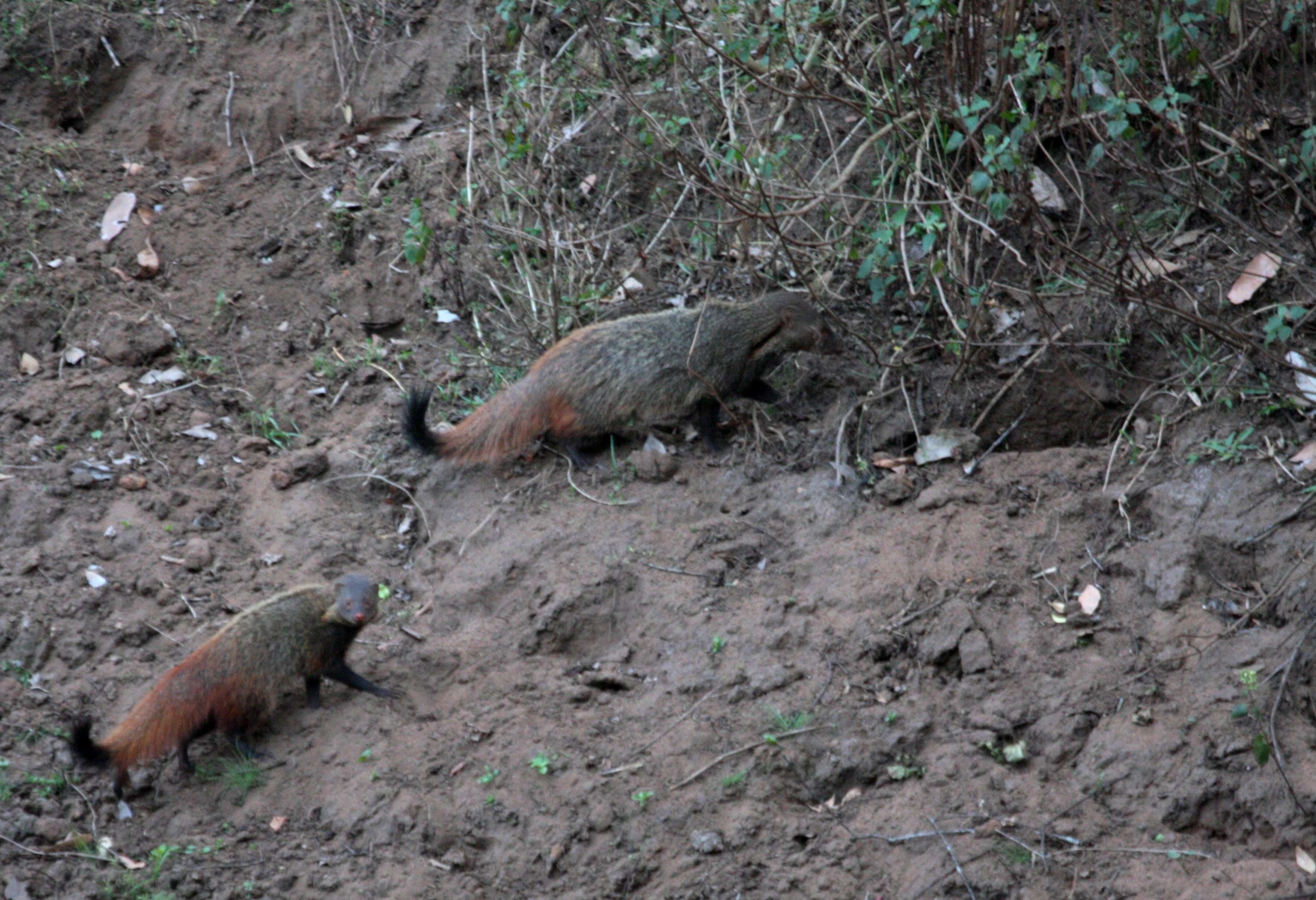
Stripe-necked mongoose:

BR Hills Mar 14 519

Giant crab spider, a pair of these graced the loo:

spider

“Biligiri”, the last log hut in its row, abuts the jungle and is reputed to offer tiger and leopard sightings if you are lucky:

biligiri

Trip Report: Tadoba Andhari Tiger Reserve, Dec 2013

Trip Report:        Tadoba Andhari Tiger Reserve (TATR)

Dates:                   21-23 Dec 2013

Camp:                   Svasara Jungle Lodge

As I start typing this post, we’re just about to leave for Nagpur. It is 2 PM and the flight back to Bangalore is at 8 PM. Nagpur is some 100 kms away, and we’ll have time to kill at the airport. Meanwhile, there’s a long-tailed shrike brooding on a perch that a green bee-eater habitually sallies from. A large flock of chestnut shouldered petronias skulks in a bush a little to the right. A pair of little brown doves, and a pair of sparrows are starting to nest in two tiny ficus shrubs on the lawn outside. There’s a pair of red vented bulbuls that haunts a bamboo thicket a little to the left. And finally, there’s a tailor bird that is a very occasional visitor to the shrubbery. These are the regular habitués around my room in the Svasara Jungle Lodge. Not an unpleasant place to stay in at all.

TATR

Not that we’ve had much time to keep track of the local avifauna. It’s been a hectic three days. We did four safaris in all, but the remarkable thing about TATR is the time allowance. The morning safari starts at 6:30 AM and goes on until 11:30 AM. Back for a quick lunch at noon and barely enough time for a battery recharge (cameras’, not ours), and off again for the second safari which starts at 2 PM (gate opening time) and goes on until 6 PM. So five hours in the morning and four hours in the afternoon. Nine hours of safari time each day, with little time for anything else. It is rather tiring.

TATR is 650 sq kms of dry deciduous forest, and a dry, warm place. Even in December the days are sultry, though evenings and especially mornings are cold. The teak trees are shedding prodigiously, and the ground in many places is carpeted with the large rotting leaves. Many of the Mahua trees are bare, as are the Indian ghost trees (in pic below). Crocodile bark and tendu trees still retain their green, as do the jamun trees by the waterlines. After having read about the place lacking the magnificence of Kanha or Corbett, I guess my expectations had been tempered down significantly; Happily, the forest seemed pretty enough in compensation. And the safaris are very productive.

Image

The safaris

We did four safaris in all. Svasara Jungle Lodge is sited a couple of hundred meters from the Kolara gate, which in turn is on the north-eastern periphery of TATR. This gate opens into the Tadoba range. Three of our four safaris were limited to the Tadoba range. For our second safari (yesterday AM) alone, we passed through the Tadoba range to reach the Katoda gate, and thereon into Andhari (Moharli range).

The first safari was an evening one. A short while into it, we sighted a ratel – Mellivora capensis. None of us had ever seen one before, and we were elated. We then reached Panderpauni, with its pretty little lake and vast meadows teeming with chital, langur and wild boar. Tree swifts in large numbers hawked insects on the wing. There was quite a bit of birdlife in the waterhole.

A short distance from Panderpauni, on the way to Tadoba lake, we ran into a bunch of Gypsies clustered at a crossroads. One of them had spotted a tigress disappearing into the underbrush. The Gypsies hung around with hopes of the tigress re-emerging for a while, but eventually people started giving up and moving on. Around six Gypsies stayed on, and our patience was finally rewarded. Someone spotted a movement at the far end of the arrow-straight road to our left. Turned out to be P2, a four-year old tigress in fine fettle. She strode down the road unmindful of the cluster of Gypsies, skirted right around us, and ambled into the one road where entry was forbidden. Some of the Gypsies scrambled to loop back for another interception, but the tigress had other ideas. She stepped off the road, into the thickets and disappeared. But P2 was not done with us. In the three remaining safaris, we experienced close encounters with her twice more.

Image

Tadoba lake is a large natural reservoir, with flocks of lesser whistling ducks lining its banks, interspersed with the occasional basking croc. Black headed ibis call noisily from a heronry on the opposite bank. On all visits to this lake, we looked for but failed to spot the grey headed fish eagle and the brown fish owl that were reputed to haunt its banks. Nearby is the little shrine dedicated to the eponymous Gond diety Tadoba or Taru (which is apparently out of bounds to tourists). From here we took the chital road to the Jamunbodi loop, where we spotted a sloth bear about fifty feet off the road – in the late afternoon atypically, and well before sunset.

Image

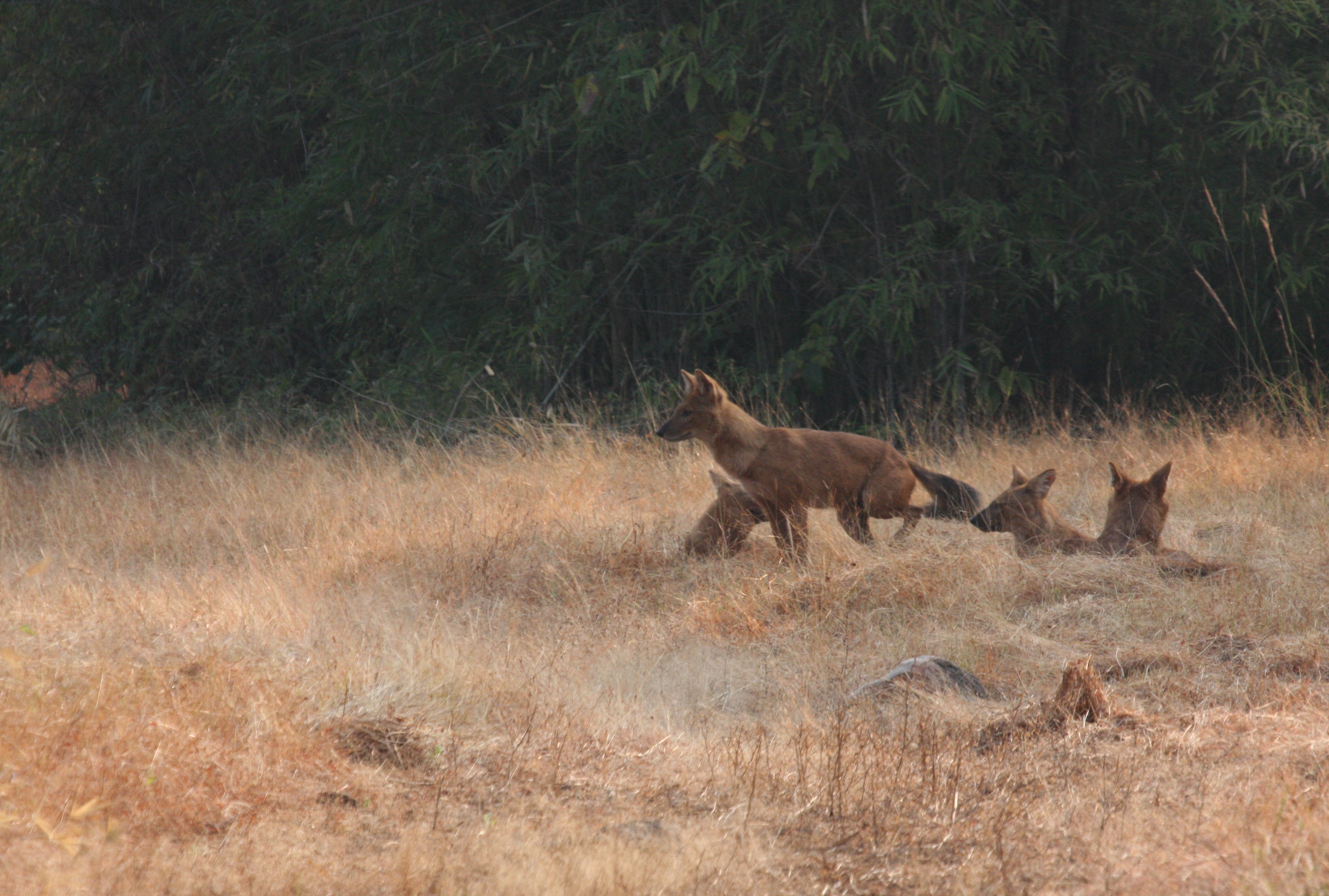
On day two we covered the Moharli range. On the Tadoba-Moharli tar road, we stopped by a pack of five dhole cavorting by the roadside. They appeared relaxed, stretching, rolling in the grass and frisking around as these creatures are wont to do, but when a couple more Gypsies piled in, they withdrew a short distance away. We proceeded to the Katoda checkpost (which delineates the Tadoba and Moharli ranges) for a breakfast break, and by the time we were done and resuming our way to Telia lake, they had brought down a chital just beyond the checkpost. The kill lay in high grass, and little could be seen beyond one or the other dog’s head bobbing above the stalks as it dipped into breakfast.

Image

The area around Telia lake on the Jamunjhora loop presents picturesque dark bamboo forests. Thirty percent of Tadoba’s greenery comprises bamboo and there is bamboo everywhere, but Jamunjhora has especially heavy growth.

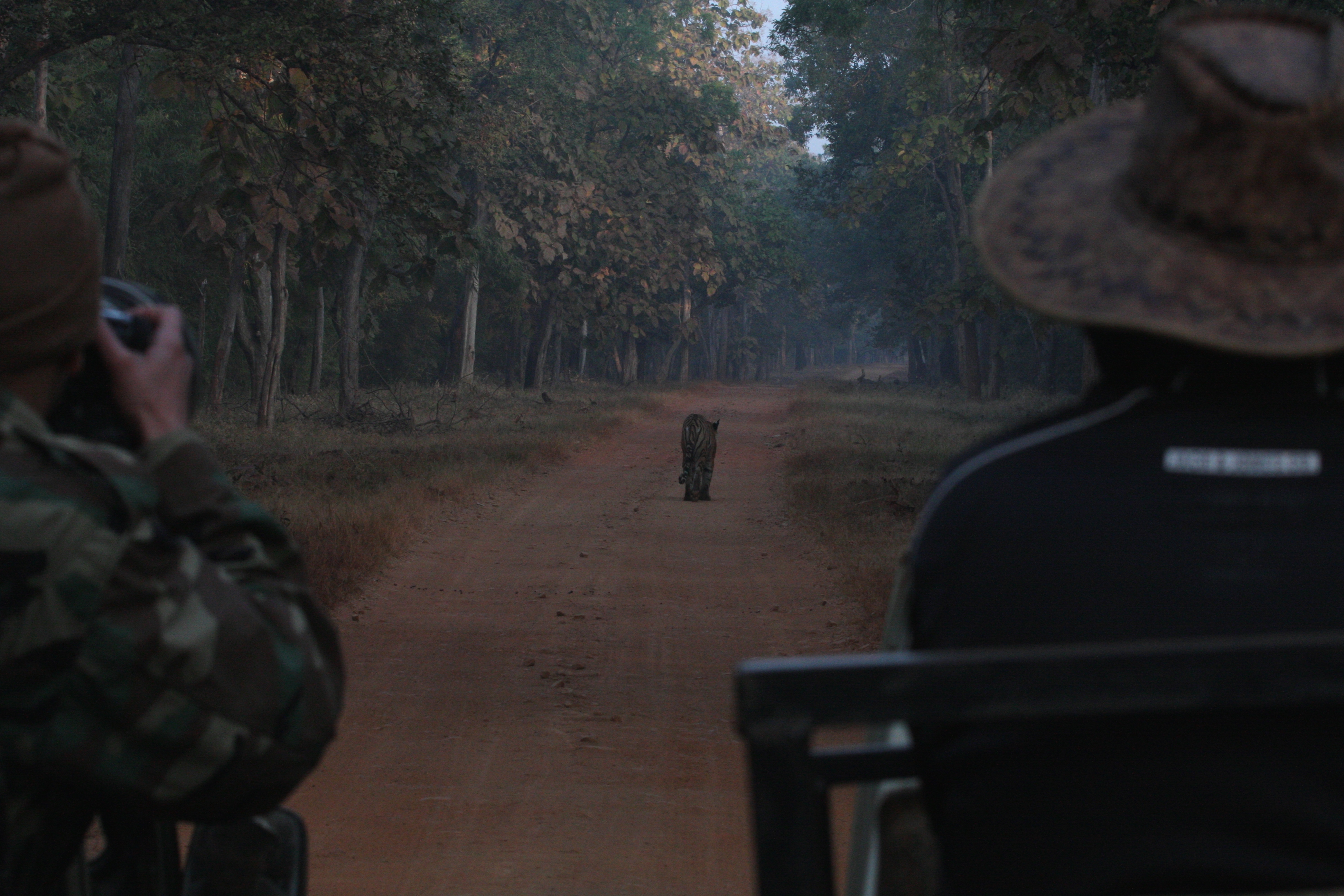
The third safari (evening) was a quiet one, with much of the time spent on birdlife, but in the last half hour, we ran into P2 again, on another arrow-straight road. This time she walked towards us, with one Gypsy ahead of, and three vehicles tailing her. Since among the occupants of these vehicles were the field director and the ranger, we were waved off the road. She marched past our Gypsy and away down the road, completely ignoring everyone around.

Image

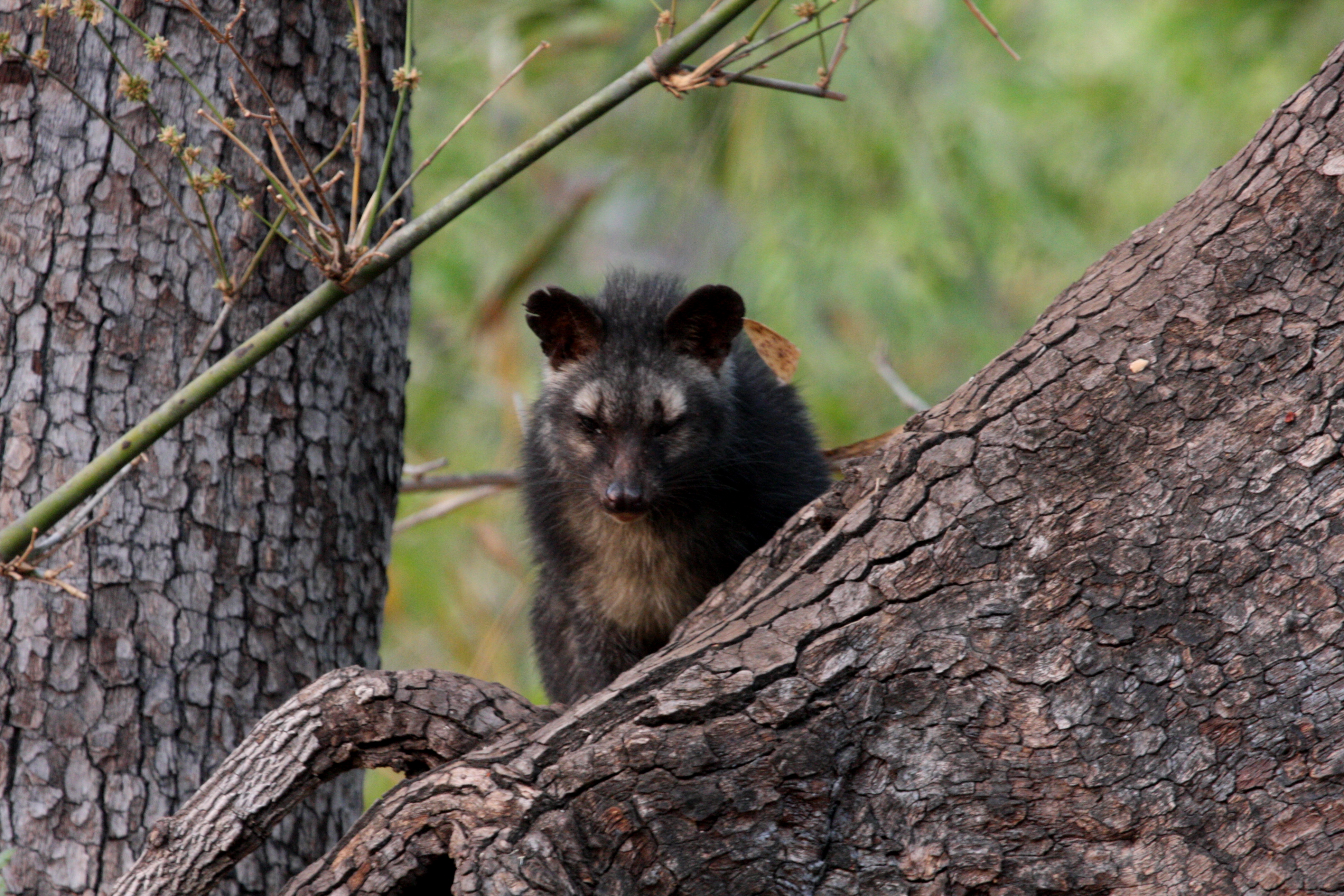
On the way back, we found an Asian palm civet on a bole a few feet from the ground (I had earlier described this as a small Indian civet, but S. Karthikeyan  noticed and was kind enough to point this out). Being a little too early in the civet’s day, it was evidently groggy; at any rate, it did nothing for a long while, sitting with somnolent eyes while we sat and watched it. It finally roused itself to do something about all the attention and clambered up the bole and out of sight.

Image

The last day’s safari was a morning one. We had covered pretty much all the local megafaunal attractions barring the nilgai and the leopard. Navegaon is a village on the northern periphery that has been relocated out in the past six months.  As in Kanha, the sites of relocated villages serve as excellent grassland habitats, supporting a healthy ungulate population. So off we went to Navegaon, looking for nilgai and birds. On the road from Panderpauni to Navegaon, who should we run into but P2. It started off with chital alarm calls. We had stopped over at the Panderpauni waterhole to check on the birdlife when calls started from the other side of the lake. We took the road that loops around the lake and stopped over on another side of the water. A brief flash of stripes, and it was another hurtling ride further down the road to try and intercept her. P2 finally emerged and did her thing – the walk on the road unmindful of the gawking audience. She walked towards us, past us and then away, and two columns of Gypsies, perhaps twelve to fifteen in all tailed her at walking pace. The tigress sauntered along unconcerned, stopping by select trees to mark her scent. This went on for the next fifteen minutes, until she turned off the road and disappeared. The Gypsy mobbing phenomenon of the popular tiger reserve is undoubtedly unseemly and downright ugly, but I’m not sure what exactly should be done about it. And Tadoba is undeniably tiger-centric. Guides and drivers do not expect tourists to come looking for much else, and at times it almost feels like they have difficulty mentally processing asks for lesser creatures.

Image

Having touched on the topic of relocated villages, I should not omit to mention Jamni, which is the first landmark after entering from the Kolara gate. The village is in the process of being relocated, and appears largely deserted. The recently harvested paddy fields around boast of a high incidence of tiger sightings – with the beats of two tigresses P1 and P2 cleaving across this area.

Anyway, we did eventually get to Navegaon, and we did see all the nilgai we could have wished for. And a few herds of gaur thrown in to boot. And plenty of birdlife.

Image

Image

I was hoping to meet the couple that has been doing splendid conservation work in Tadoba – Harshawardhan and Poonam Dhanwatey (their organization is called TRACT – Tiger Research and Conservation Trust) – but this privilege will have to wait for the next trip.

The list

Here’s the full list of sightings from three remarkable days:

Avifauna

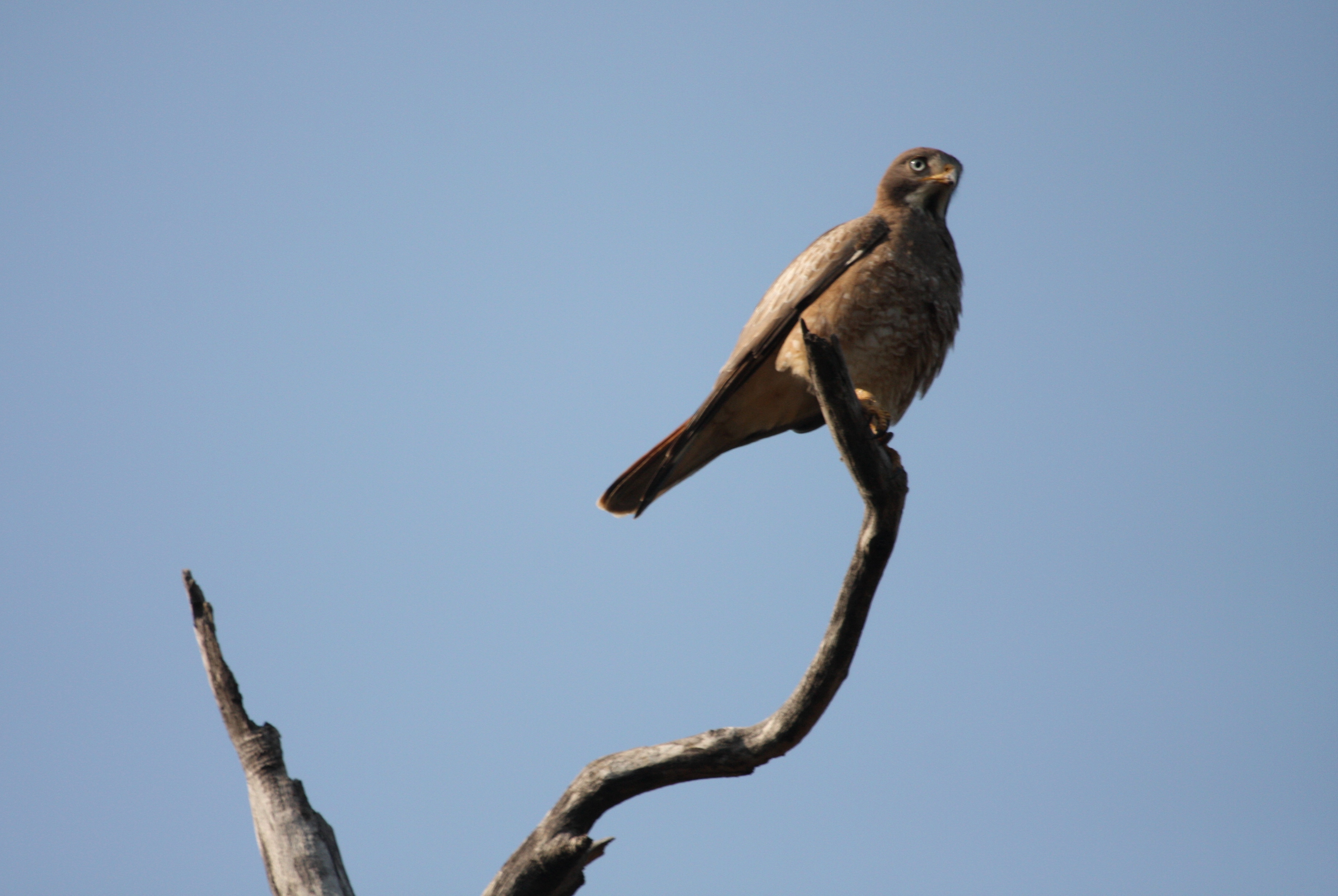
  1. White eyed buzzard (fairly frequent sightings)
  2. Sirkeer Malkoha
  3. Common pochard
  4. Lesser whistling duck (plenty of them)
  5. Black headed oriole
  6. Indian treepie (everywhere)
  7. Crested serpent eagle
  8. Orange headed thrush
  9. Plum headed parakeet
  10. Rose ringed parakeet
  11. Tickell’s blue flycatcher
  12. Tree swift
  13. Black drongo
  14. Brahminy starling
  15. White wagtail
  16. White browed wagtail
  17. Red wattled lapwing
  18. Common myna
  19. House sparrow
  20. Asian koel
  21. White browed bulbul
  22. Yellow footed green pigeon
  23. White breasted waterhen
  24. White throated kingfisher
  25. Purple heron
  26. Grey heron
  27. Peafowl
  28. Longtailed shrike (plenty of them, especially outside the reserve)
  29. Pond heron
  30. Common sandpiper
  31. Shikra
  32. Coucal
  33. Chestnut shouldered petronias
  34. Spotted dove
  35. Little brown dove
  36. Eurasian collared dove
  37. Pied bushchat
  38. Leaf warbler
  39. Black redstart (female)
  40. Indian robin
  41. Magpie robin
  42. Black shouldered kite
  43. Plain prinia
  44. Tailor bird
  45. Black headed ibis
  46. Asian open billed stork
  47. Black ibis
  48. Egrets
  49. Indian roller
  50. Jungle babbler
  51. Lesser flameback
  52. Green bee eater
  53. Grey junglefowl (calls only)

Mammals

  1. Ratel/Honey badger
  2. Panthera tigris (3 of 4 safaris, few feet away each time)
  3. Ruddy mongoose (couple of comfortable sightings)
  4. Sambar
  5. Sloth bear
  6. Barking deer (couple of close sightings, quite unmindful of us)
  7. Wild dog/Dhole
  8. Asian palm civet
  9. Nilgai
  10. Gaur
  11. Wild boar
  12. Chital
  13. Common langur

Others

  1. Mugger
  2. Olive keelback (at the resort, rescued with injuries)

Tadoba 555

Image