Trip report: Thattekad, Nov ’14

Trip:       Thattekad

Camp:   Periyar River Lodge

Dates:   14-16 Nov ‘14

Who:     GiK

This trip was originally put together for GK, GiK and SS. GK’s wife wasn’t feeling very well and SS had to travel urgently on business to Laos, and so GiK and I ended up doing the trip by ourselves. I did two nights at Thattekad for the first time and this was the best of the three trips I’ve done so far.

The weather was muggy with the threat of rain every evening. On the day we landed (Fri), Mr. Luigi, the amiable manager of PRL spoke to Gireesh Chandran and was told that considering the weather, the afternoon’s birding plan was off and we’d meet the next morning. There was a steady drizzle and we had the afternoon to ourselves. We spent a couple of hours swimming in the river – in fact we spent a couple of hours everyday swimming in the river. The current was languid and the water was cool, making for a perfect wallow. The PRL boat was docked there, and we took turns diving off the gunwale.

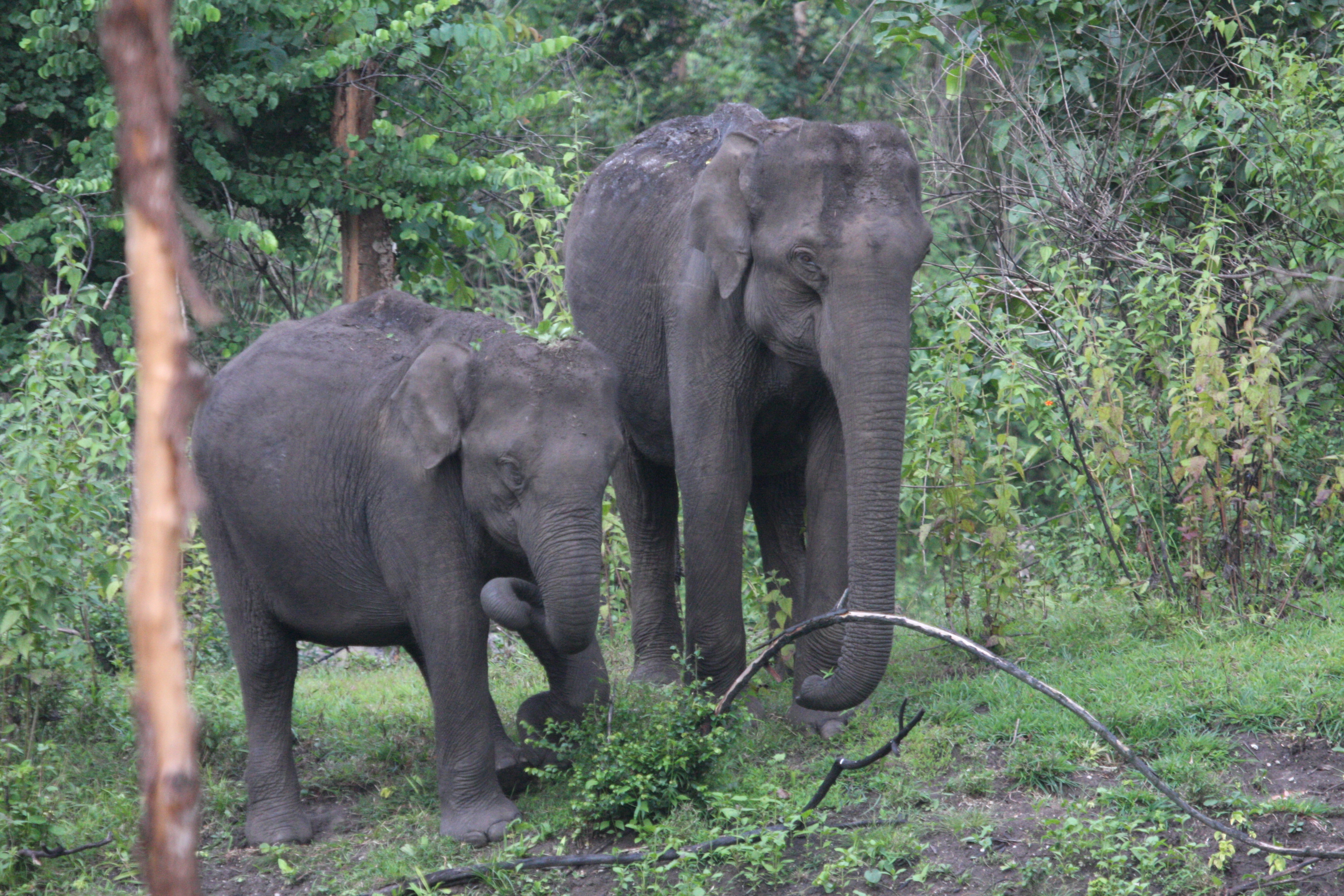
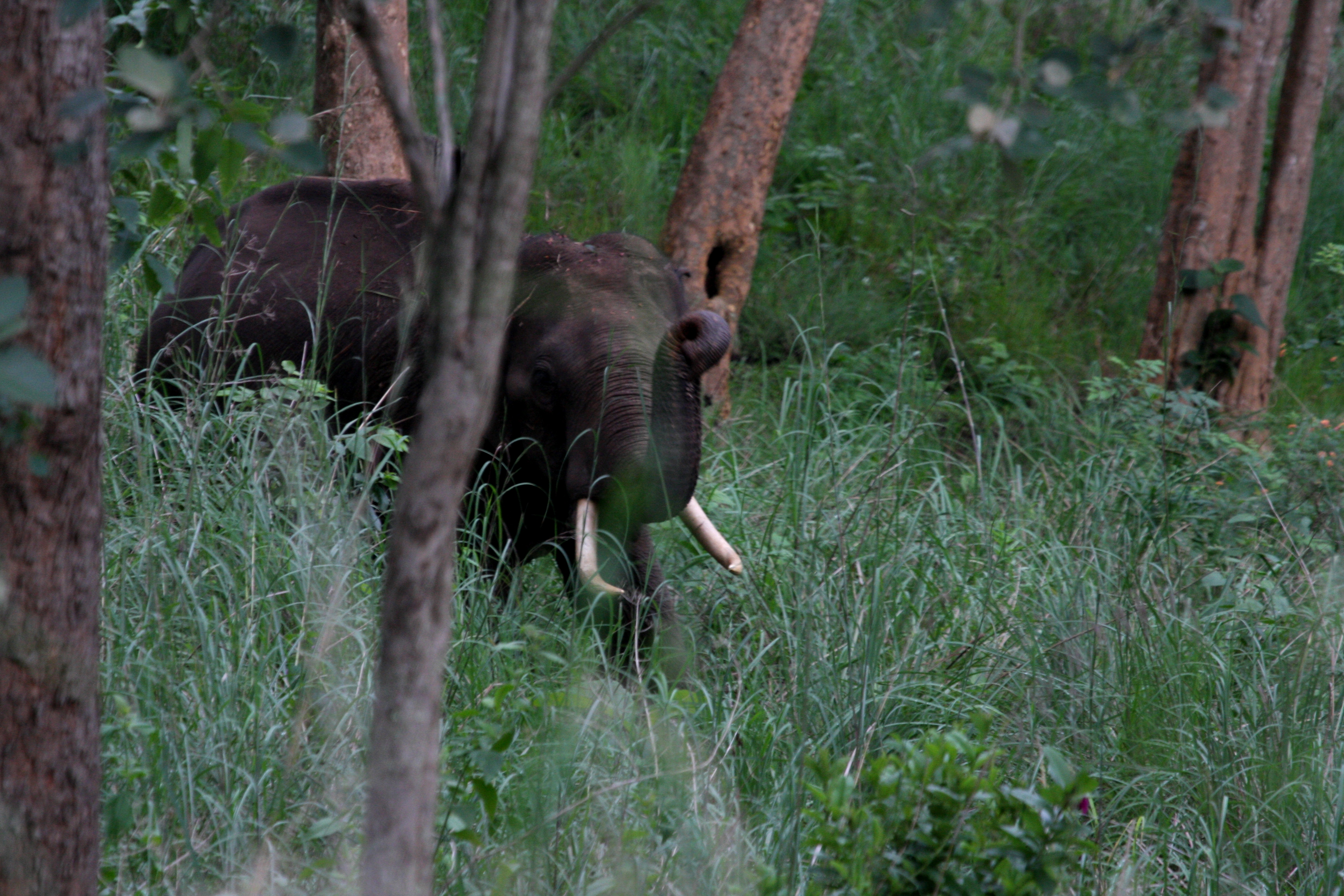
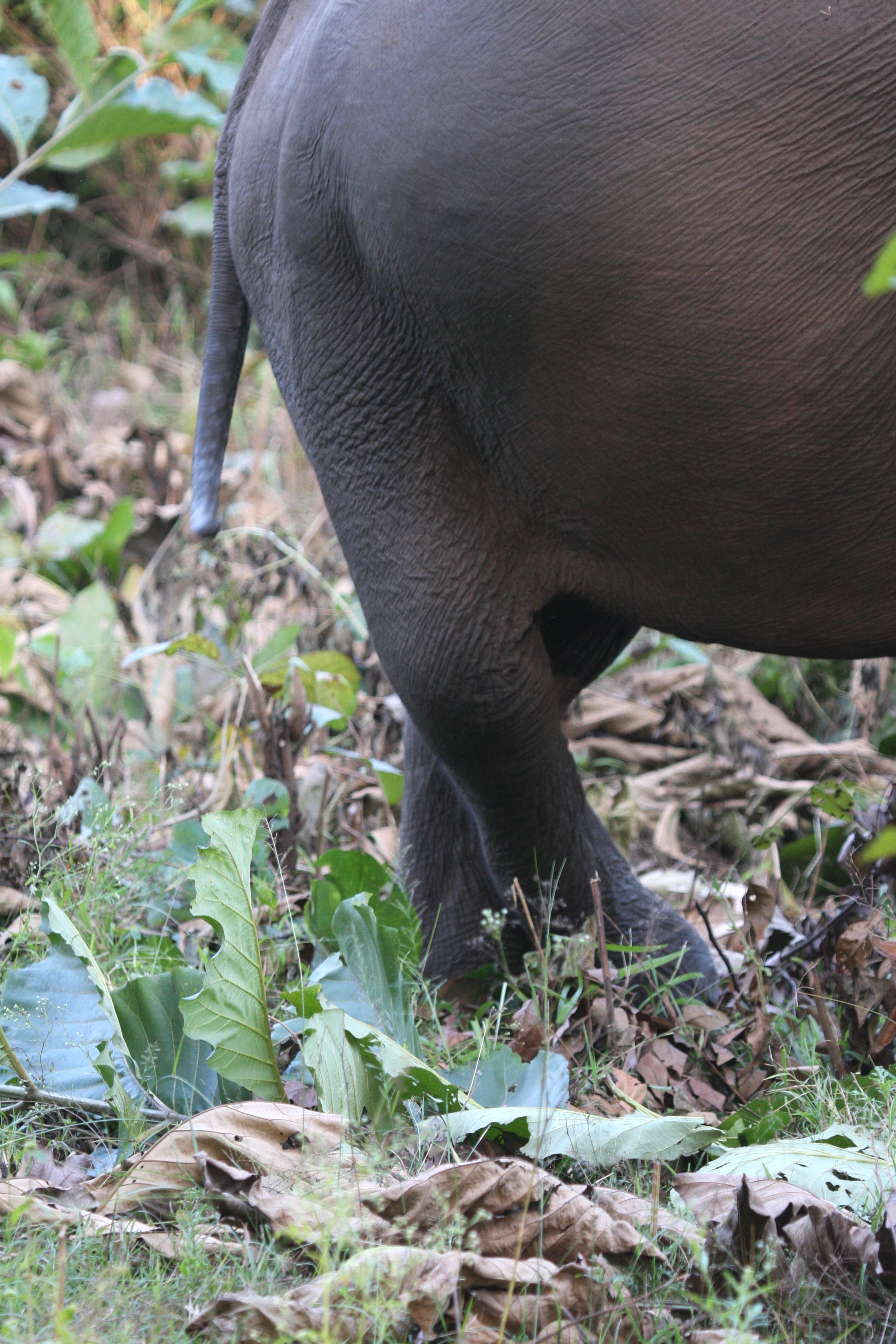
By four thirty in the evening, Mr. Luigi suggested that we take a boat ride. The drizzle had run out though the clouds persisted and it was a very pleasant ride although the birding was not great. We were back at sundown when an elephant herd made its presence felt in the forest across the river, with the reedbrakes being violently demolished and boles being snapped with rifle-shot cracks. The light had faded, but we re-boarded the craft and drifted across, to about fifty or sixty feet from the opposite bank. The elephants themselves were not visible except for one glimpse at a pair, but the stripping of bark, uprooting of whole trees and demolition of the reedbrakes was loud enough to give us a very clear idea of where the animals were. As also the quink of the calves and the occasional trumpet. There was a small rocky islet not far from this bank on which a small group of men sat chatting idly in the still air, but their presence seemed to make no difference to the herd. After a while of silent observation, we headed back. The herd was there all night, with the animals taking turns to enter the water, churning it noisily. Sometime before five in the morning, the noises ceased and the herd melted away. GiK and I thoroughly enjoyed the experience. We sat on the porch for hours listening to the din.

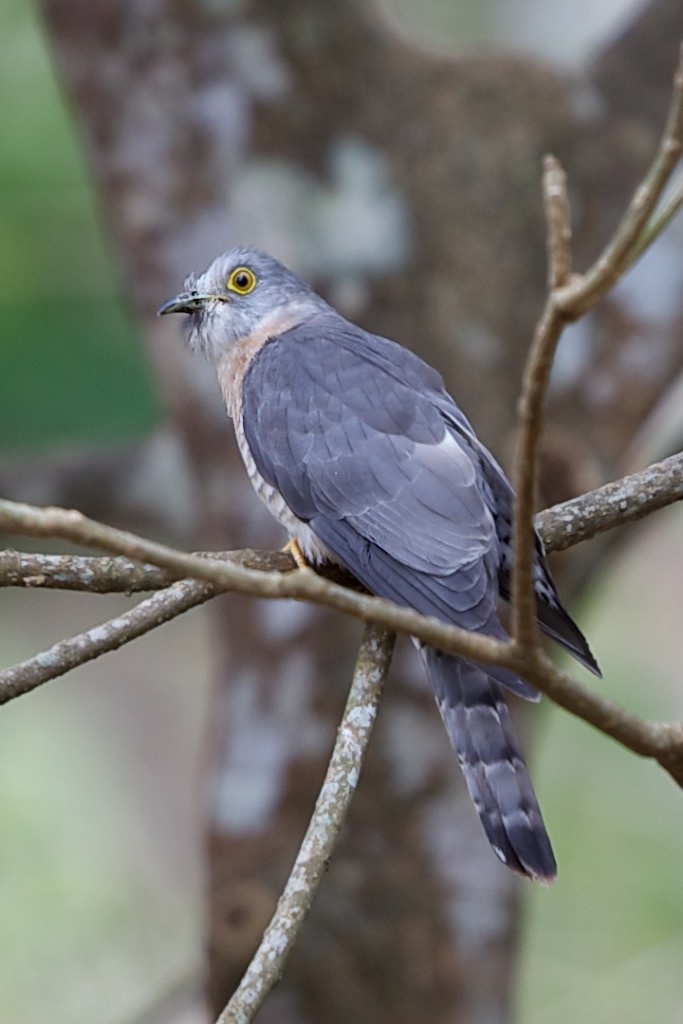
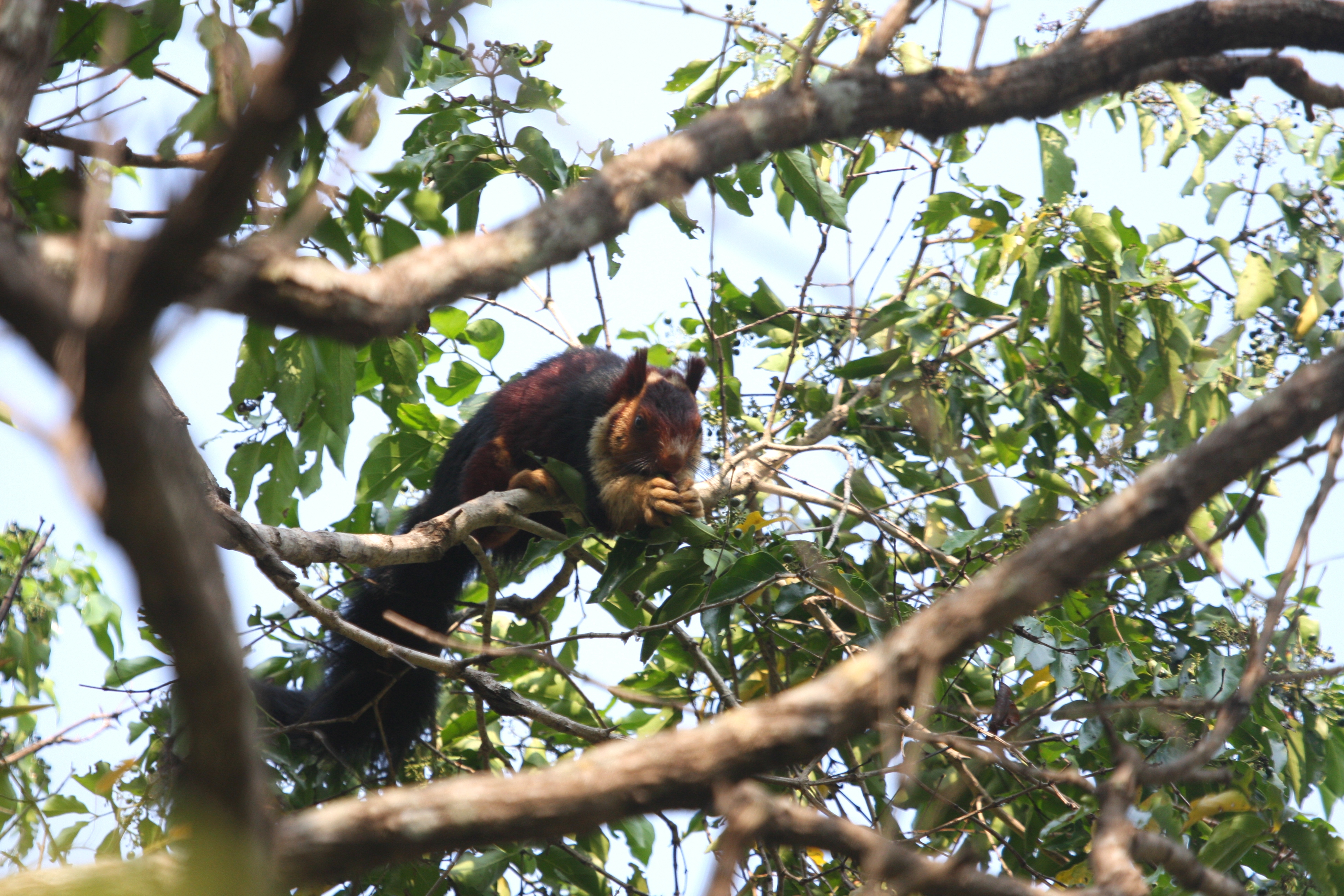
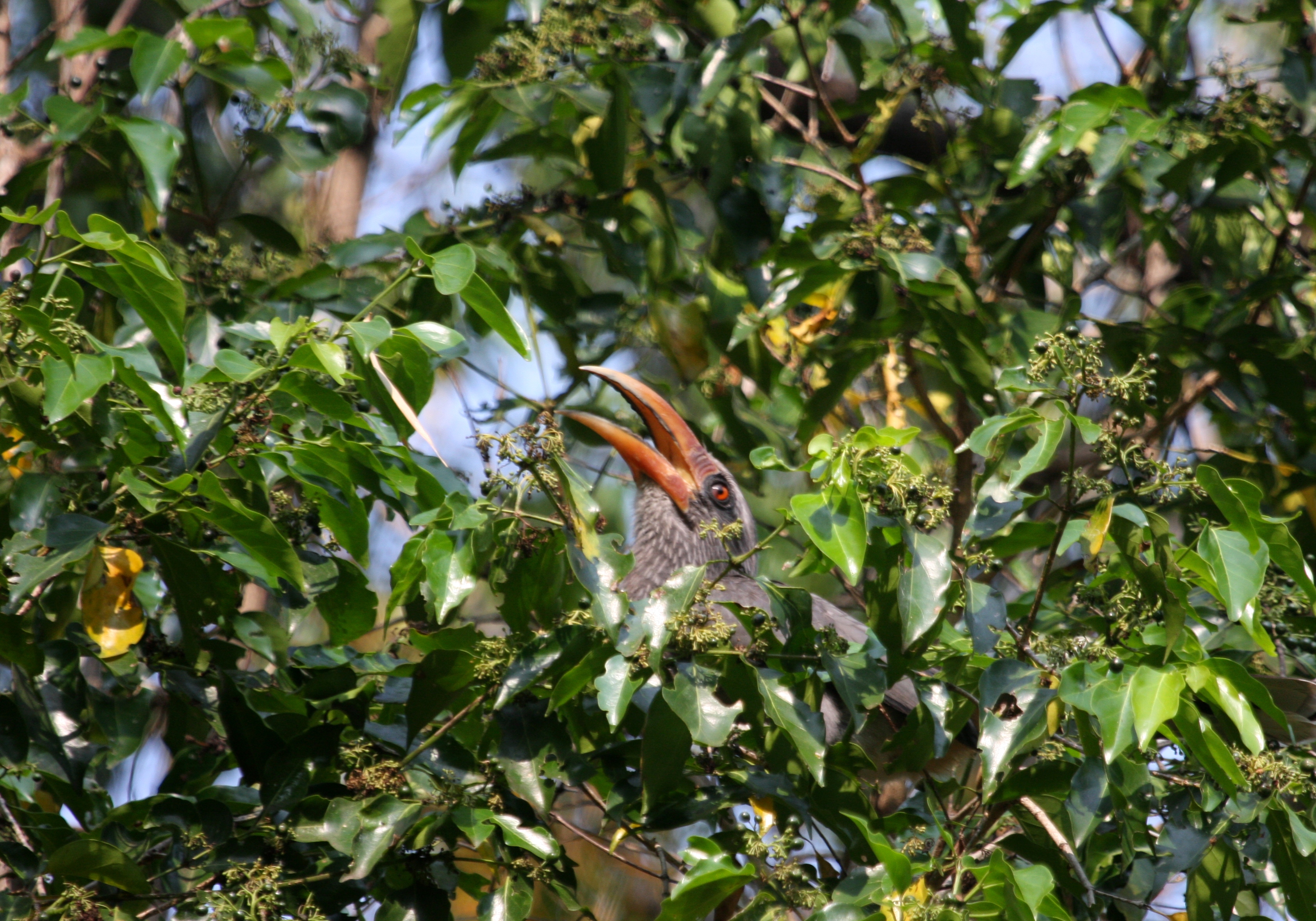
The birding in and around PRL was fairly good, though we heard far more than we saw. We sighted the most common residents repeatedly – Cinereous tit, Malaber grey hornbill, Hill myna, White-browed wagtail, Little cormorant, River tern, Malabar parakeet, Purple-rumped sunbird and Orange minivet. And also Common iora, Fish eagle (Grey-headed or Lesser I couldn’t tell), Brown-capped pigmy woodpecker, Green imperial pigeon, Racket-tailed drongo, White-throated kingfisher, Indian roller, Chestnut-headed bee eater and coucal. And heard Indian scops owl, Common hawk cuckoo (all night), Red-wattled lapwing, flameback, Grey junglefowl and Jungle owlet. Each day began with a single song from the Malabar whistling thrush after rendering which, the bird promptly went silent for the rest of the day.

We did three outings with Gireesh Chandran. He was his usual effusive, amiable self notwithstanding the little incident of the last trip (which he doubtless hadn’t forgotten, considering his recollection of many specific sightings from my previous trips – the man doubtless has an incredible facility for memory).  Since this was GiK’s trip, his primary ask was what we were after – five birds – Black baza, Drongo cuckoo, Srilanka frogmouth, Dollar bird and the Indian pitta. And we saw them all, barring the pitta.

The first morning outing was to the usual rocky area. Atypically, we were the only people Gireesh was guiding, so we had him all to ourselves. The rocky area was lively as ever. In addition, there were elephants foraging noisily hardly fifty meters away in the reedbrakes off the rocks. We couldn’t see them, but could follow their movements from the tremendous din. Trying to ignore the elephants, we notched up a splendid list. Lesser flameback, Racket-tailed drongo, Black-naped oriole, White-bellied blue flycatcher, Blyth’s starling, Plum-headed parakeet, Malabar parakeet, Dollar bird, White-rumped needletail, Greenish warbler, Common iora, White-browed bulbul, Purple sunbird, Emerald dove, Orange minivet, Grey-fronted green pigeon, Drongo cuckoo, Gold-fronted leaf bird, Blue-bearded bee eater, Nilgiri flowerpecker, Loten’s sunbird, Crimson-backed sunbird, Grey-headed bulbul, Flame-throated bulbul, Jungle nightjar (on the way), Little spiderhunter, Bronzed drongo, Ashy drongo  and Chestnut-headed bee eater. And heard Indian treepie, Brown shrike and Grey junglefowl. Three Black bazas went flying past, and settled on different tree-tops. Both GiK and I missed catching them in flight and Gireesh Chandran was not too pleased as the light was good and they were not far away. There was what we thought to be a juvenile Oriental honey buzzard being mobbed by a Racket-tailed drongo. A little before we stepped over the electric fence to exit the sanctuary, Gireesh traced a solitary frogmouth and we spent some time getting pictures.

Srilanka frogmouth (pic: Girish Kulkarni):
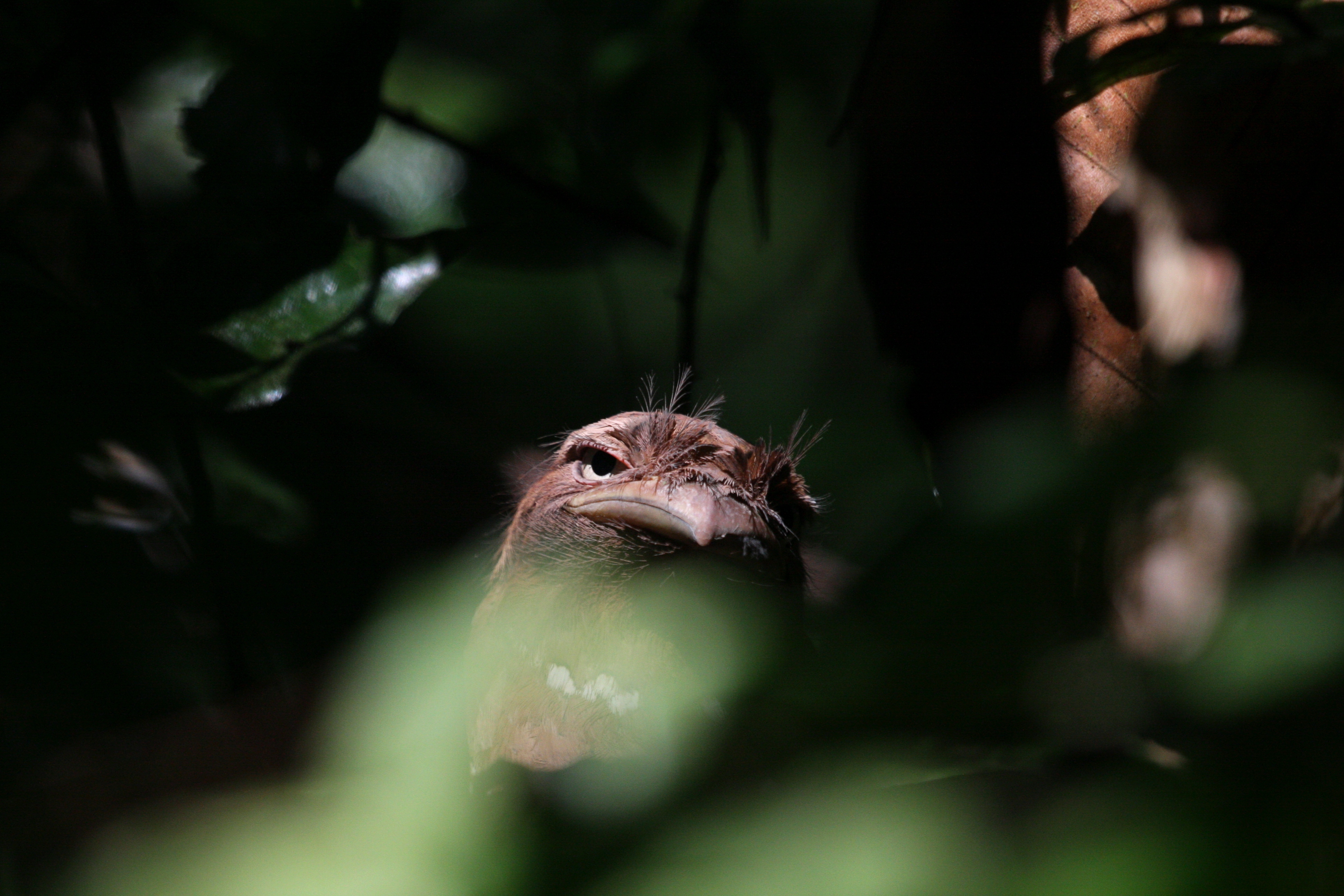
Girish Galibore Thattekad 249

And on the way out, in the rubber plantation adjoining the sanctuary was a mixed hunting party comprising Malabar wood-shrike, Racket-tailed drongo, Velvet-fronted nuthatch, Orange minivet and Bronzed drongo.

The evening session was a wash-out. A couple from Mumbai – Govind and Sheetal, house guests of Gireesh – were with him when we linked up at the sanctuary entrance. Gireesh drove us for a few kilometers on the road back towards Kochi, to an area I haven’t visited before. Crested tree-swifts evidently flocked in this area, but there was nothing in sight except for Spotted doves. It was not yet 4 PM and presuming that we were early for the evening’s action, we suggested that we instead finish with the frogmouth pair that Gireesh had promised earlier. It was a twelve kilometer drive to the lovely forested place I’d been to a few times before; and also to a rocky slope surrounded by lush evergreen forests that I don’t remember seeing.

Srilanka frogmouth pair (pic: Girish Kulkarni):

Girish Galibore Thattekad 327

We watched the frogmouth pair briefly after which Gireesh suggested we head into the main sanctuary entrance to look for the pitta at its roosting haunt. However his car had developed a deflated tyre and precious daylight was lost in getting it fixed at Kuttampuzha en route. We had to perforce abandon the pitta plan for the day. Heading back, we were briefly distracted by what Gireesh identified as the Great-eared nightjar flitting above the road. Stopping for it, we were further distracted by Indian scops owls – a pair – that was calling from the foliage just by the road. We could see the owls occasionally sailing over our heads, but were unable to spot them when they called from the trees, try as we might. We finally gave up and headed our separate ways.

Dollar bird by torchlight, the light has distorted colours (pic: Girish Kulkarni):

Girish Galibore Thattekad 333

For the third outing (AM), Gireesh again led us to the rocky slope. There was plenty of activity this time, with other groups of birders present too.  In addition to many of the species seen the previous day, we saw Greater flameback, Golden oriole, Yellow-browed bulbul, Small minivet, Verditer flycatcher, Vernal hanging parrot, Black-naped monarch and Asian brown flycatcher. We then descended into the forest for a short loop (with a little bit of leech infestation en route). Gireesh was looking for the pitta and possibly a Malabar trogan. We sighted a White-bellied treepie, Crested serpent eagle, Brown-capped pigmy woodpecker, Malabar wood-shrike and a Brown-breasted flycatcher. Apart from the trogan, which presented a distant and fleeting sighting. Pitta called tantalizingly, but none appeared despite Gireesh’s efforts.

Common wasp (Vespula vulgaris) nest (pic: Girish Kulkarni):
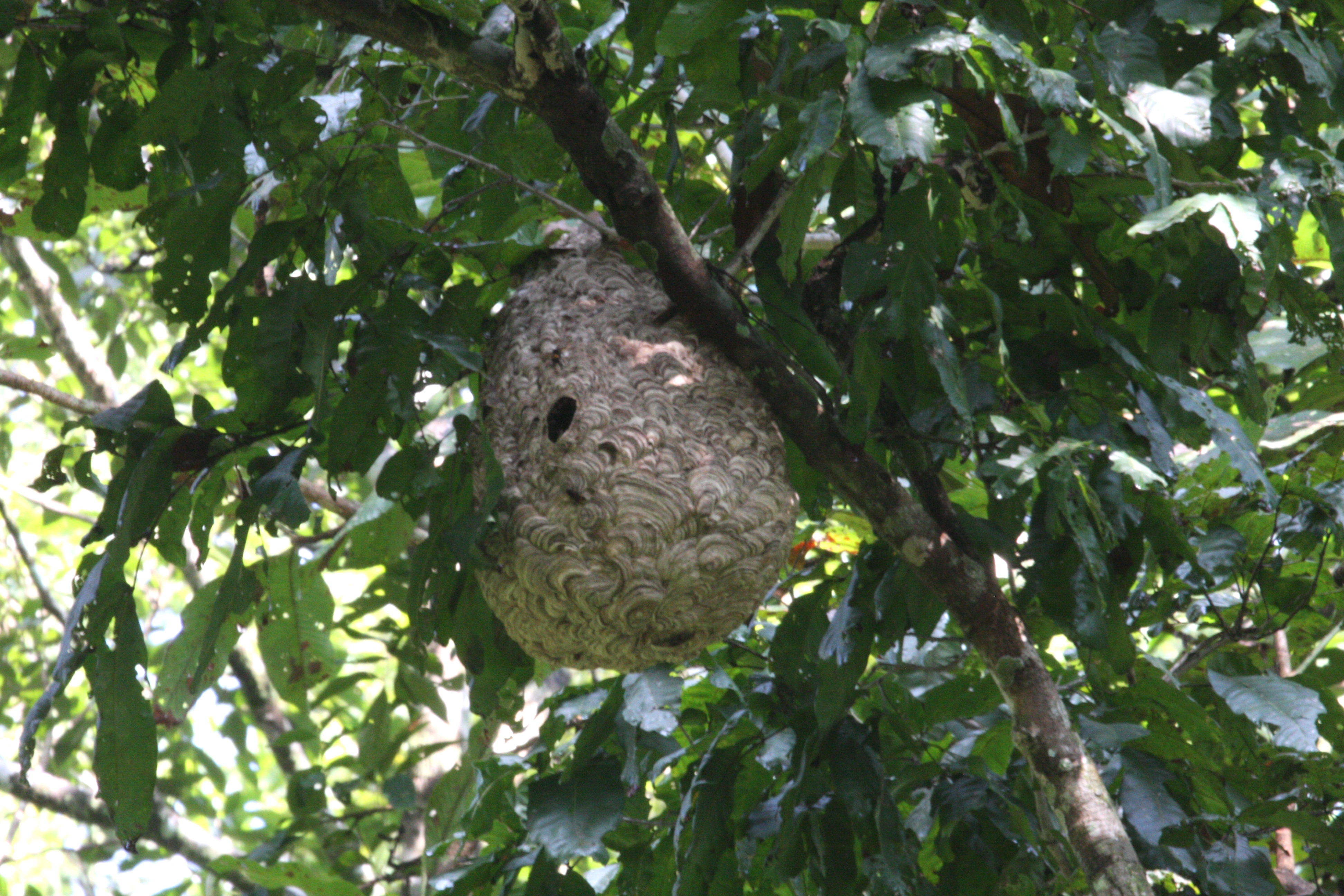
Girish Galibore Thattekad 505

This was our final day and we were required to vacate our rooms at PRL to make way for a Brit group that was arriving. Mr. Luigi, considerate as ever, suggested that we take a packed lunch and trek up the dirt track running by the river on the opposite bank to kill time until evening. Some three hours or so on this road would bring us to the Idamalayar dam.

Accordingly, Elias was dispatched to accompany us and to keep a sharp lookout for elephant, and laden with a big heavy bag of food. Our usual driver Vijay hauled some eight liters of water as we were thirsty all the time. We crossed the river by boat and gained the track. This track ran by the river and through some picturesque forests, although the birding was not very satisfying. We walked at an unhurried pace and had the forest to ourselves. Some work was being done on this road although the workwomen were missing, this being a Sunday. There was heavy degradation of the prey base – chital, sambar and pig having been decimated for bush meat. Only the odd junglefowl had survived. There were traces of pig though at places, by way of dug earth.

Giant wood spider (Nephila pilipes), note the tiny male dwarfed by the massive female:

Girish Galibore Thattekad 530

Some four or five kilometers later, the dirt track ran into an asphalted road bearing a fair degree of traffic. We turned back at this point, stopping a short while later to demolish the foodbag – Mr. Luigi had crammed the bag with sandwiches and a cartful of fruit.

We were curious to examine the results of the elephants’ foraging as great patches of gouged earth and felled trees could be seen from across the river.  The patch of forest the elephants had been in looked like a deranged gang had been let loose with dynamite sticks and JCBs. Trees as wide as a foot had been uprooted whole and flung aside, while others had been snapped clean in half. The earth was gouged in large patches. And the place was littered with dung everywhere.

The track back evidently continued until it terminated on the bank opposite Kuttampuzha, a village midway to the sanctuary entrance from PRL. This road is motorable and can be accessed by car from Bhoodhathankettu. We have a plan to attempt it by car at sunrise or sunset on the next trip, looking for elephants or the odd sloth bear.

The list

Birds:

  1. Ashy drongo
  2. Asian brown flycatcher
  3. Asian openbilled stork
  4. Black baza
  5. Black-naped monarch
  6. Black-naped oriole
  7. Blue-bearded bee eater
  8. Blyth’s starling
  9. Bronzed drongo
  10. Brown-breasted flycatcher
  11. Brown-capped pigmy woodpecker
  12. Brown shrike (calls)
  13. Chestnut-headed bee eater
  14. Cinereous tit
  15. Coucal
  16. Common hawk cuckoo (calls)
  17. Common iora
  18. Crimson-backed sunbird
  19. Crimson-fronted barbet (calls)
  20. Dollar bird
  21. Drongo cuckoo
  22. Emerald dove
  23. Fish eagle
  24. Flame-throated bulbul
  25. Golden oriole
  26. Gold-fronted leaf bird
  27. Great-eared nightjar
  28. Greater flameback
  29. Green imperial pigeon
  30. Greenish warbler
  31. Grey-fronted green pigeon
  32. Grey-headed bulbul
  33. Grey junglefowl
  34. Hill myna
  35. Indian roller
  36. Indian scops owl
  37. Indian treepie
  38. Jungle nightjar
  39. Jungle owlet (calls)
  40. Lesser flameback
  41. Lesser whistling duck
  42. Little cormorant
  43. Little spiderhunter
  44. Loten’s sunbird
  45. Magpie robin
  46. Malabar grey hornbill
  47. Malabar parakeet
  48. Malabar trogan
  49. Malabar whistling thrush
  50. Malabar woodshrike
  51. Nilgiri flowerpecker
  52. Orange minivet
  53. Oriental honey buzzard?
  54. Plum-headed parakeet
  55. Purple sunbird
  56. Purple-rumped sunbird
  57. Racket-tailed drongo
  58. Red-wattled lapwing (calls)
  59. River tern
  60. Small minivet
  61. Spotted dove
  62. Sri Lanka frogmouth
  63. Stork-billed kingfisher
  64. Velvet-fronted nuthatch
  65. Verditer flycatcher
  66. Vernal hanging parrot
  67. White-bellied blue flycatcher
  68. White-bellied treepie
  69. White-browed bulbul
  70. White-browed wagtail
  71. White-cheeked barbet
  72. White-rumped needletail
  73. White-throated kingfisher
  74. Yellow-browed bulbul

Mammals:

  1. Elephant
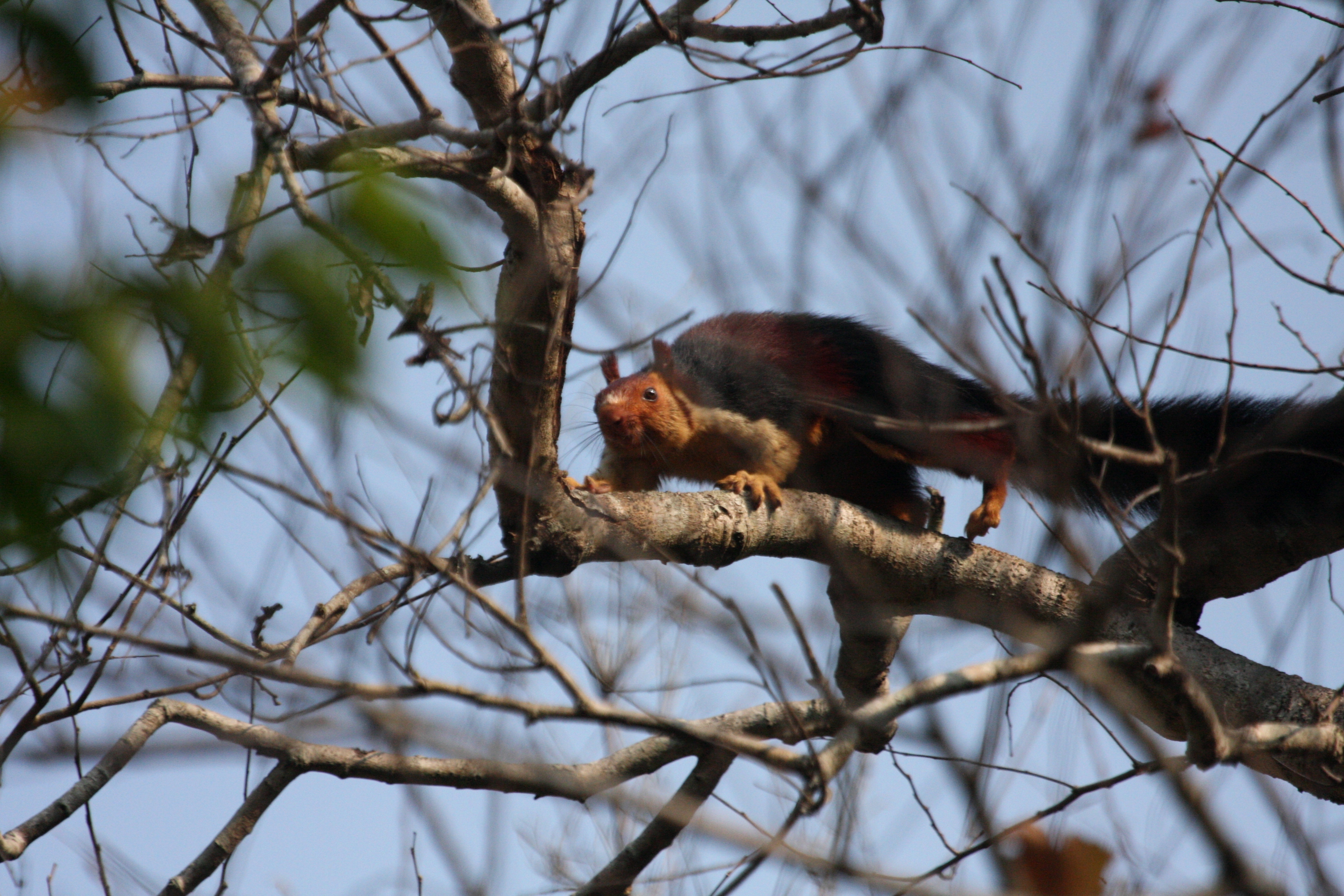
  2. Indian giant squirrel

Trip Report: KMTR, Oct ’14

Trip Report:        Kalakkad Mundanthurai Tiger Reserve (KMTR)

Dates:                  2-5 Oct 2014

Camp:                  Talayannai FRH, Mundanthurai Range Office FRH

Who:                    GK, VR

The best laid schemes o’ mice an’ men gang aft a-gley… [often go awry] – Robert Burns

Dog’s breakfast

GK and I had prepared for this trip for weeks. We had spent time compiling lists of endemic or significant species that we wanted to look for, and in checking on what areas and routes to cover (I’ve included the list of target species at the end of this post). However the trip didn’t quite pan out the way it was intended to.

The jinx began right from the word go. GK hatched this plan of saving a day by driving the 600-odd kilometers to KMTR overnight. Shortly after reaching the place, I realized that I’d left behind my binoculars, notebooks and torch back in Bangalore. My eyesight being what it is, I was unable to ID a bunch of birds that weren’t close enough. And then we weren’t able to get permission to visit places in the higher ranges – places like Sengaltheri, Upper Kodayar and Kakachi. We intended to seek accommodation at the Kuduraivetti or Kodamadi FRHs – these are sited in spectacular locations – but had to be content with being put up at the Talayannai and Mundanthurai RO FRHs located at the fringes of the reserve, and at low elevations. Even these are available only if requested by someone in the FD. A tough new Deputy Director has taken over for the past few months and she has pretty much closed off many areas that were hitherto accessible. We saw several instances of people flaunting various degrees of influence being stonewalled and refused permission. While this effectively hamstrung our trip, it was heartening to see a young officer (this is evidently her first posting) take an uncompromising stand on behalf of our forests and wildlife. May her tribe increase.

Day 1, Talayannai

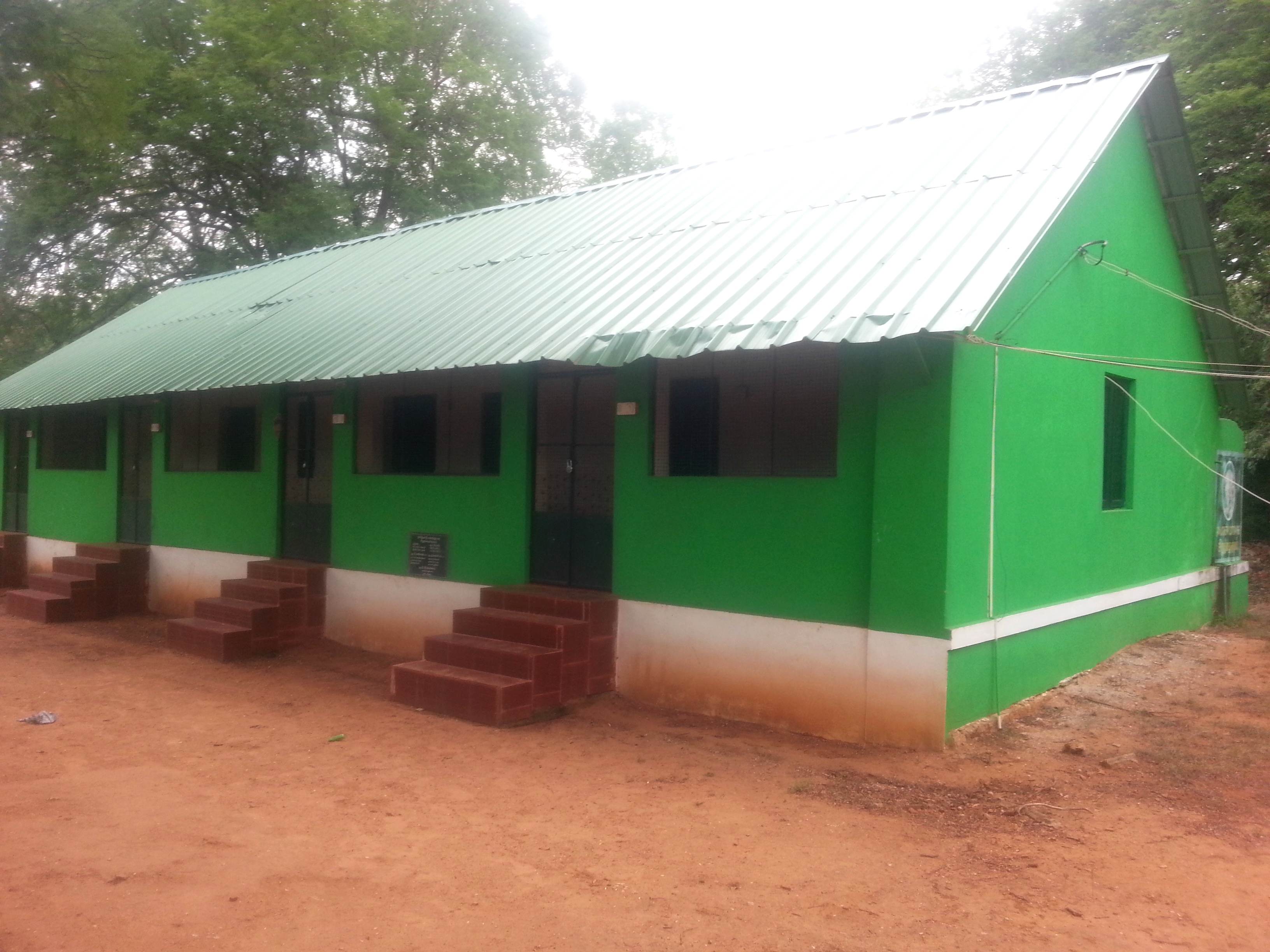
After a sleepless night spent driving from Bangalore and Chennai, we reached the Talayannai Dormitory near the tiny town of Kalakkad after a short break in Tirunelveli. This is the very same place I’d been to with my sister’s family last year. A short distance inside the reserve lies a small check dam and the resultant waterfall is a popular spot with local tourists, most of whom land up with towels slung around their necks. And understandably so, as the heat of the second summer was oppressive. The FRH lies a short distance from this check dam. The day was squandered in trying to get permission to access the upper reaches of the forest. Fourteen kilometers from Talaiyannai is a place with a spectacular reputation – Sengaltheri. This place is now out of bounds for just about everyone, and we finally gave up all hope of getting access to it after day-long effort. There’s a large dormitory in Talayannai with bunk beds and that’s where we camped for the night.

View from Talayannai watch tower

20141002_174904

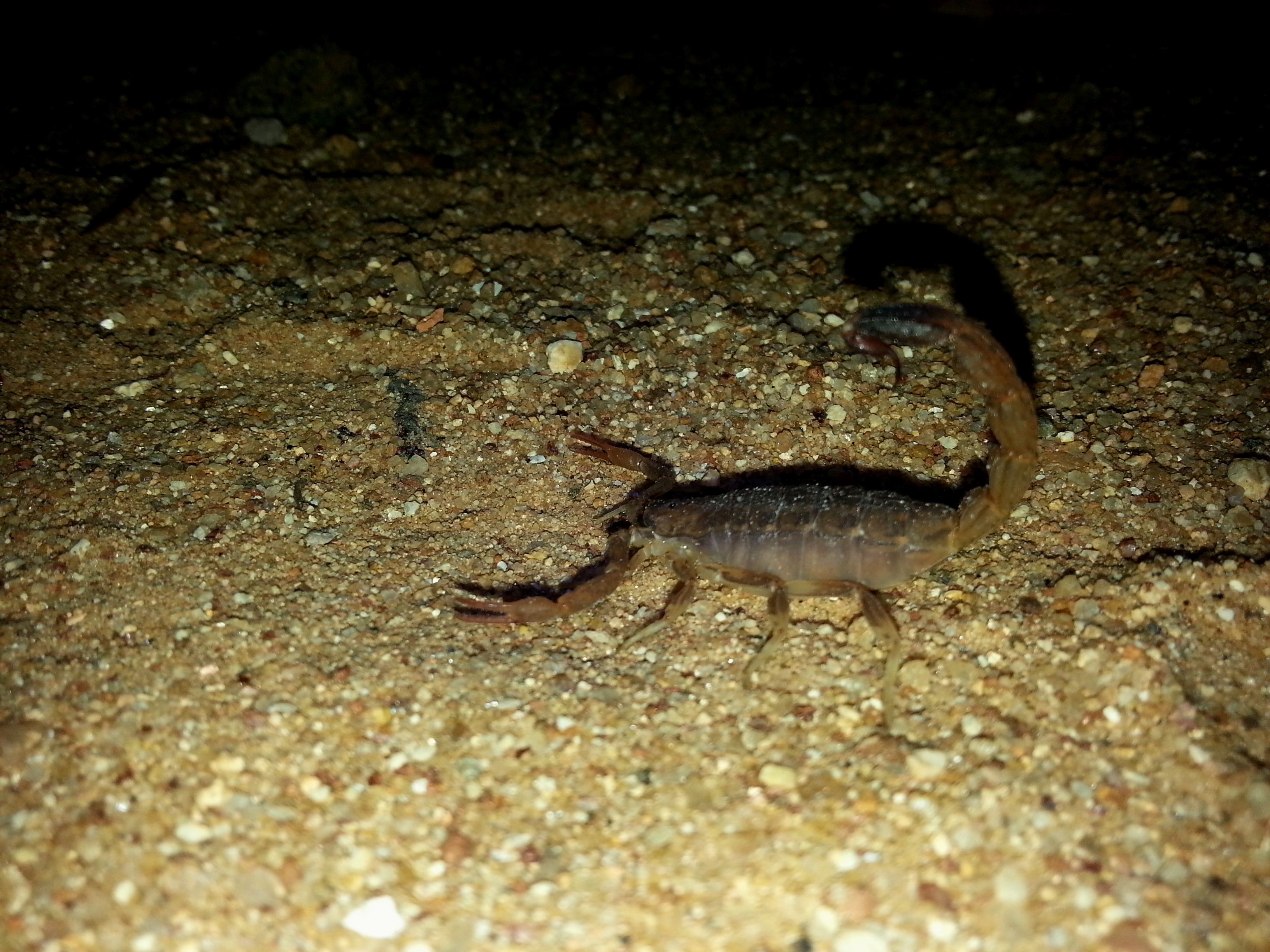
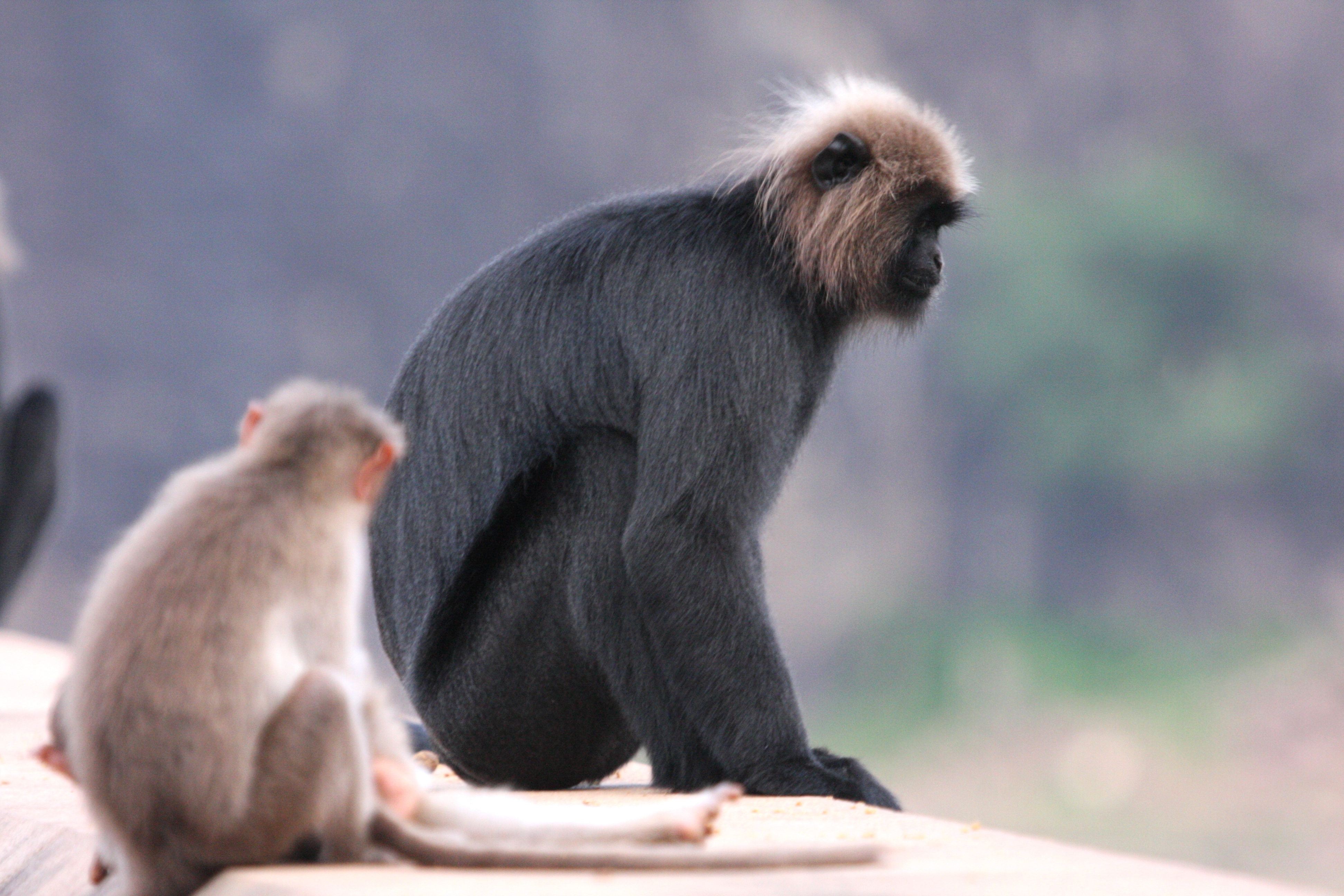
Standing outside the dorm at about 4:30 in the evening, we saw a couple of dhole canter across the road. Grabbing my camera, GK and I hurried after them, but they’d moved on and we got no pictures. There was some birdlife around, but I couldn’t do much without my bins. All we saw was Sambar, bonnet macaques, tufted langurs, Indian giant squirrel, Indian treepie, peafowl, Small minivet, coucal, Magpie robin, White-cheeked barbet, Grey junglefowl and Blue-faced malkoha. And we heard hoopoe, Savanna nightjar and what evidently was the Mottled wood owl calling (the latter two after sundown, naturally). A Changeable hawk eagle called persistently all day; we eventually located it and sighted it a few times. A couple of species of scorpion were met with around the dorm.

Fattail scorpion

20141002_191007

Dhole spoor set in concrete

20141003_061454

Offroading interlude

VR (who is a cop himself) had stumbled across a police inspector in Tirunelveli while searching for KMTR leads online. Inspector SE has a staggering range of interests including trekking, parasailing, paragliding, snake rescue, cactus cultivation, gardening, philately and offroading. Prior to the trip, VR had contacted the inspector to see if we could get some local guiding help. Finding that I was missing the bins, we contacted inspector SE again and he was kind enough to offer to lend us his for the duration of the trip. We therefore dropped by the police station in the morning to pick up the bins, when the inspector asked us if we’d like to join him for a spot of offroading.

We then ended up spending time until a very late lunch being bounced over rocks, ditches and other tyre-shredding obstacles. In the searing heat. It was spectacular fun nonetheless.

20141003_110057

20141003_130613(0)

We then picked up the borrowed bins and headed for the Mundanthurai Range Office via Ambasamudram and Papanasam, and the amiable ranger there agreed to put us up (in the ‘Panther cottage’) for two nights.

The Panther Cottage

20141003_164456

Day 2, Karaiyar and Servalar dams

The Mundanthurai range office is sited about ten kilometers inside the reserve. The road forks from here with one prong leading to the Servalar dam about seven kilometers away, and the other to the Karaiyar dam, also about seven kilometers away. The reservoirs of these two dams are linked by a massive tunnel three kilometers long – to equalize water levels. About halfway to the Karaiyar dam is a road that branches off to the Sorimuthu Ayyannar temple; and this draws a considerable pilgrim crowd. We covered the Karaiyar and Servalar roads several times in the mornings and evenings, with no significant sightings. Junglefowl called in alarm at a couple of places, most likely triggered by our presence.

Nilgiri langur on the Karaiyar dam

KMTR Oct 14 057 

Since driving on these roads is banned after dark, we took a public bus on impulse at about eight thirty in the evening, to Karaiyar and back. The driver spoke of leopard and sloth bear sightings almost on a daily basis on this stretch, but we had no such luck. GK spoke to some tribals employed as watchers and they recommended driving along the Servalar route early next morning to look for leopards. Again no luck. However we saw Jungle babbler, White-headed babbler, Common iora, Black eagle, White-bellied drongo, Tailor bird, Ruddy mongoose, Brahminy kite, Brown-headed barbet, Grey junglefowl, Tufted langur, nightjar (possibly Savanna) and peafowl (the latter being especially numerous all over the lower ranges). And heard Common hawk cuckoo and coucal. We also spotted a malkoha-like bird which I am unable to identify – it appeared dark with a white terminal band on its tail. In the waters of the Karaiyar dam was a swimming herd of buffaloes – I initially assumed they were domestic animals, but a tribal watcher later told GK they were wild – perhaps a feral herd. An Indian scops owl called persistently after dark around the FRH without us being able to spot it. Sambar belled once in alarm late in the evening.

Incidentally, we saw no chital, wild pig or gaur in the course of the whole trip. Just the occasional sambar. The scanty prey base probably explains KMTR’s low tiger density, at least in the areas we visited. However leopards are reputed to be met with commonly (langurs, macaques, peafowl and junglefowl abound in these forests). Elephants are small in number. Dr. Johnsingh attributes this to the scattered and sparse presence of their food plants, and to the mountainous terrain.

From the Servalar dam, there is a rough road which leads to the Kodamadi FRH, three klicks away. Again a highly restricted route that we couldn’t get permission for. This FRH nestles in another wild spot and has a great reputation.

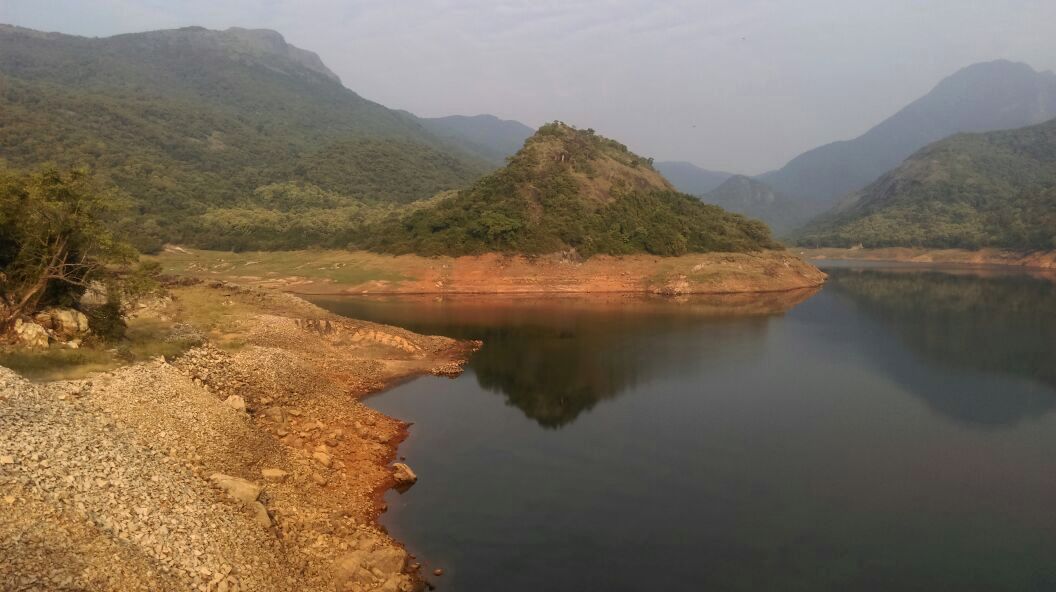
View from the Servalar dam. The Kodamadi FRH is sited somewhere around the conical hill.

IMG-20141007-WA0023

The ranger – Mr. I – became very friendly with us once he realized we were there with a serious wildlife interest and not as casual tourists. He chatted transparently and disarmingly about his profession, and about forests and their management.

Day 3, Kuduraivetti

On day three, we finally got permission to drive upto Kuduraivetti, thanks to Ranger I’s intercession. Access to this place is heavily controlled, with a quota of five vehicles permitted daily. And all visitors are required to exit by 6 PM, with no overnight stay allowed either in the FRHs or in the estates. After crossing the Manimuttar dam, we climbed steadily to reach tea country and a string of estates leased to the Bombay Burmah Trading Company. Manimuttar dam is crowded with bathing visitors, but hardly anyone is allowed beyond this. Beyond lie Manjolai estate – Manimuttar estate – Naalumooku estate -Oothu estate and finally Kuduraivetti, in sequence. The drive took a good three hours and we spent a few minutes at Kuduraivetti chatting with the watcher on duty before turning back.

Kuduraivetti FRH

KMTR Oct 14 159

From Naalumooku estate, a road branches off to Upper Kodayar and Kakachi – places we badly wanted to visit. But again, these were out of bounds. Two famed birds – the Broad-tailed grassbird and White-bellied shortwing are reputed to skulk around those areas. We kept an eye out for the Southern birdwing – our largest butterfly – having been told that it was a common sighting on this route, but it is not easy to spot butterflies whilst driving through winding hill roads.

Between the estates are stretches of lush evergreen forests. It is a beautiful drive. A brace of Painted spurfowl went scurrying off the road. Flamebacks and Asian fairy bluebirds called repeatedly without showing themselves. Ashy wood-swallows flocked on an electric wire. A solitary Racket-tailed drongo went sailing across the road. We also saw a solitary Green imperial pigeon. And small flock of Black-throated munias on the way back.A shikra was perched near the Manimuttar dam. The estates were alive with noisy Red-whiskered bulbuls and Tailor birds.

Tea estates and evergreen forests

IMG-20141007-WA0016

Ashy wood-swallow taking off

KMTR Oct 14 158

Besides streams at elevation were great clusters of Ochlandra reedbrakes (Ochlandra travancorica) – an endemic we were looking for. And plenty of Messua ferrea – a plant common to the W Ghats and the Himalayas – however these were not in bloom. GK pointed out Fern trees – Filicium decipiens – which were plentiful in the forest.

Ochlandra travancorica, these reedbrakes are found in clusters by streams above 1,000 meters altitude, and constitute one of the few sources of food for elephants in KMTR

KMTR Oct 14 134

Messua ferrea, an example of flora common to the W. Ghats and the Himalayas

KMTR Oct 14 108

Canarium strictum, another example of flora common to the W. Ghats and the Himalayas

KMTR Oct 14 129

A stream in the forest. KMTR spawns fourteen rivers and is the primary source of water for surrounding districts

20141004_140024

Day 4, Kadayam range

Ranger I had encouraged us to visit an orphanage and speech-and-hearing-impaired childrens’ home near the Kadayam range run by the Gandhigram Trust. He felt they were doing great work and needed all the encouragement they could get. Perhaps as a sort of inducement, he also promised to send us trekking up the Kadayam range with a watcher to guide us. And so there we went on the last day.

The Kadayam range begins from the Sivasailam dam and drab, hot countryside sparsely dotted with Indian palm and Prosopis juliflora abruptly transforms into lush evergreen forest.

Approach to the Kadayam range

20141005_151108

A trek of four kilometers from here brings one to the Korakkanadar temple. The path up was choked with pilgrims visiting the temple. We rested for a while in a tiny FRH that nestles just above the temple.

IMG-20141007-WA0028

The path carries on from this point for another thirty kilometers until it reaches another temple, but access is restricted owing to elephant and bear presence en route. And there is no FRH at the path’s terminus.

Mohammed Ismail the watcher who accompanied us then brought us back through another route, this a restricted and therefore blissfully undisturbed one. And a pretty route at that. Elephant droppings were occasionally seen but signs of sloth bear were everywhere – by way of dug and scraped ground.

IMG-20141007-WA0045

I should add that after the strain of the day’s activities, we were fairly drained and the daunting 600 kilometer overnight drive back through steady rain and horrendous traffic is not something I’ll remember fondly. I was pretty much done in when I reached home at about three thirty in the morning, after successfully having avoided falling asleep at the wheel between Salem and Bangalore. (VR who is evidently incapable of exhaustion drove the Scorp until Salem, and then drove GK’s car all the way to Chennai through the night).

Common sand boa rescued by Inspector SE

20141005_190516

The target list

Here’s the list GK and I created prior to this trip. AJT Johnsingh’s Field days was of great use in compiling this. Some of these are so rare that we didn’t have a prayer of a chance of actually encountering them, but we got them on the list anyway. In any case, considering that we were mostly confined to the foothills, this effort came to naught and we saw just a couple of these candidates.

Endemic

  1. Ochlandra travancorica
  2. Discoria wightii
  3. Gluta travancorica
  4. Bentinckia condapanna – endangered palm tree
  5. Dasia subcaeruleum – Boulenger’s dasia, tree skink originally mistaken for Dasia haliana, a Sri Lankan endemic
  6. Broad-tailed grassbird
  7. White-bellied shortwing
  8. Cochin forest cane-turtle
  9. Anamalai gecko

Flora common to the W Ghats and the Himalayas

  1. Bishchofia javanica – Bishop’s wood tree
  2. Canarium strictum
  3. Messua ferrea

Other significant flora and fauna

  1. Podocarpus wallinchiana – only coniferous tree native to peninsular India
  2. Paphiopedilum druryi – Asian lady slipper orchid, on the verge of extinction
  3. Gnetum ula – endangered woody climber
  4. Brachycorythis splendida – orchid also found in Africa
  5. Southern birdwing
  6. Oriental bay owl
  7. Brown palm civet
  8. Brown mongoose
  9. Black narrow-mouthed frog – rediscovered after a hundred years in Kakachi
  10. Calotes andamanensis – Andaman lizard
  11. Indian kangaroo lizard

Trip Report: Kabini River Lodge/Nagarahole NP

Trip:       Kabini River Lodge/Nagarahole NP

Camp:   JLR’s Kabini River Lodge

Dates:   20-22 Sep ‘14

Who:     GiK & SV

GiK and I had met SV and his family at K Gudi last, and we hit it off well considering our shared interests in wildlife. We had proposed a trip to Kabini together and SV promptly did the reservations as soon as he got back to Bangalore. By happy coincidence, BR who figures in my last K. Gudi post was also there, and it was a reunion of sorts. We did two nights at Kabini River Lodge, and GiK and I stayed back for an extra evening safari on day three, leaving for Bangalore late in the evening. This was a good plan as in addition to the extra safari, it allowed us to avoid return traffic on the Mysore road.

Kabini RL is considered JLR’s flagship property and their sightings are reputed to be second to none. Despite this I haven’t been there after a single trip ten years back. The scale of the establishment puts me off I guess. The safaris are indubitably spectacular, but the place lacks the sense of intimacy that the K. Gudi camp has, in my opinion. And BR agrees with me on this.

The “five kilometer” road. This is a disused and restricted (erstwhile) section of the highway to Kerala – SH17D. This road was fairly productive for us. Particularly interesting was a spot along this road known as the “burning place”, which bears the scars of the 2012 fire that ravaged the park.  Kabini Sep 2014 1080

Changeable hawk eagle. We saw at least three CHEs and only one Crested Serpent Eagle in a reversal of the usual proportions.

Kabini Sep 2014 868

Sambar hind. Note the bald patch on the neck, which is a strange and not-fully-understood occurrence in the species. Kabini Sep 2014 885

I was trying to get a shot of these two stags sparring, but they took a break to stare back at us instead. Kabini Sep 2014 227

I saw Common langur without the tuft after a long while. The langurs that occur in Bandipur, K. Gudi and Galibore are all Tufted langurs, with a distinct tuft on their heads. Langurs helped us locate a she-leopard with a single cub that we sighted on two safaris, near the KV waterhole. Incidentally, there is a watch tower by this waterhole on which I’d spent an entire afternoon ten years back, with only  chital and langur sightings to show for all my trouble. Kabini Sep 2014 851

Both gaur and wild boar were strangely missing. We saw just two herds of gaur, and that in the last couple of safaris. And just one token wild boar. This animal below was photographed in the “burning place” Kabini Sep 2014 1076

We saw plenty of elephants right through the trip. This makhna crossed the road just behind our jeep. Kabini Sep 2014 003

We met this young tusker while he was grazing by the highway. Kabini Sep 2014 085

We watched a herd of three elephants systematically destroy a patch of teak saplings. Kabini Sep 2014 888

Elephants stand around all day and even sleep standing up. This cow gave her leg a break. Kabini Sep 2014 891

Another member of the herd of three approaching. Kabini Sep 2014 893 Kabini Sep 2014 925

This cow approached very close to the jeep. And stood placidly grazing at spitting distance. I asked the naturalist Ravi if Nagarahole elephants were so habituated to human presence that they grazed like cattle around us. He replied that they do mock-charge frequently, and that the tolerance we were seeing wasn’t always present. Kabini Sep 2014 940

We sighted this large tusker with a broken tusk on two separate occasions, both on the “five kilometer” road. Kabini Sep 2014 953

Another massive tusker, this one in the “burning place”. Kabini Sep 2014 1167

This tusker accompanied a small herd. Kabini Sep 2014 1170

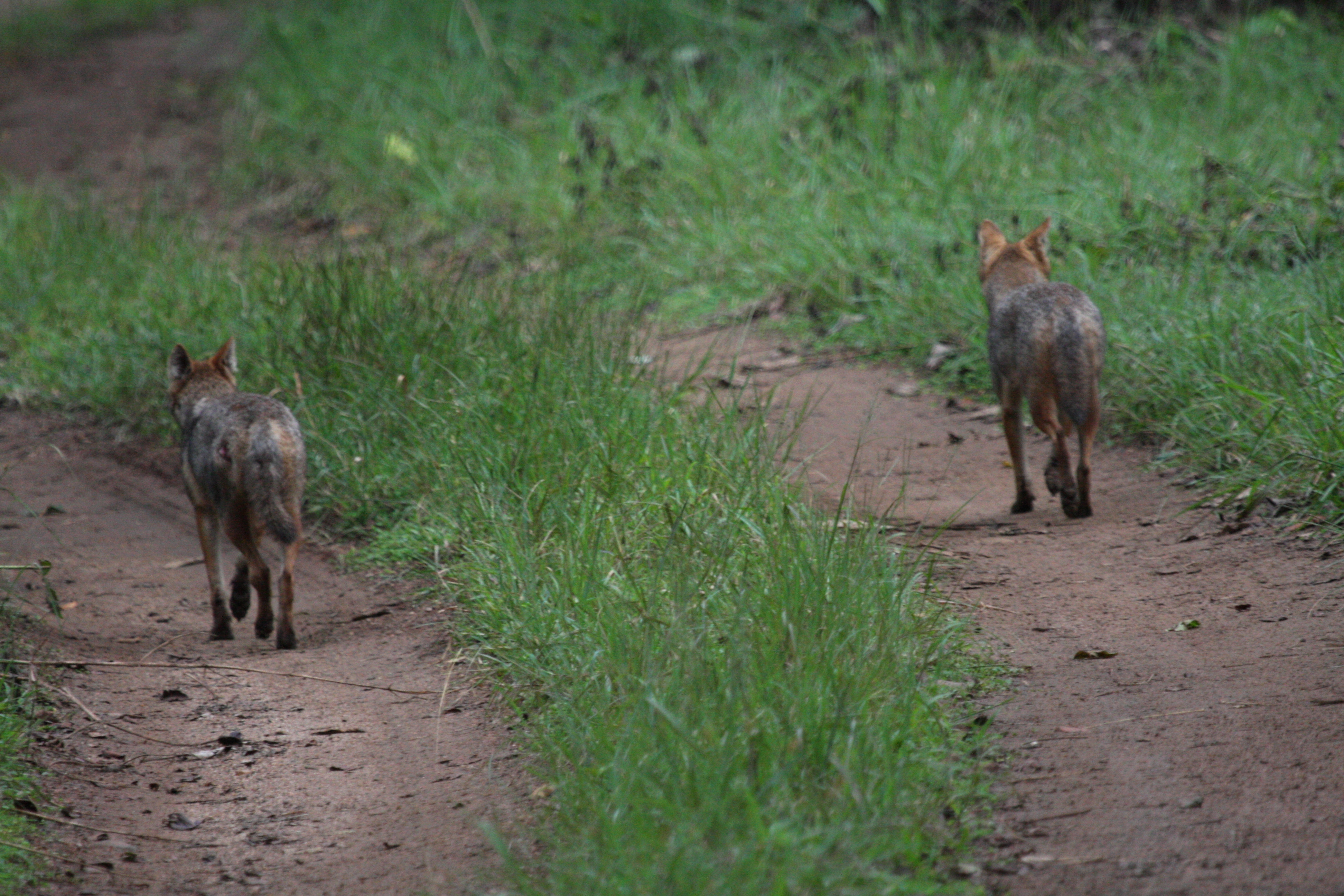
A pair of Golden  jackals (Canis aureus) came cantering down the track, stepped off it to pass the jeep, and regained the track to continue on their way. Typical jackal behavior. Kabini Sep 2014 121 Kabini Sep 2014 142

We encountered a pack of three dhole on the “five kilometer” road. Possibly the same pack was sighted by another group the next day in the “burning place”. Kabini Sep 2014 994

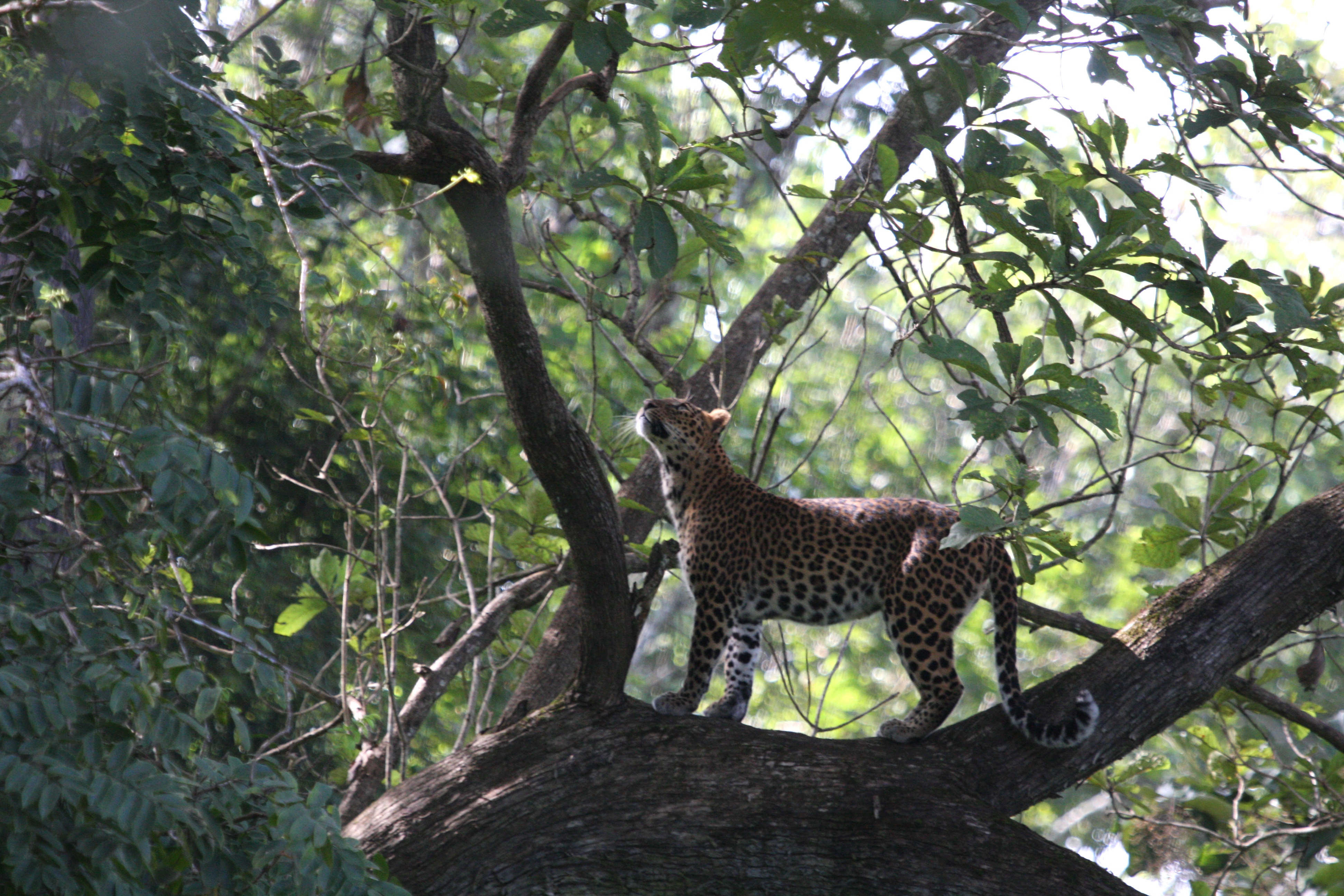
We had leopard sightings in three of the five safaris. This she-leopard was found on a tree by the highway, a little before the Balle gate. She stayed put for forty five minutes and treated us to a variety of poses. Two cubs were with her, and had descended out of sight before we arrived at the spot. Kabini Sep 2014 378 Kabini Sep 2014 590 Kabini Sep 2014 608 Kabini Sep 2014 709

The cat was briefly distracted by something in the tree above. We later learned that there was a Giant flying squirrel (Petaurista petaurista) on the tree, but none of us noticed at the time. Kabini Sep 2014 669  

My jungle trees 101 progressed at a slow crawl. I learned to ID the Nandi tree or Crepe myrtle (Lagerstroemia microcarpa). This tree is called the naked lady of the forest alluding to how it looks when shorn of its bark – the trunk resembles that of the Eucalyptus, somewhat. And the Belleric myrobalan (Terminalia bellerica). Both of which were fairly common. I also learned that the Axlewood tree has a handle too – leper of the forest – owing to its pale blotchy patterns. There were plenty of these trees in Nagarahole. My old friends Tectona grandis, Terminalia tomentosa and Phyllanthus emblica were there in force too.

The birding lacked the usual intensity. What came our way was what we saw. There was plenty of unrecognized birdlife we zipped past in our quest for megafauna. Incidentally, Grey wagtails had just started to arrive for the winter and were seen around the Gol Ghar. But what was truly striking was the sheer number of Grey junglefowl everywhere. On two occasions, I counted eight individuals foraging at one place.

The list

Birds:

  1. Ashy prinia
  2. Ashy wood-swallow
  3. Asian brown flycatcher
  4. Asian paradise flycatcher
  5. Black-hooded oriole
  6. Bronzed drongo
  7. Brown fish owl
  8. Bushlark?
  9. Changeable hawk eagle
  10. Common hawk cuckoo (calls)
  11. Coppersmith barbet (calls)
  12. Crested serpent eagle
  13. Unidentified flameback
  14. Green imperial pigeon
  15. Grey francolin
  16. Grey junglefowl
  17. Grey wagtail
  18. Hill myna
  19. Hoopoe (calls)
  20. Indian grey hornbill
  21. Jungle myna
  22. Jungle owlet
  23. Magpie robin
  24. Malabar parakeet
  25. Paddyfield pipit
  26. Peafowl
  27. Pied bushchat
  28. Plum-headed parakeet
  29. Puff-throated babbler (calls)
  30. Brown-capped pygmy woodpecker
  31. Racket-tailed drongo
  32. Red-whiskered bulbul
  33. Red-vented bulbul
  34. Rose-ringed parakeet
  35. Streak-throated woodpecker
  36. Tailor bird
  37. Velvet-fronted nuthatch
  38. Vernal hanging parrot
  39. White-bellied drongo
  40. White-bellied woodpecker
  41. White-cheeked barbet (calls)
  42. White-throated kingfisher

Mammals:

  1. Barking deer
  2. Chital
  3. Common langur
  4. Dhole
  5. Elephant
  6. Golden jackal
  7. Indian flying fox
  8. Leopard
  9. Malabar giant squirrel
  10. Ruddy mongoose
  11. Sambar
  12. Stripe-necked mongoose
  13. Wild boar

Trip report: Galibore/Cauvery WLS, Sep 2014

Trip Report:          Galibore/Cauvery Wildlife Sanctuary

Dates:                   13-14 Sep 2014

Camp:                   JLR’s Galibore Nature Camp

Who:                     Dr. M, Dr. R, SS, VJ and three kids Vh, Vv & P

All photographs used in this post were clicked by Dr. M

A quick weekend trip to the Galibore camp, 100 kms away. The second summer was here, so the weather was warmish.

En route we made crawling progress after Kanakapura, owing to the birding. The doctor couple being sharp spotters necessitated plenty of slow-downs and stops. We saw a solitary Black-shouldered kite, White-headed babbler (Yellow-billed, to the punctilious), Small minivet, Baya weaver bird, Black ibis and Scaly-breasted munia amongst other avifauna. Beyond the new check-post and before the hairpin bends, we ran into flocks of European bee-eaters on the wires. And past Sangam, in the forest, there was a tree laden heavy with Red-rumped swallows.

European bee-eater:

European B eater

In the camp were plenty of White-browed wagtails, foraging on the ground. And an occasional Forest wagtail. In addition we spotted Black-hooded oriole (plentiful, these), Gold-fronted leaf bird, Tawny-bellied babbler, a female Asian paradise flycatcher, White-bellied drongo and Asian brown flycatcher. And the Grizzled giant squirrels of course. These have built nests at this time of year, and Thomraj – our new-found friend and competent birder – explained that the squirrels build multiple nests as decoys to evade Changeable hawk eagles and other predators. My old favorite Govind was there too, and accompanied us on all outings as well.

Grizzled giant squirrel:

Grizzled giant squirrel

Tawny-bellied babbler:

Tawny bellied babbler

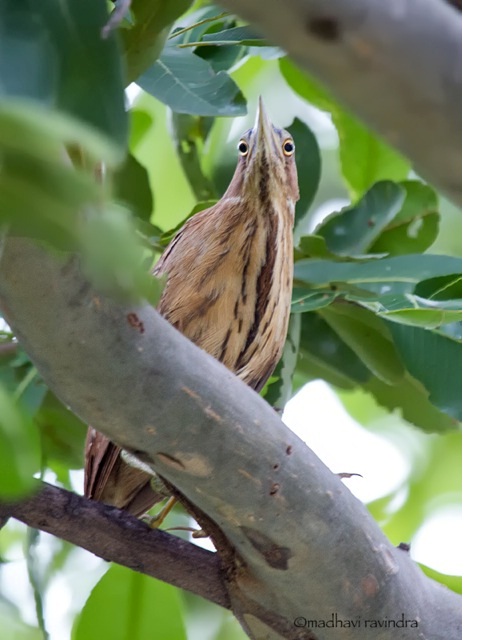
The evening coracle ride turned up Wire-tailed swallow, darter, Green imperial pigeon, Common kestrel, Asian paradise flycatcher, Lesser fish eagle, Grey hornbill, Stork-billed kingfisher and a bird we later surmised to be the Yellow bittern. While the ladies and kids jeeped back from the Coracle alighting point five or six kilometers downstream, SS, Dr. R and I walked back to the camp in the gathering darkness. We flushed a flock of sandgrouse in the fading light, most likely Chestnut-bellied. Painted and Black-bellied sandgrouse also occur here although they are rarer. Elephants had been sighted on the road the previous day, but this encounter continues to elude me at Galibore.

Green imperial pigeon:

GIP

Yellow bittern:

Yellow bittern

Additions sighted in the next morning’s walk included Puff-throated babbler, Sirkeer malkoha, Common babbler, Common wood-shrike, Brown-capped pygmy woodpecker, Large wood-shrike and Cinereous tit. And a bird we later identified as the Yellow-crowned pygmy woodpecker. As a completely unnecessary aside, the Cinerous tit turns up occasionally outside the kitchen window in Bangalore too, on an Inga dulcis tree. Along with Purple-rumped sunbird, White-cheeked barbet, Ashy prinia, Tailor bird, Rose-ringed parakeet, Red-whiskered bulbul and Jungle myna. And crows.

Puff-throated babbler:

Puff throated babbler

I had to forego the rafting owing to junior P’s terror of it, but went along with the jeep to drop the others off. On the way back I saw Black eagle, Grey francolin and Jungle bush quail.

Before and at lunch, there was this tall, dark, grey-haired, hatted gentleman sitting around. Suspecting I knew who he was, I asked one of the boys manning the counter and was told that he was a ‘retired forest officer’. But my suspicions proved right and Sundar, the manager and a very amiable gentleman, was kind enough to introduce me to Dr. AJT Johnsingh a short while later. This was a pleasant surprise and a privilege of sorts.

We sat on plastic chairs by the riverside, Dr. Johnsingh, Sundar, Dr. R and I, and chatted. I told Dr. Johnsingh I had thoroughly enjoyed Field days (see my review) and he said an extended version was in the pipeline. He also talked about having traced Corbett’s footsteps in the lower Himalayas (On Jim Corbett’s Trail, Orient Blackswan). And also about how elephants in Africa communicate with each other over great distances, about ancient practices of preserving ragi stocks in vast underground caverns, and about why elephants don’t stay in a confined area even if food and water is plentiful. The badagas in Bandipur evidently believed that the smell of the dung was distasteful to them and compelled them to move on. And considering elephants eat 200 kgs of vegetation a day and defecate over fifteen times, there is a lot of dung lying around. This theory he heard during his dhole research days in 1976. He also strongly recommended Lawrence Anthony’s books to us – The Elephant Whisperer and The Last Rhino.

While we were talking, Dr. Johnsingh suddenly drew our attention to chital on the far bank. Dr. R spotted some brief movement, but I could spot nothing even through the binoculars until the deer were completely in the open. A little demonstration of superior spotting skills and visual acuity by a much older man.

I wanted an autograph, but Dr. Johnsingh politely declined to sign as the only book I had to sign on was Satpada – Our world of insects. He however happily agreed to a photograph, which Dr. R then took.

P1010115

On the way back, there is a tamarind tree a short way from the camp, and beside a large boulder. Thomraj had pointed out an Indian scops owl nest’s location on this tree while walking down the previous evening. He said the owls withdrew into the hollow if people approached on foot, but were quite alright with people approaching in cars. He had recommended we check out and photograph the owls the next day on our way back. Accordingly we found an owl peeping out as this species typically does, and both the doctors got some pictures. SS, who was driving the car following could not locate the nest and I sneaked out to show him, only to have the owl disappear. We then decided to turn back to the camp for a quick coffee, to give the bird time to reappear. On the second approach, the owl wasn’t in sight and SS who was now in the lead, moved on. We hung around for a few minutes and the owl made a re-appearance, making for some excellent photographs in mellow evening light.

Indian scops owl:

Scops owl2

I’m referencing a piece I wrote about Galibore many months back in JLRexplore here.

The list

Birds:

  1. Asian brown flycatcher
  2. Asian koel
  3. Asian paradise flycatcher
  4. Ashy prinia (calls)
  5. Baya weaver bird
  6. Bay-backed shrike?
  7. Black drongo
  8. Black eagle
  9. Black-hooded oriole
  10. Black ibis
  11. Black-shouldered kite
  12. Blue-bearded bee eater
  13. Blue-faced malkoha
  14. Brahminy kite
  15. Chestnut-bellied sandgrouse
  16. Cinereous tit
  17. Common babbler
  18. Common kestrel
  19. Common kingfisher
  20. Common woodshrike
  21. Coppersmith barbet
  22. Coucal (calls)
  23. Darter
  24. European bee-eater
  25. Forest wagtail
  26. Gold fronted leaf bird
  27. Greater cormorant?
  28. Green bee-eater
  29. Green imperial pigeon
  30. Grey francolin
  31. Grey heron
  32. Grey junglefowl (calls)
  33. Indian grey hornbill
  34. Indian robin
  35. Indian roller
  36. Indian scops owl
  37. Indian treepie (calls)
  38. Jungle babbler
  39. Jungle bush quail
  40. Jungle owlet (calls)
  41. Large woodshrike
  42. Lark?
  43. Lesser fish eagle
  44. Lesser flameback
  45. Little cormorant
  46. Little brown dove
  47. Magpie robin
  48. Open-billed stork
  49. Oriental white-eye
  50. Pygmy woodpecker (brown-capped)
  51. Plain prinia
  52. Puff-throated babbler
  53. Purple-rumped sunbird
  54. Red-rumped swallow
  55. Scaly-breasted munia
  56. Sirkeer malkoha
  57. Small minivet
  58. Spotted dove
  59. Spotted owlet (Dr. M only)
  60. Stork-billed kingfisher
  61. Tawny-bellied babbler
  62. Unidentified warbler
  63. White-bellied drongo
  64. White-browed wagtail
  65. White-cheeked barbet
  66. White-headed babbler
  67. White-throated kingfisher
  68. Wire-tailed swallow
  69. Yellow bittern
  70. Yellow-crowned pygmy woodpecker

Mammals:

  1. Tufted langur
  2. Chital
  3. Common mongoose
  4. Grizzled giant squirrel

Others:

  1. Monitor lizard
  2. Rock agama

Trip Report: Wild Valley Farm/Sathyamangalam TR

Trip Report:        Wild Valley Farm, Germalam/Sathyamangalam TR

Dates:                   30-31 Aug 2014

Camp:                   Wild Valley Farm, Germalam

GiK and I drove to the farm for a quick weekend trip. We had not sought prior permission, so driving through Sathyamangalam TR was not on the cards. We thought we’d spend some time around the farm, do some birding, and some walking through the surrounding forests. Moreover, GiK was just recovering from a fever.

View from the dining porch; the fencing in the distance demarcates the forest boundary. Bilbo in the foreground.

IMG_5316

The weather was lovely. There was intermittent drizzling, but never lasting more than a few minutes each. Strangely, it was colder now in August than it was in October last when I was there. Germalam is evidently well known for its wind at this time of year, and wind there was. Gusty spells that swept screaming across the forest and farms.

I renewed my acquaintance with my canine pals on the farm – Bilbo the GSD/lab mix, his brother Rover. Spike the deceptively intimidating looking Dobermann. And Patch, one of the two Lhasa Apsos. The farm is worth visiting just for this reason alone. As also for relaxed conversations with Mr. Daniel, these can be extremely pleasant as well. The story of his life is a truly remarkable one.

Bilbo and Patch. “The better I get to know men, the more I find myself loving dogs” – Gen Charles de Gaulle

IMG_5314

Giving Spike a rub-down.

IMG_5329

Reaching by the forenoon of Saturday, we pottered around the farm until lunch, and then went on the “short” trek. We crossed the stream that marks the boundary for a loop through the forest, Shankar the guide intently and ceaselessly scanning the route ahead for any sign of elephant. This area comprises stunted tree and scrub vegetation. Except by the streams, where towering riverine trees occur. Barring a solitary Asian paradise flycatcher and a herd of chital, we were the only souls around. Not counting a herd of cattle grazing in the forest that went crashing away in panic at the sight of us. The trail wound back and intercepted the same stream we crossed at some point and at this place was a Terminalia arjuna tree with very distinct (but old) leopard claw marks on it.

Since the trek was a short one, we were back on the farm in a couple of hours. We spent the time until dark tramping around the periphery of the farm, skirting the tiger reserve. On one side, the farm borders the main road, across which lies the reserve. There is a rocky outcrop on this edge that offers a sweeping vista of the landscape, all the way to the cloud-shrouded BR hills in the distance. Mr. Daniel talked of putting some sort of observation deck around this point, as the view is very pretty.

Dinner done, we tried driving on the road for a five kilometer stretch in the direction we hadn’t been on. The drive was a cropper, and all we did was roll through a few modest settlements on that side. And a very small stretch of deafeningly silent forest. The only fauna visible was tethered and ruminating cattle in these villages, bedded down for the night.

We spent the next morning hanging around the farm and with the dogs, taking in the Waldenesque charms of the place before it was time to leave. The best places on the farm to watch birds from are the dining area patio, and atop the work-in-progress roof of Mr. Daniel’s house.

Gooseberry

IMG_5298

Sitting by the tent, we watched a pair of caterwauling grey cats flush a francolin from the shrubbery, sending it sailing over a rubble wall to safety.  And a foraging pair of Scaly-breasted munias that came very close if we sat still. A little to our left was a pair of robins apparently nesting in a mud embankment, and a solitary Red-wattled lapwing. Bulbuls were all over the place, both red vented and whiskered varieties. Malabar parakeets were also numerous, rocketing overhead while screaming hysterically. As were spotted doves, with their soporific hooting. We crossed into the forest to sit on some rocks in the stream-bed along with Bilbo, savoring the lush silence. Mr. Daniel later told us that he discouraged the dogs from crossing the fence and that the ones that got into the habit of doing so never lasted more than a few months thanks to leopards. We should’ve shooed Bilbo back into the farm.

IMG_5336

I should note that what wasn’t very Waldenesque about the trip was the food. It was delicious and I stuffed my face at every meal, making up for GiK’s tiny, fever-stricken appetite.

GiK tries his hand at silhouettes.

_MG_4762

The list

  1. Ashy-crowned sparrow lark
  2. Ashy prinia
  3. Asian paradise flycatcher
  4. Baya weaver bird
  5. Black drongo
  6. Bushlark
  7. Common hawk cuckoo
  8. Common iora
  9. Coppersmith barbet
  10. Coucal (calls)
  11. Grey francolin
  12. Grey hornbill (calls) – Indian or Malabar I couldn’t see
  13. House sparrow
  14. Indian nightjar
  15. Indian robin
  16. Indian roller
  17. Indian treepie (calls)
  18. Little brown dove
  19. Magpie robin
  20. Malabar parakeet
  21. Oriental white eye
  22. Peafowl
  23. Pied bushchat
  24. Purple-rumped sunbird
  25. Red-vented bulbul
  26. Red-wattled lapwing
  27. Red-whiskered bulbul
  28. Scaly-breasted munia
  29. Spotted dove
  30. Tailor bird
  31. Velvet fronted nuthatch
  32. White-bellied drongo
  33. White-browed wagtail
  34. White-cheeked barbet
  35. White-headed babbler
  36. White-throated kingfisher

Trip Report: BRT Tiger Reserve/K. Gudi, Aug 2014

Trip Report:        BRT Tiger Reserve/K. Gudi

Dates:                   15-18 Aug 2014

Camp:                   JLR’s K. Gudi Wilderness Camp

This was intended to be a 2-nights’ trip with GiK and my 7-year old kid. Overall, sightings were muted with some wet weather (it rained during the first safari, and all through the last night). However the forest was lush and we didn’t have the heart to leave on day three. So around ten kilometers from the camp, we changed our minds, K-turned, and spent a third night at the camp (six safaris in all). The Scorp got bogged in the wet grass attempting this K-turn, and it took some little effort to extricate it.

On day one, entering from the BR temple side, we had gone halfway when a parked transport driver flagged us down to tell us the road was blocked by a fallen tree a few kilometers ahead. He then described a very circuitous and convoluted detour. We thought we’d take a look at the block in case there was a way around, and since we were very close anyway. The fallen tree did span across the road, but there was enough space between one portion of it and the grassy verge to squeeze the Scorp through, with inches to spare on the sides and above. Fortunately the car did not get bogged in the wet grass here, as happened later.

Past the tree the road was undisturbed due to the block, which was a rarity for this much-degraded stretch. And sure enough, a young tusker presented himself on the roadside a few kilometers ahead.  The elephant was to my right and I passed it before stopping, to avoid having to back up. The animal became aware of our presence only when we were passing right by it, took alarm, trumpeted in fright, and mock-charged. I stopped the car some ten yards away – still not far enough to allow it to calm down. It continued grazing for a few minutes showing signs of agitation and then shuffled off into the lantana.

We were allotted tent No 7 and it turned out to possess the best view in the row. Strange I hadn’t realized this on earlier visits. Made a note to ourselves.

The safaris were all tepid, in large part because Rajesh was on leave for his sister’s wedding. While the other drivers did try hard, it is tough to match up to Rajesh’s spectacular spotting skills and his keen fascination for birds. This was a huge disappointment and I kicked myself for not having called and confirmed his availability in advance. We would have moved our dates had we known.

We did spot all my wish-listers from the previous trip though –some very good Rufous babbler sightings, a couple of Black eagle sightings, at least four Southern tree shrew sightings and three or so Red spurfowl sightings. Waiting by Anni kere, we spotted a quartet of what evidently were Slaty-legged crakes (Rallina eurizonoides), foraging on the dry lake bed. Although we could observe the birds for a long while, the vegetation on the ground was thick and the birds were never fully visible. Karthikeyan S later asked me about this sighting, and commented on how rare it was.  

K Gudi Aug 14 144

There were also a couple of elephant herd sightings, including one of an impressive tusker.

K Gudi Aug 14 048

And a massive bull gaur sighting. The 1.5 ton kind of specimen.

There were three or four instances of chital, sambar and langur alarm calls erupting in the jungle, though the waits proved unproductive. Scat and pugmarks also raised hopes of cat sightings, but nothing came of it. There was one instance when the gentleman beside the driver peripherally caught a brief flash in a turnoff we passed. We backed up and went up the track for a distance and sure enough, langurs called in alarm. However the cat was evidently moving at a brisk pace and we soon lost contact without a sighting.

The gentleman in question by the way turned out to be an interesting fellow, let’s call him BR. He runs an environmental engineering business and is completely in love with BRT TR, so much so that he has been visiting K Gudi every month for the past twelve years or so. He does occasionally visit other JLR properties, but his primary loyalty lies with K Gudi. And with that sort of frequency, he naturally has scores of exciting sightings to talk about, along with photographs. This chap made an observation about the more interesting sightings all having occurred on weekdays, which was one of the reasons for our extending by a night on impulse.

K Gudi Aug 14 104

On the third evening, as we were walking back to the tent after the evening safari, chital persistently called in alarm from the area behind the Biligiri/Nilgiri log huts. It was dark by then and hurriedly grabbing our large torch, GiK scrambled up the slope. Junior was as alarmed as the deer and wouldn’t let me go and I was left sitting on my hands in the tent, steaming. GiK came back in about seven minutes with this exciting story. He’d spotted a sloth bear from about fifty feet away. The bear darted a few steps towards him and back twice, and then when GiK stepped forward a few paces, it turned tail and bolted into the jungle. And I missed it. But then, GiK is a magnet for intense wildlife experiences. He’s had a leopard leap down on his shoulders from an overhead branch a few years back after all, and has the scars to prove it. That injury kept him confined in bed for three months.

K Gudi Aug 14 176

I did continue my jungle trees effort somewhat, with rather humiliating results. I failed to ID something as basic as Flame of the forest (Butea monosperma) and realized what it was only after asking Karthik yesterday. The Crocodile bark tree or kari mathi (Terminalia tomentosa) was numerous and easy to ID. I ran into some confusion over the Axlewood tree (Anogeissus latifolia) as the driver identified another, quite different looking tree as this one. Indian gooseberry (Phyllanthus emblica) I think I got right. What I need is a simple field guide to the common forest trees of south and central India, on the lines of Karthik’s Discover Avenue Trees. I have a few of the popular tree books, but they’re not easy to use for field identification.

K Gudi Aug 14 397

GiK and I have discussed returning on a weekday sometime. We’ve also discussed seeking permission to access Jodikere. GiK has long wanted to check out this spot given its apparently wondrous reputation.

K Gudi Aug 14 120

Four more pictures, these by GiK:

Terrapins:

_MG_3668

Orange headed thrush, outside the tent:

_MG_3720

Barking deer:

_MG_3747

Sambar stag:

_MG_3806

The list

Avifauna:

  1. Black-hooded oriole
  2. Black eagle
  3. Brahminy kite
  4. Bronzed drongo
  5. Brown fish owl
  6. Changeable hawk eagle
  7. Cinereous tit
  8. Common myna
  9. Coucal (calls)
  10. Crested serpent eagle
  11. Flameback
  12. Grey junglefowl
  13. Hill myna
  14. Indian blackbird
  15. Jungle babbler
  16. Jungle myna
  17. Jungle owlet
  18. Large cuckoo shrike
  19. Magpie robin
  20. Malabar parakeet
  21. Malabar whistling thrush (calls)
  22. Orange-headed thrush
  23. Orange minivet
  24. Oriental white-eye
  25. Purple sunbird, eclipse male
  26. Purple-rumped sunbird
  27. Red spurfowl
  28. Red-vented bulbul
  29. Red-whiskered bulbul
  30. Rufous babbler
  31. Scimitar babbler (calls)
  32. Spotted dove
  33. Streak-throated woodpecker
  34. White-bellied drongo
  35. White-cheeked barbet
  36. White-rumped munia
  37. White-throated kingfisher
  38. Yellow-footed green pigeon

Mammals:

  1. Barking deer
  2. Elephant
  3. Gaur
  4. Malabar giant squirrel
  5. Southern tree shrew
  6. Spotted deer
  7. Stripe-necked mongoose
  8. Tufted langur
  9. Wild boar

Others:

  1. Terrapin

Trip report: Agumbe, June 2014

Trip:      Agumbe

Camp:   Kalinga Center for Rainforest Ecology (KCRE)

Dates:   27-29 June ‘14

Who:     SS, Dr. R and P. Ramesh (the last figured in my Meghamalai post)

All the pictures used in this post were shot by Dr. R.

This trip was different from our usual ones, as none of us had ever tried a herp outing before. It was put together for us by Ficus, and they did a pretty good job of it, taking care of all reservations and transfers efficiently and courteously. We stayed at Kalinga for two nights and three days. The camp was very basic with tented acco and a wash-your-own-plate policy, but we had a delightful time nonetheless. The rough-and-ready ambience didn’t extend to the loos though – the toilets were spic and span, with rustic red oxide flooring, something many of us hadn’t seen in years. The camp was managed by Prashant and had a couple of interns pursuing research – Sonu Soman and Udit Singh Chauhan, and all three went out of their way to make sure we were kept comfortable and entertained.

We took the slow train from Bangalore, the Karwar express that covered the 400+ kilometers to Udupi in an agonizing fourteen hours. That translates to an average speed of less than 30 kmph, though the actual distance the train covered was more considering that it wound its way via Mysore. Driving down was possibly a better option. From Udupi, we back-tracked by road to KCRE, a distance of about sixty kilometers. The road is motorable until a short distance from the camp and the short walk down the path into it is a great opportunity to make your first acquaintance with the leech.

Prior to the trip, we had been warned to expect heavy rains and millions of leeches. The former didn’t show and while Bangalore was experiencing heavy showers, Agumbe remained rainless. The leeches didn’t disappoint though. They were everywhere, millions of ‘em.

Shortly after settling in, we made our first foray around the camp and were instantly rewarded. There was a Malabar pit viper – Trimeresurus malabaricus – a foot off the ground on a wild turmeric plant right outside the bathroom building. And a green vine snake on some shrubbery near the dining area.

Green vine snake:

3_green_vine_snake

By the path leading out of the camp was a mating pair of Malabar pit vipers, under 24-hour surveillance by the interns who endured much hardship to record data around courtship rituals and the mating act. Sonu and Udit were running shifts almost round the clock, taking turns to sit by the mostly inactive pair.

Mating pair of Malabar pit vipers; the male is the smaller individual:

2_mating_pair

There are four trails that radiate out from the KCRE camp, and we did the stream trail in the evening.  The trail was pretty enough, winding its way through areca plantation and evergreen forest, alongside the little stream that flows beside the camp. We didn’t see any snakes on that outing, but we did see a bunch of amphibians. Roux’s forest lizard (Calotes rouxii), Minervarya sp., Skittering frog (and tadpole), the endemic Bicolored frog (Clinotarsus curtipes), Tiger toad and another endemic – the Reddish burrowing frog (Zakerana rufescens).

Roux’s forest lizard:

1_Roux_FL

Minervarya Sp.:

13_Minervarya

Bicolored frog:

11_Bicoloured

And a bunch of bugs and spiders. Lantern bugs, Tiger beetles, Water spiders, Two-horned spiders and a rather reclusive Tarantula. I should mention that Udit, the intern who guided our trails did a spectacular job of spotting and identifying critters none of us would have otherwise noticed.

Night times at the KCRE camp are noisy. If the day belongs to the cicadas acoustically, the night belongs to a bunch of other equally vocal critters. Most noteworthy of which was a creature which produced a clear-toned, two-note whistle very reminiscent of birdsong. It was loud, distinctive and ubiquitous. Naturally, we were intrigued. Turned out it wasn’t a bird after all, but a bush-cricket or Katydid – Holochlora albida. Sonu clarified this, showed us a picture he had clicked, and then rummaged through an entomology book the next day to produce the identification. We saw the actual culprit on the night walk the next evening. There were also plenty of fireflies around, lighting up the night with their little lanterns.

There is a small bamboo platform in the forest a little above the camp that provides a nice, secluded camping site. Prashant was willing to pitch tents for us there if we wanted it, but a quick inspection showed the path to be packed with wet mud and leeches and we opted to stay down in the camp tents.

Early next morning, we walked over to the grassland area that is a kilometer or so from the camp. This is a beautiful area when the weather is pleasant, and it was brilliant that morning – cloudy, cool and breezy. We saw a Hump-nosed pit viper (Hypnale sp.) by the path a short way from the camp, and the day was starting to look good. Our plan was to do a couple of hours of birding along the edge of the grassland patch, and we netted a small bunch of the usual suspects. Yellow-wattled lapwing, Red-wattled lapwing, Crested serpent eagle, Red vented bulbul, Red whiskered bulbul, a solitary White ibis, Gold-fronted leaf bird, Flame-throated bulbul, Vernal hanging parrot, Orange minivet, Asian fairy bluebird,  and White-cheeked barbet. And a bird none of us could identify, which Messrs Grimmett and Inskipp kindly identified for us later at the camp as the Grey-headed bulbul – a Western Ghats endemic. And on the way back, we ran into a juvenile Beddome’s keelback (Amphiesma beddomei) as it frantically slithered off the path and out of our way.

Bull frog:

12_bullfrog

Breakfast done, we were entertained by Draco Dussumieri – the Southern flying lizard. There was Draco action all afternoon as the little dragons constantly flitted between the Areca boles in the camp. We learned this was not typical at this time of year.  Prashant also unearthed a Caecilian to show us – a fossorial amphibian that superficially resembles a snake or earthworm.

In the late afternoon, we took another trail to a nearby peak with a mouthful of a name – Akki Battha Rashi Gudda. The trail involved stiff climbs on some stretches, though the view from the summit more than compensated for the sweaty effort.

10_view_from_the_top

We saw Fejervaria sahyadris and bush frogs en route, and a Malabar pit viper on a bush beside the path on the way back.

Malabar pit viper:

5_Malabar_pit_viper

We wanted to experience a night walk, and Prashant and Udit obliged us by taking us out some distance on the driveway.  We saw three snakes – a Malabar pit viper and a vine snake that we passed by the next day too a couple of times, a Hump-nosed pit viper, Yellow bush frogs and another local celebrity – the endemic Malabar gliding frog (Rhacophorus malabaricus).

Hump-nosed pit viper:

8_humpnosed

Malabar pit viper:

9_malabar_pit_viper

Malabar gliding frog:

4_Malabar_gliding_frog

Yellow bush frog:

6_yellowbush_frog

We repeated the trip to the grassland the next morning, though the weather was not quite as pleasant as on the previous day. The sun was out and we were all tanned three shades darker. In addition to the previous day’s avians, we saw several Malabar grey hornbills, Malabar parakeets, White-bellied treepies, Racket trailed drongos, Common Ioras, Bronzed drongos, Loten’s sunbird, a flowerpecker and two endemics that we identified back at camp with some help from Prashant – Malabar lark and Crimson-fronted barbet.

Being newbies to herping, we had requested Ficus and Prashant for a short classroom orientation session. Sonu and Udit did a masterful job of taking us through the basics of snake evolution, local species, snake identification, taxonomy and snake-bite handling. The session culminated with an informal test of our snake identification ability by having us study moults against a handbook to try and identify the species.

7_grasshopper

Trip report: BRT TR & Bandipur NP, May 2014

Trip Report:        BRT Tiger Reserve

                               Bandipur National Park

Dates:                   1-3 May 2014

Camp:                   JLR’s K. Gudi Wilderness Camp & Bandipur Safari Lodge

All the photographs used in this post were shot by S. Balajee.

I was supposed to do KMTR this weekend with GK. Unfortunately he fell ill and we abandoned the plan at the last moment. I was however able to tag along with my sister’s family on this trip. We did one night and two safaris each at BR Hills and Bandipur.  The two-destination idea turned out to be quite productive, adding variety without being inconvenient as Bandipur is a short 70 kms from K Gudi.

BRT TR/K. Gudi

Reaching the camp by 11:30 AM gave us opportunity for some pre-lunch birding, in the camp and around the little lake by it. We saw Cinereous tit, Magpie robin, Common myna, unidentified warbler, Asian brown flycatcher, Orange minivet, White-browed wagtail, Red-rumped swallow, Red-whiskered bulbul, Gold-fronted leaf bird, White-cheeked barbet, Jungle babbler, Brahminy kite, Oriental white-eye, Black hooded oriole, unidentified flameback and Spotted dove. And the Black eagle.

On my wish-list for this visit were four stars – Black eagle, Red spurfowl (don’t ask why), Rufous babbler (with a photo-op) and Southern tree shrew – and possibly an elephant mock charge as icing on the cup-cake. The first of these – the Black eagle – was knocked off the list within an hour of reaching camp. And this is not the first time I’ve seen this raptor over the K. Gudi camp.

Gold-fronted leaf bird:

Image


Orange minivet, male:

Image


Cinereous tit:

Image

Incidentally, we stayed in the Biligiri and Nilgiri log huts, farthest down the line and abutting the jungle. I had referred to the Biligiri log hut in my previous K. Gudi trip report post.

The first safari was naturally the evening one. The weather was surprisingly cool and cloudy, a welcome change from the dry, sweltering furnace that was Bangalore. On my last visit, we had an extremely productive time with birds thanks to us being driven on safari by Rajesh. We asked for him this time too and Prasad, the new manager was kind enough to oblige. Rajesh has razor-sharp eyesight, spotting skills like you wouldn’t believe, and is a mustard-keen birder. A worthy successor to Thapa, the legendary driver/spotter of K. Gudi, now retired. With Rajesh, his bins and his copy of Grimmett & Inskipp along, there was not a dull moment on safari. And the forest was fairly throbbing with birdlife despite the time of year.

Barking deer, fawn:

Image

The evening was therefore pleasant enough, with some involved birding. Early into the safari we found a pair of Racket-tailed drongos mobbing a Jungle owlet. These drongos were ubiquitous.

Racket-tailed drongo:

Image


Fairly common also was Magpie robin, Indian blackbird, Jungle myna, Jungle babbler, Bronzed drongo, Indian treepie, Grey junglefowl, Common hawk cuckoo, White-bellied drongo and bulbul (both Red-vented and Red-whiskered).

Rajesh had marked a burrow in the earth tenanted by a Blue-bearded bee-eater and we spent some time watching the bird flit in and out. Both Rajesh and BIL B were keen on getting a picture of the event, but this posed a challenge as getting close enough for a clear line of sight was deterring the bird – although the nest was just off the road and barely a foot off the ground.

Blue-bearded bee-eater:

Image


Other notables were Indian pitta (two separate sightings), Malabar whistling thrush, Green imperial pigeon, Orange-headed thrush,  Oriental honey buzzard, Crested serpent eagle, Brown fish owl and Rufous babbler (second item off the wishlist). The much-awaited mock charge didn’t materialize, but we did see a trio of elephants in high grass.

Brown fish owl:

Image

Waking up in camp the next morning to the calls of Jungle owlet, Indian Nightjar, Common hawk cuckoo, Black-hooded oriole, Magpie robin, Hoopoe, and Tufted langur, we set off on what turned out to be a sparkling safari.

Black-hooded oriole:

Image

Common hawk-cuckoo:

Image

We found a quartet of Nilgiri wood pigeons fluttering about a salt lick and spent some time there. We then ran into a Mountain imperial pigeon and the day was starting to look better and better.  Red spurfowl went off the wishlist next, although the sighting was a tad too fleeting for comfort. That left just one worthy on the list – the Southern tree shrew.

And as luck would have it, we found a pair of these rodents gamboling on the grass and on a fallen tree, in the open, not very far away, and in perfect light. Of such moments is paradise made. BIL B got a bunch of very decent pictures, and I got a good clear look at Anathana ellioti. Suum cuique!

Southern tree shrew:

Image

Bandipur

The evening safari started off with a spot of rain but this quickly subsided, leaving the jungle cool and glistening. This was a typical Bandipur safari, with plenty of flamebacks and intrepid Stripe-necked mongooses. If BRT is the place for Barking deer that aren’t human-shy, Bandipur is the place for Stripe-necked and Ruddy mongooses.

Stripe-necked mongoose:

Image

Passing by the Anekatte waterhole, Kiran the driver thought he spotted a ‘brown shape’ disappearing into some shrubs, and we stopped there waiting. In a while, someone at the back of the jeep realized that there was an elephant standing just off the road and about seventy meters behind us. It turned out to be a magnificent makhna, and we rolled the jeep back a short way to watch this distraction. The elephant was not too happy with the situation, and showed signs of restless agitation. But he wasn’t sure what do to about it either. Turn tail and flee, or get all belligerent and nasty. And so he kicked his feet, threw dust over himself, stamped around, swayed and did a bunch of things to express his annoyance.

Image


After a while, we decided to leave him to his devices and started up again, stopping briefly by the pool to confirm that the brown shape hadn’t materialized while we weren’t looking. It had not, and off we went. Later on in the safari, we saw another herd of four elephants at some distance.

Sambar hind:

Image

The next morning was better. We entered the forest not by the usual gate right across the road from the reception center, but from the turn-off further down the road, towards the congregation of resorts. A couple of oncoming vehicles reported the presence of dhole further up the road. Passing by a massive herd of chital some hundred strong, we heard alarm calls and stopped. A lone, unseen sambar stag to our right responded with his own belling honk. Scan as we might with binoculars, nothing was visible and the calls presently subsided. This herd was within the perimeter of the camp, with buildings not very far away. Concluding that a snake was the probable cause of all the commotion, we moved on to look for Cuon Alpinus.

The pack came into view in a short while, with the remnants of a chital kill by the road. The dogs had demolished the carcass and were lying around worrying the larger bones when we appeared on the scene. One by one they took themselves off, pausing to stare at us before pattering into the thickets without showing undue haste. We counted six dogs in the pack. The morning light was fine and mellow, and BIL B got some impressive pictures.

Indian wild dog or dhole:

Image

Much later in the safari, we passed by an anti-poaching camp (APC) and a while later, ran into a JLR safari van driver who had news of a tigress kill near this APC. K-turning back, we found what was left of the kill (a sambar hind) hidden just by the road. A lone jungle crow that was making the most of the opportunity and a waiting safari van pointed us to the spot. We waited for a short while before concluding that the tigress had possibly decamped after consuming the kill.

Streak-throated woodpecker:

Image

I made a start with jungle trees during this safari. Six trees were most commonly seen on this route and I learned to ID the ones I earlier couldn’t. Flame of the forest (Butea monosperma), the Crocodile bark tree or kari mathi (Terminalia tomentosa), Axlewood tree (Anogeissus latifolia) with its pale, guava-like bark and clustered, drooping leaves, Indian gooseberry (Phyllanthus emblica) with its fern-like foliage, and teak (Tectona grandis). The sixth I haven’t been able to relate to; Kiran used the local term Jaaldar for it. This is a small-to-medium sized tree, vaguely reminiscent of Tabebuia aurea/argentea. I have photographs and should be able to take someone’s help to ID it in a day or two.

Not having paid more attention to trees in BRT TR too was a pity, and I should spend some effort on trees in upcoming trips.

Grey junglefowl, cock:

Image


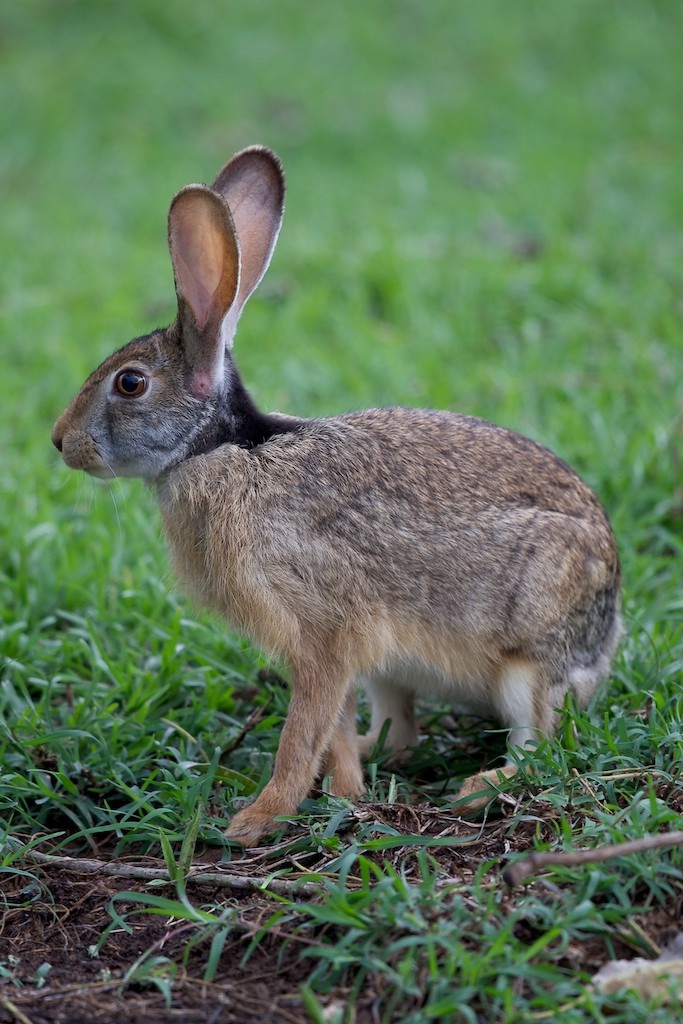
Black-naped hare:

Image

The List:

BRT TR

Avifauna:

  1. Asian brown flycatcher
  2. Asian fairy bluebird
  3. Black-hooded oriole
  4. Black kite
  5. Blue-bearded bee-eater
  6. Brahminy kite
  7. Bronzed drongo
  8. Brown fish owl
  9. Cinereous tit
  10. Common hawk cuckoo
  11. Common myna
  12. Coucal
  13. Crested serpent eagle
  14. Flameback (?)
  15. Flowerpecker (?)
  16. Gold-fronted leaf bird
  17. Green imperial pigeon
  18. Grey junglefowl
  19. Hill myna
  20. Hoopoe
  21. Indian blackbird
  22. Indian cuckoo (calls)
  23. Indian nightjar (calls)
  24. Indian pitta
  25. Jungle babbler
  26. Jungle myna
  27. Jungle owlet
  28. Large cuckoo shrike
  29. Magpie robin
  30. Malabar whistling thrush
  31. Mountain imperial pigeon
  32. Nilgiri wood pigeon
  33. Orange-headed thrush
  34. Orange minivet
  35. Oriental honey buzzard
  36. Oriental white-eye
  37. Pigmy woodpecker
  38. Plum-headed parakeet
  39. Racket-tailed drongo
  40. Red-rumped swallow
  41. Red spurfowl
  42. Red-vented bulbul
  43. Red-whiskered bulbul
  44. Rufous babbler
  45. Spotted dove
  46. Warbler (?)
  47. White-bellied drongo
  48. White-browed wagtail
  49. White-cheeked barbet
  50. White-throated kingfisher

Mammals:

  1. Barking deer
  2. Elephant
  3. Gaur
  4. Malabar giant squirrel
  5. Southern tree shrew
  6. Spotted deer
  7. Tufted langur
  8. Wild boar

Others:

  1. Terrapin

Bandipur

Avifauna:

  1. Asian paradise flycatcher
  2. Bay-backed shrike
  3. Brahminy starling
  4. Bushlark (?)
  5. Common hawk cuckoo
  6. Coucal
  7. Flameback
  8. Grey junglefowl
  9. Hoopoe
  10. Indian cuckoo (calls)
  11. Jungle babbler
  12. Jungle myna
  13. Magpie robin
  14. Peafowl
  15. Pied bushchat
  16. Plum-headed parakeet
  17. Red-wattled lapwing
  18. Shikra
  19. Spotted dove
  20. Streak-throated woodpecker
  21. White-bellied drongo
  22. White-breasted waterhen
  23. White-browed fantail
  24. White-throated kingfisher

Mammals:

1. Barking deer

2. Dhole

3. Elephant

4. Gaur

5. Sambar

6. Stripe-necked mongoose

7. Tufted langur

8. Black-naped hare

Meghamalai Reprised, Apr 2014

Trip Report:        Meghamalai Willife Sanctuary

Dates:                  11-13 Apr 2014

Camp:                  Vellimalai FRH

Companions:     GK, GiK, SS

Revisits to any place tend to be let-downs, primarily because a large part of the pleasure the first time around is in all likelihood, derived from the sheer unexpectedness of it. This trip was an exception. GK and I visited Meghamalai in January this year (blog post here), were unable to get permission to occupy the picturesque Vellimalai FRH, and swore we’d come back to stay there someday. We made good on our promise this time.

This FRH nestles in a spot of great beauty deep inside the forest, is dwarfed by towering riverine forests, and has a stream running by it. Armed with the requisite permission, we were eagerly looking forward to the experience of camping at this beautiful spot. And the experience did not disappoint, despite the heightened expectations.

In terms of the itinerary, we did pretty much the same things we did the last time around – driving up through the Pandian estate to the Vellimalai Murugan temple, and having Thangaraj jeep us up to the Anaikullipallam estate (these are separate outings). In addition to these, we spent the mornings and evenings absorbed in some very pleasant birding in the vicinity of the FRH. This last was probably the most fulfilling part of the trip, given the pleasant surroundings and richness of birdlife around.

We expected sunrise and sunset hours to be especially spectacular around the FRH, and they were. We woke up to the calls of Malabar whistling thrushes, Asian fairy bluebirds (plenty of them around), Hill mynas, Malabar grey hornbills and Grey jungle fowl. On a single tree in the camp, we counted four species of bulbul all at once – Red whiskered, Flame throated, White-browed and Yellow-browed. There were quite a few Black bulbuls around, but they regrettably did not join in the record attempt or else we’d have seen five species of bulbul all on one tree. And this was in addition to a Malabar giant squirrel, a Malabar grey hornbill and a couple of Green barbets that were foraging on the same tree. Elsewhere around the camp we saw Hill myna, Racket-tailed drongo (plenty of both), Malabar whistling thrush, Asian fairy bluebird (dozens of them), Golden oriole, Puff throated babbler, Brown-cheeked fulvetta, Orange minivet, Cinereous tit, Nilgiri flycatcher, Crimson-backed sunbird (plenty of these too), Pond heron, Common kingfisher (both by the stream), Lesser flameback and Nilgiri langur (there were plenty of Bonnet macaque in the camp).

On Saturday evening around sunset, GiK and I took a walk down the road towards a little culvert a short way from the FRH. Incidentally Muniswamy, the forest watcher who accompanied us on our drives had told us of having sighted a tiger on a kill (a cow) beside this culvert a while back. The road runs parallel to the stream that abuts the FRH, and we had gone some distance when we heard splashing and snorting noises from the water below. We were looking forward to (and dreading, at the same time) meeting elephants and naturally assumed we’d hit paydirt. GiK moved around to find a gap in the intervening shrubbery and three sambar went crashing through the water in alarm, splashing up a tremendous din in the silence of the forest.

We resumed our walk and went a little further ahead when sambar alarm calls erupted in the jungle across the stream to our right, and some distance ahead of us. The calls persisted and a Nilgiri langur presently took alarm too. This animal was just off the road to our left, and both calls some hundred meters ahead of us. (We could see neither sambar nor langur). Stealing ahead noiselessly on rubber-soled feet, we reached the culvert. I was desperately hoping for a tiger sighting on foot – an item on my bucket-list that has so far refused to fructify. We planted ourselves on the culvert and waited in silence, but were disappointed when the calls eventually died out. Incidentally, sambar alarm calls also erupted around the FRH a couple of times after sunset, when we were sitting on chairs outside our room.

The eight-kilometer drive through Pandian estate to the Vellimalai Murugan temple was pleasant as ever and very productive as far as birding was concerned. We entered the estate in the evening after the labour-force had departed and had the route to ourselves. Our luck was on a roll this time around. We had searched for but failed to find Lion-tailed macaque the last time around and here they were, a whole troop just off the road. I had mentioned a flashing tree shrew sighting which only GK got a clear look at in January and now I got a clear sighting of Anathana ellioti – the Southern tree shrew.  We also saw the White-bellied treepie in the upper reaches. We saw this bird multiple times on this trip – once here and thrice on the Anaikullipallam track. SS was unwell and had elected to stay back, and he got the privilege of sighting Draco dussumieri – the Southern flying lizard – at the FRH.

Anaikullipallam if you recall is eight kilometers or so from the Vellimalai FRH. The road to get there passes through some very rough, lantana-choked, boulder-strewn terrain. The track is far too rough for the Scorp, and hence the need to have Thangaraj jeep us up. Having learnt our lesson from the last trip, we had requested Thangaraj to organize a cooked meal for us at Anaikullipallam.

En route are some three or four estates in various states of disrepair, all of them having been abandoned presumably due to labour shortage. Living quarters built for the hands are empty and dilapidated, having been visited by the occasional marauding elephant. There was an injured or ill gaur – bull or cow we couldn’t tell – just off the road that the men with us said had been sighted around the same spot for a couple of days now. The creature sat in the lantana by the roadside and made some effort to rise and move away at the sight of us.

We got off the jeep a kilometer or so before the Anaikullipallam estate house, and walked the rest of the way looking for birds. The upper reaches are cool and pleasant, with evergreen vegetation interspersed with plantation – coffee and cardamom. We saw what Muniswamy identified as sloth bear scat during the jeep drive, and Dhole scat in the last stretch (we had seen this the last time too). After a modest scratch meal at the estate house, we walked back the same distance and en route ran into a truly exhilarating encounter. GK who has eyes sharp as they come suddenly called out that there was a cobra just off the track. Since some people seem to equate all snakes with cobras, I rather uncharitably assumed he’d spotted a rat snake. Peeping over, I was astonished to find that we were in fact looking at Ophiophagus hannah himself – the King cobra – at a distance of less than six feet. Strikingly dual-toned in yellow and black, the snake had his hood raised two and a half feet off the ground and stood completely motionless. GiK and I were alternating between staring in fascination and fumbling with the wretched camera, which had chosen this of all moments to misbehave. The snake stood there for a full minute, and then lowering its hood, went slithering down the slope at great speed. Regrettably, we found the inadvertent setting change on the camera that had ruined our chance of a picture just after the snake departed.

Two quick points before I end this narration. One, I had been fretting over being unable to identify a call that is common in all our forests at night – it is a ping with a plop-like echo. On this trip, we traced the source to a tree and a torch beam revealed the culprit to be an Indian nightjar. I rechecked Xeno-canto and can only find the chuck-chuck-chuckrrrr calls that are typical of the nightjar.

Second, I had wrongly mentioned the named of the entry checkpost as Manjur in my last post. Turns out it is Manjoothu.

Here are some pictures GiK took – I seem to have completely abandoned my camera for binoculars.

Macaca silenus – the Lion-tailed macaque:

Image

The Vellimalai Murugan temple:

Image

The Vellimalai Murugan temple commands a spectacular view of the surrounding forests:

Image

Malabar giant squirrel:

Image

Image

Image

Indian nightjar, there is some camera shake as the picture was shot under trying conditions, by headlight:

Image

Flameback around the FRH:

Image

Malabar grey hornbill:

Image

Here is a full list of sightings:

Avifauna

Ashy woodswallow
Asian fairy bluebird
Black bulbul
Black-hooded oriole
Brown-cheeked fulvetta
Cinereous tit
Common babbler
Common hawk cuckoo
Common kingfisher
Coucal (call)
Crested serpent eagle
Crimson-backed sunbird
Flame-throated bulbul
Green barbet
Golden oriole
Grey junglefowl
Hill myna
Hoopoe (call)
Indian nightjar
Indian robin
Magpie robin
Malabar grey hornbill
Malabar whistling thrush
Nilgiri flycatcher
Orange minivet
Pond heron
Puff-throated babbler
Purple-rumped sunbird
Racket-tailed drongo
Red-vented bulbul
Red-whiskered bulbul
Spotted dove
Yellow-browed bulbul
Warbler
White-browed bulbul
White-bellied treepie
White-headed babbler
White-throated kingfisher

Mammals
Barking deer (Ganesh only)
Black-naped hare
Bonnet macaque
Gaur
Lion-tailed macaque
Malabar giant squirrel
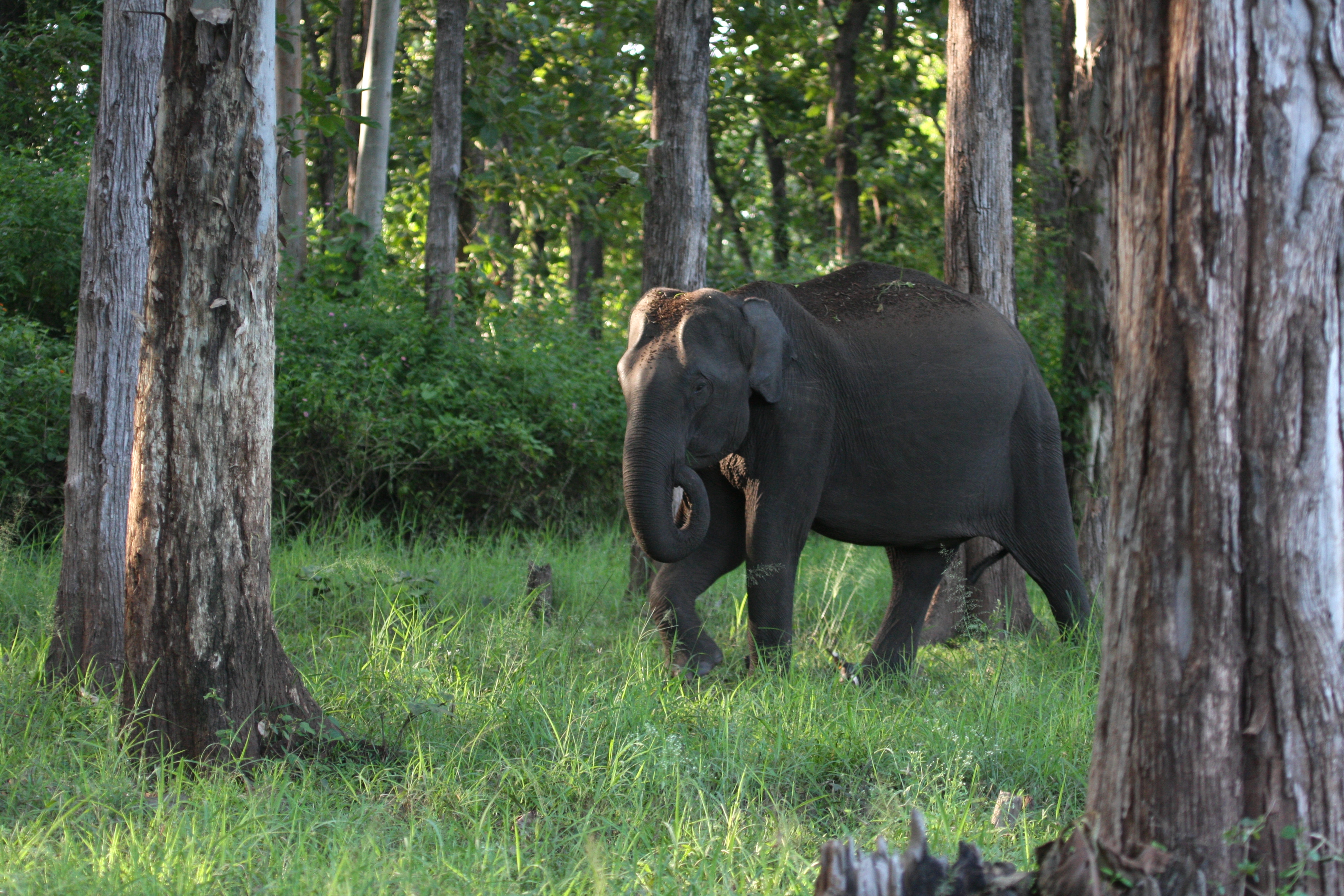
Nilgiri langur
Palm squirrel
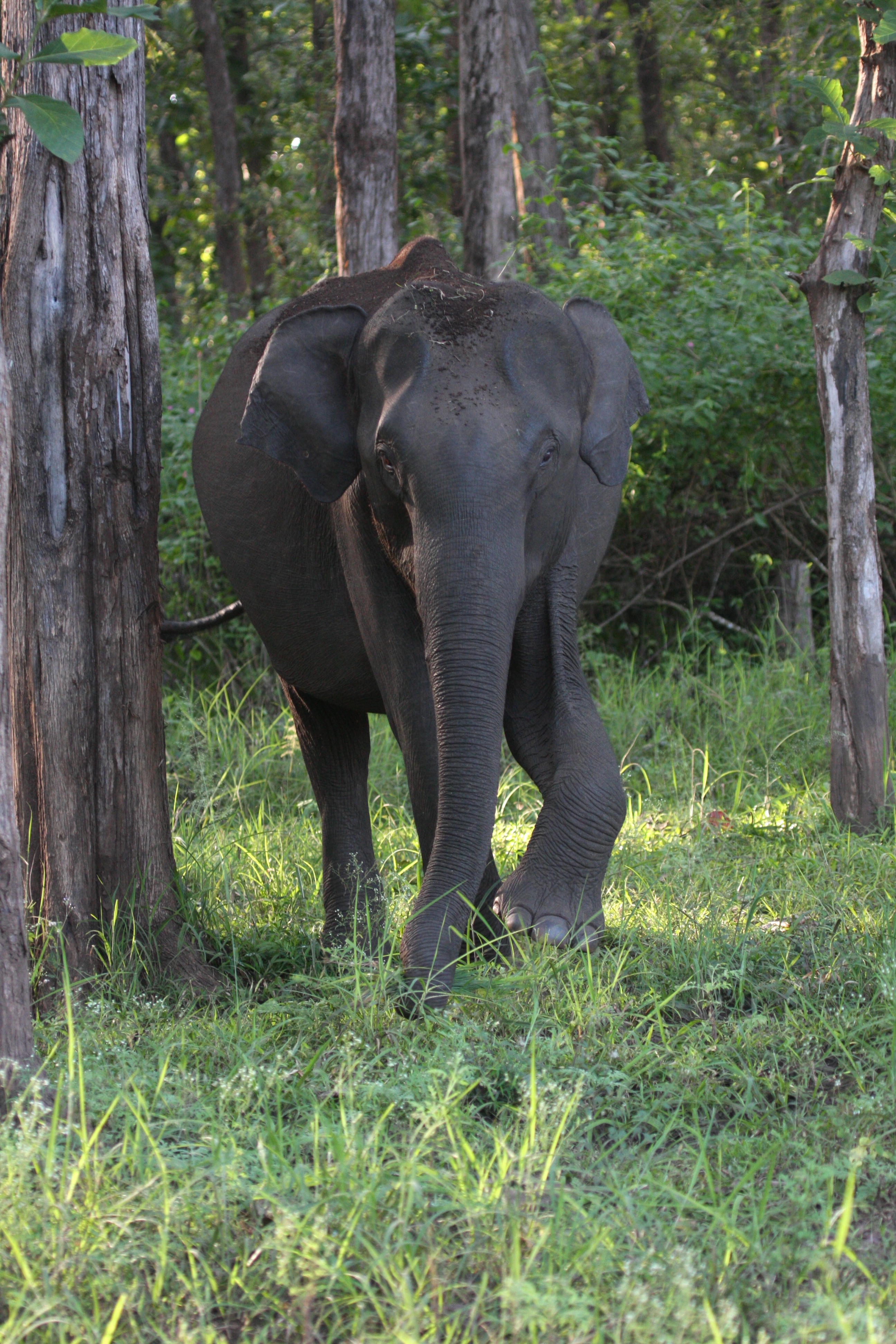
Sambar
Southern tree shrew

Others
King cobra
Southern flying lizard (SS only)

Book Review: The Secret Life of Tigers, by Valmik Thapar

Image

Book review: The Secret Life of Tigers, by Valmik Thapar

Second edition

Oxford University Press, published 2008

This slim volume was first published in 1989, by Elm Tree Books in Great Britain, and by OUP in India in 1999. It is tiny as books go, but was a seminal work in terms of the insights it revealed.

Valmik Thapar is probably the most well-known tiger conservationist there is. He is not a trained scientist or field biologist, but in this book Thapar traced the development of the litters of three tigresses in Ranthambore – Laxmi, Noon and Nalghati – along with his mentor, the legendary Fateh Singh Rathore.

In the March of ’86, the tigress Laxmi was sighted with a pair of month-old cubs, fathered by a tiger called the Bakaula male. Shortly after, Rathore observed the Nalghati tigress with a pair of cubs a month older than Laxmi’s, these fathered by a male called Kublai. A month or so later in May, another tigress Noon was seen with a newly born litter, this too fathered by Kublai. Sensing the unique opportunity offered by having on hand three tigresses with cubs, Thapar and Rathore closely followed the triumphs and travails of the three litters over the next couple of years, until the cubs reached adulthood. This book is the fruit of those efforts.

A good part of the book deals with the question of the tiger’s family ties. It was traditionally believed that male tigers indulge in routine infanticide, killing off any cubs they encountered. In the April of ‘86, Thapar was stunned to find Kublai with the Nalghati tigress’ cubs, together soaking the summer heat away in a pool. This behavior was presently confirmed with the other litters. Thapar then postulated that the resident male interacts and develops bonds with the litters of the tigresses in his range. He also speculated that infanticide may occur when a male takes over the territory of another and proceeds to eliminate any litters sired by his predecessor to bring the tigress into oestrus. This is behavior observed in monkeys and lions, and Thapar surmised that it was probably applicable to tigers too.

A male tiger’s beat may encompass the beat of more than one female and being essentially solitary, the male roves over his range ceaselessly. On occasion, this brings him in contact with the resident females and their litters, and he consorts with the family until it is time to move on again. Further, Thapar found that the male partook of kills made by the tigress, along with the cubs, and allowed the latter to partake of kills made by him whilst in contact. This brought up the remarkable sight of familial feeding in tigers, and Thapar observed upto eight tigers feeding off a single kill. Also, he found (as in the case of Kublai) that the male may consort with more than one tigress and associate with their respective litters.

The bonds between the tigress and her litter is strong, and the task of keeping the cubs alive into adulthood while passing on essential life skills was a huge order, as Thapar discovered. He recollected watching the tigress Padmini in ’77, maiming a tethered bait buffalo and leaving the cubs to attempt bringing it down. He also discovered her regulating the feeding to ensure all the cubs got to eat. As the three tigress’ cubs got older, they began to actively help with the hunt, taking up positions to drive prey towards the tigress. And thus you have the phenomenon of co-ordinated group hunting for at least a brief period in the tiger’s life. In Thapar’s words, “if undisturbed and well managed, tigers can, as families, form temporary groupings in order to hunt and share food”.

At about sixteen months of age the process of detachment started, though Thapar surmised that the family retained kinship ties for life, recognizing individuals when one of them occasionally happened to run into another.

Thapar also made observations around the variation of hunting styles across individuals. In the mid-eighties, a tiger named Genghis Khan pioneered and perfected the hitherto untried technique of charging at sambar across open water in the Gilai Sagar lake,adjacent to the Jogi Mahal guest house. The tigress Noon evidently picked this technique up from him, and preferred bursts of speed over open land while in contrast, Laxmi preferred stalking from thick cover and with shorter bursts.

Thapar dramatically describes an incident that occurred in the February of 1987, terming it his “most exciting time ever with tigers”. The narration fills three pages of tiny italicized text. Noon attacked a massive sambar stag that valiantly resisted until the tigress gave up, exhausted. The stag died of its wounds a few weeks later. Thapar describes this and other dramatic first-person encounters in italicized interludes with usage of the present tense. And the ploy works rather well, making taut what might otherwise have been a bland account.

There is quite a bit of discussion around the threats tigers and their habitats face, from poaching or other human incursions, and Thapar outlines some prescriptive points to address the menace.

I should add that twenty colour photographs buttress some of the points made about tiger behavior.

In summation, while this may not be a masterpiece you’ll remember forever, it is certainly a quick, insightful, absorbing (and inexpensive) read for anyone who is a tiger lover. I’ll probably do a review of Karanth’s tiger book next and some comparison will be inevitable.